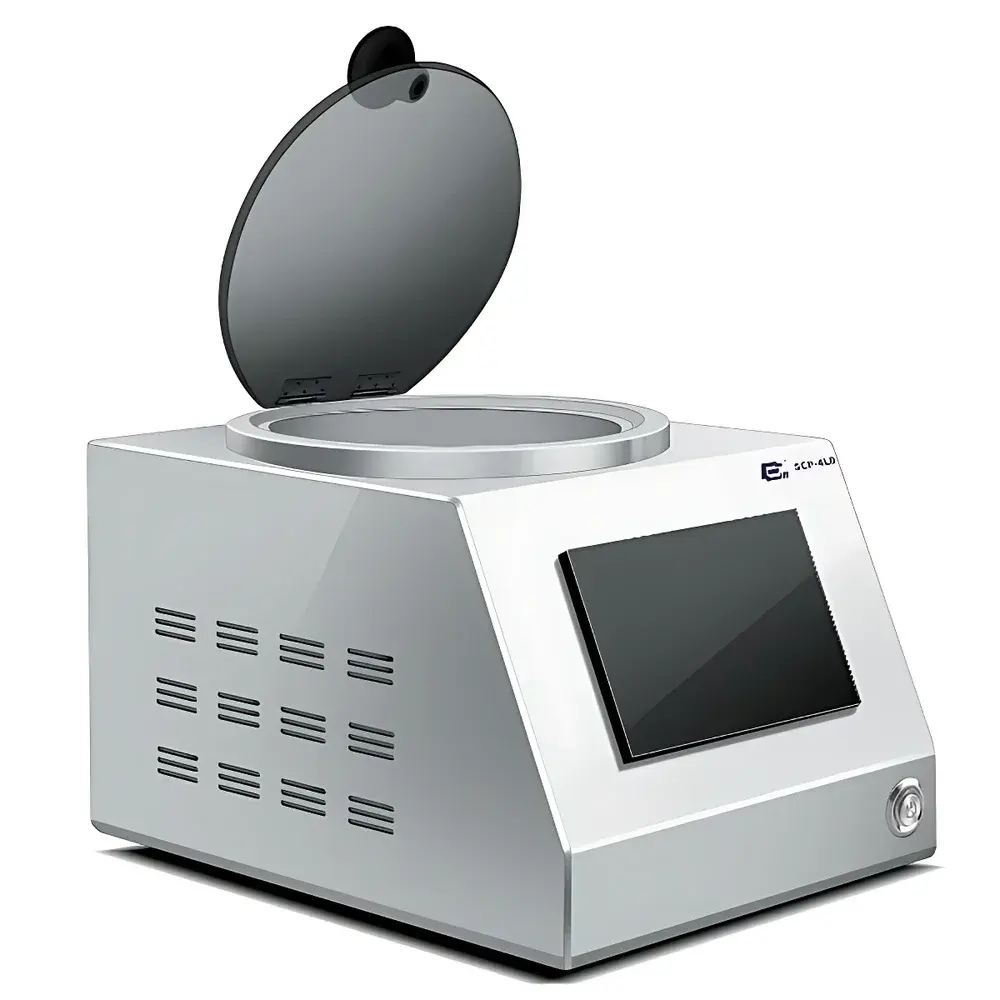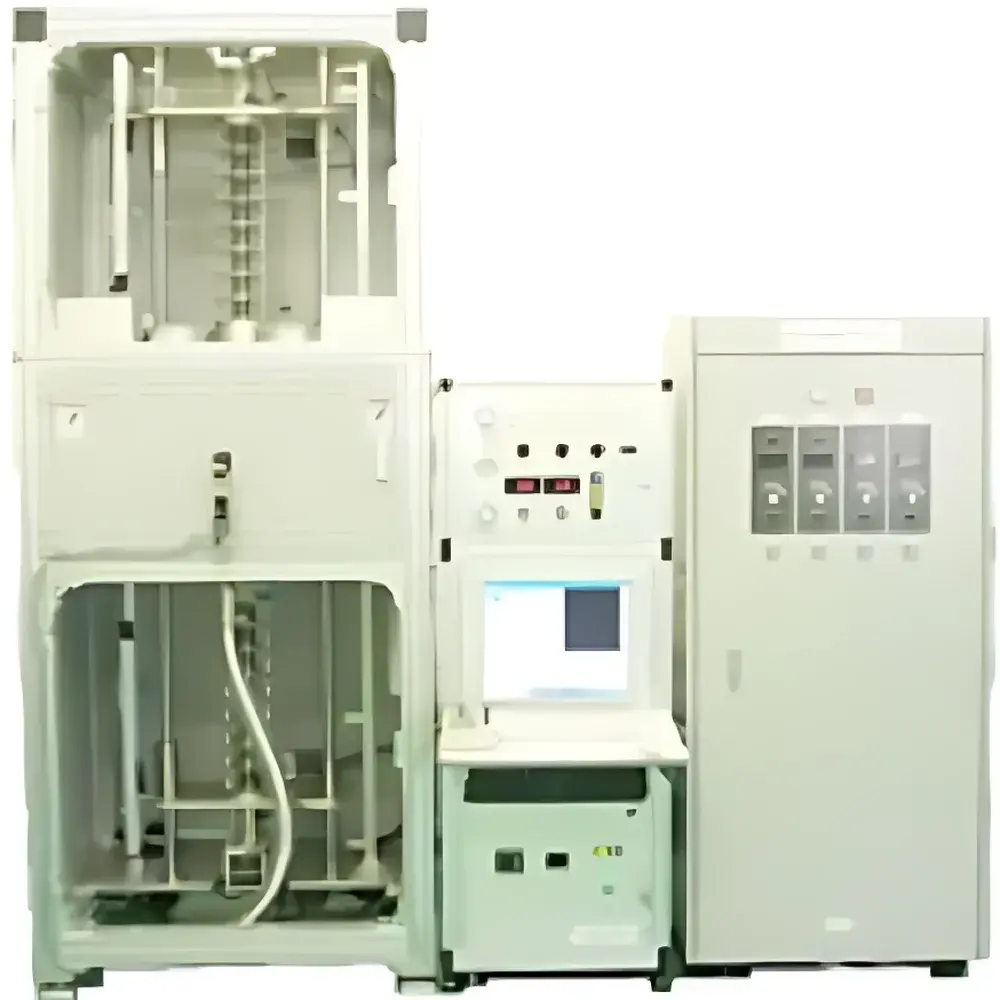
Optical Floating Zone Furnace with Magnetic Liquid Seal
| Brand | CSC |
|---|---|
| Origin | Japan |
| Model | Magnetic Liquid Seal Type |
| Crystal Growth Capability | Single Crystal |
| Vacuum/Pressure Compatibility | Continuous Operation from High Vacuum to High Pressure |
| Heating System | Four-Mirror Optical Configuration |
| Control Interface | PC-Based Remote Control |
| Power Variants | FZ-T-4000-H (Standard), FZ-T-10000-H (High Power), FZ-T-12000-X (Super High Temperature) |
Overview
The CSC Optical Floating Zone Furnace with Magnetic Liquid Seal is an advanced crystal growth system engineered for the controlled, containerless melting and solidification of high-purity single crystals under precisely regulated atmospheric conditions. Operating on the optical floating zone (OFZ) principle, it employs focused high-intensity halogen or xenon lamp arrays—reflected and concentrated via a four-mirror optical system—to generate a localized molten zone along a vertically oriented polycrystalline feed rod. Crucible-free processing eliminates contamination from crucible materials (e.g., quartz or graphite), making it especially suitable for oxide superconductors, refractory intermetallics, and semiconductor-grade oxides such as sapphire (Al₂O₃), YBCO, and LiNbO₃. The defining feature of this system is its magnetic liquid seal (MLS) mechanism, which maintains dynamic vacuum integrity while enabling continuous pressure modulation—from 10⁻⁶ mbar ultra-high vacuum to ≥10 bar inert gas overpressure—without mechanical wear or outgassing typical of elastomer or metal bellows seals.
Key Features
- Four-mirror optical concentrator ensures axial symmetry and exceptional radial temperature uniformity across the molten zone—critical for stable interface shape and low thermal stress during crystal pulling.
- Magnetic liquid seal assembly provides hermetic, maintenance-free rotary feedthrough for rod rotation and translation, eliminating vacuum leaks and particulate generation associated with conventional O-ring or ferrofluid-based seals.
- Modular furnace architecture supports three standardized power configurations: FZ-T-4000-H (standard), FZ-T-10000-H (high-power, optimized for high-melting-point metals and intermetallics), and FZ-T-12000-X (super-high-temperature variant with extended spectral output and enhanced cooling).
- Integrated PC-based motion control system enables synchronized, programmable control of feed rod rotation (0–30 rpm), translation rate (0.1–50 mm/h), lamp power (0–100% in 0.1% increments), and ambient pressure (via mass flow controllers and capacitance manometers).
- Water-cooled chamber housing with double-walled stainless-steel construction ensures thermal stability, electromagnetic shielding, and compatibility with glovebox integration for air-sensitive materials.
Sample Compatibility & Compliance
The furnace accommodates cylindrical feed rods up to 12 mm in diameter and 150 mm in length, supporting growth of single-crystal ingots with diameters up to 10 mm and lengths exceeding 80 mm per run. Compatible material systems include but are not limited to: SiC, GaN, SrTiO₃, Nd:YAG, FeSi₂, TiAl, and Ni₃Al. All vacuum components conform to ISO-KF and CF flange standards; pressure vessels meet ASME BPVC Section VIII Division 1 requirements. The MLS subsystem complies with ISO 2859-1 sampling plans for seal performance validation and is documented per ISO 9001:2015 quality management protocols. Full traceability of vacuum history, temperature profiles, and motion logs satisfies GLP audit requirements for academic and industrial R&D environments.
Software & Data Management
The proprietary FZ-Control Suite v4.2 runs on Windows 10/11 and provides real-time visualization of thermocouple readings (type B, dual-point), chamber pressure, motor encoder feedback, and lamp current/voltage. Data acquisition occurs at 10 Hz minimum resolution with timestamped binary logging (.fzlog) format. Export options include CSV, HDF5, and MATLAB-compatible .mat files. Audit trail functionality records all user actions—including parameter changes, emergency stops, and calibration events—with operator ID and system time, meeting FDA 21 CFR Part 11 electronic record/electronic signature (ERES) readiness when deployed with domain-authenticated login and encrypted storage.
Applications
- Growth of ultra-high-resistivity silicon-on-insulator (SOI) substrates for RF and radiation-hardened microelectronics.
- Development of stoichiometrically precise complex oxides for quantum materials research (e.g., topological insulators, spin liquids).
- Processing of refractory intermetallic compounds for high-temperature structural applications in aerospace and nuclear engineering.
- In-situ studies of solid–liquid interface kinetics using high-speed pyrometry and shadowgraph imaging (compatible with optional side-view ports).
- Reproducible synthesis of doped scintillator crystals (e.g., Ce:LuAG, Pr:LYSO) for medical PET detector development.
FAQ
What vacuum level can be achieved with the magnetic liquid seal configuration?
The system achieves ≤5 × 10⁻⁷ mbar base pressure after 12-hour bakeout at 150°C, sustained continuously during rotation and translation cycles.
Is the furnace compatible with reactive atmospheres such as H₂ or NH₃?
Yes—when equipped with optional hot-wall liner and corrosion-resistant internal coatings, the chamber supports H₂/N₂ mixtures up to 5% H₂ at 1200°C and anhydrous NH₃ up to 800°C under flow-controlled conditions.
Can existing FZ systems be retrofitted with the magnetic liquid seal upgrade kit?
Retrofitting is feasible for FZ-T-4000-H and FZ-T-10000-H models manufactured after 2018; hardware compatibility assessment and vacuum integrity certification are required prior to installation.
What documentation is provided for regulatory compliance in pharmaceutical or medical device R&D?
A complete IQ/OQ protocol package—including factory acceptance test (FAT) reports, metrology certificates for all sensors, and traceable calibration records—is supplied with each system shipment.
Related Products