
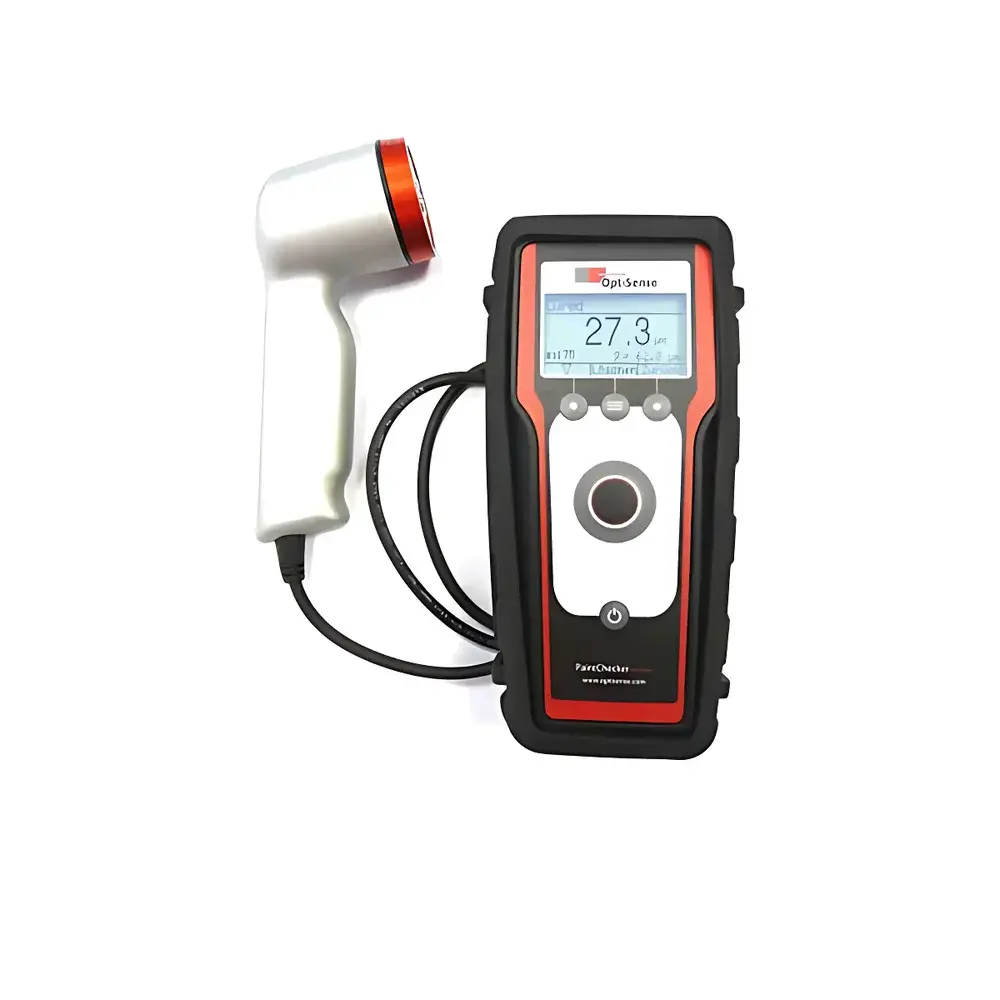
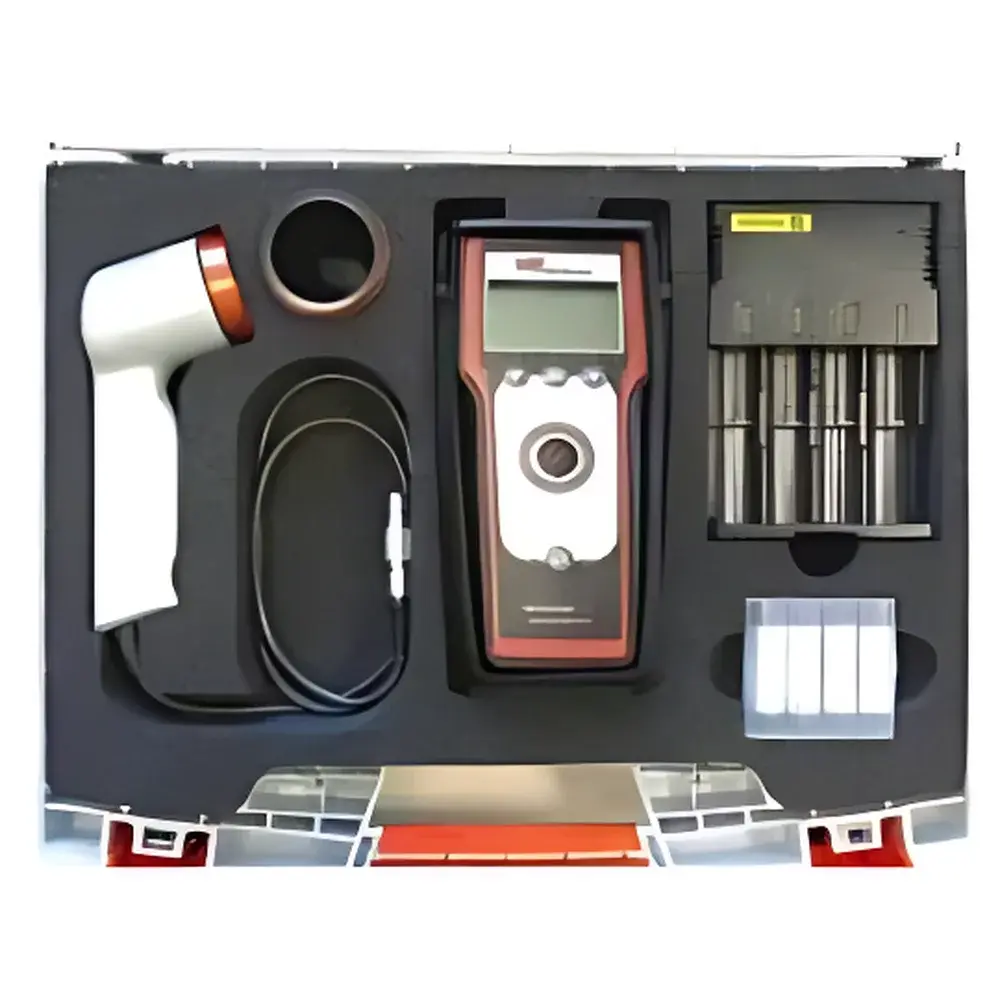
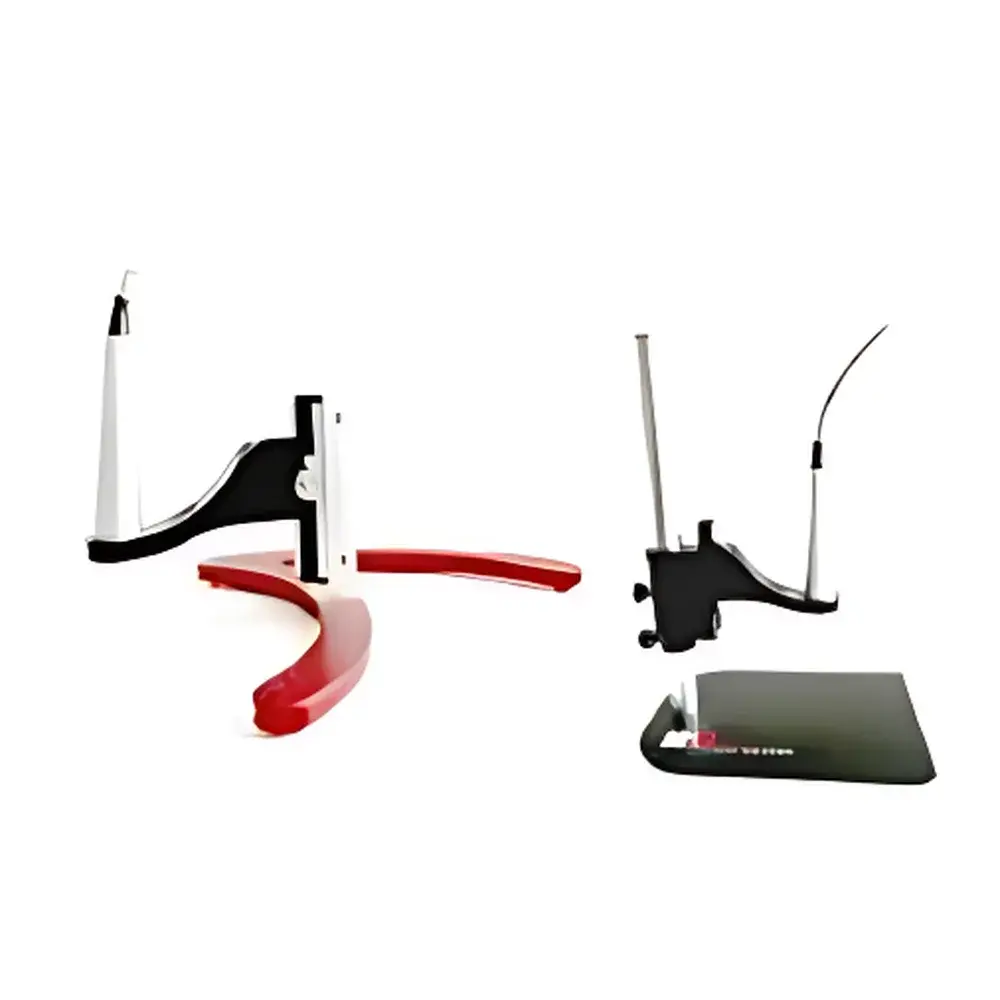
OptiSense PAC Mobile Handheld Infrared Coating Thickness Gauge
| Brand | OptiSense |
|---|---|
| Origin | Germany |
| Model | Infrared Type |
| Measurement Principle | Photothermal (Light-Heat) Method |
| Compliance | DIN EN 15042-2 |
| Thickness Range | 1–300 µm |
| Spot Size | Ø 1 mm |
| Measurement Distance | ≈35 mm |
| Repeatability | ≤1 Hz |
| Measurement Time | 32–2048 ms |
| Accuracy | ±3% of reading |
| Resolution | ~1% of reading |
| Angular Tolerance | ±15° |
| Probe Dimensions | L 160 × W 50 mm |
| Probe Weight | 200 g |
| Terminal Dimensions | 80 × 180 × 42.5 mm |
| Total Device Weight | 750 g |
| Power Supply | 4 rechargeable Li-ion batteries |
| Battery Life | Up to 10 hours continuous operation |
| Interface | USB |
Overview
The OptiSense PAC Mobile Handheld Infrared Coating Thickness Gauge is an industrial-grade, non-destructive, non-contact measurement system engineered for real-time thickness assessment of uncured and cured coatings across diverse substrates. It operates on the photothermal principle—where a pulsed infrared light source induces transient thermal expansion in the coating layer, and the resulting surface displacement is detected via high-sensitivity optical interferometry. This physics-based methodology enables quantitative thickness evaluation without physical contact, eliminating mechanical wear, substrate deformation, or interference with coating integrity. Designed for use in demanding production and field environments—including wet-film application lines, powder-coating ovens, and ceramic glazing stations—the PAC Mobile delivers traceable, repeatable data aligned with DIN EN 15042-2, the European standard governing optical measurement of organic and inorganic coatings on conductive and non-conductive substrates.
Key Features
- True non-contact operation: No probe-to-surface contact required—ideal for soft, tacky, or thermally sensitive coatings including waterborne, solvent-based, and thermosetting powder systems.
- Ergonomic handheld probe with integrated optics: Lightweight (200 g), compact form factor (160 × 50 mm), and intuitive trigger interface enable one-handed operation on complex geometries, curved surfaces, and confined spaces.
- Field-deployable architecture: Ruggedized portable terminal (80 × 180 × 42.5 mm, 750 g total system weight) with full onboard processing eliminates dependency on external PCs or network infrastructure.
- Adaptive calibration framework: Supports user-defined calibration curves for substrate-coating combinations—including steel, aluminum, rubber, ceramics, and composites—ensuring metrological validity across heterogeneous material systems.
- Extended operational endurance: Four rechargeable Li-ion cells provide up to 10 hours of continuous measurement at typical sampling intervals (≤1 Hz), validated under ambient temperatures from 5 °C to 40 °C.
- Laser safety compliance: Class 1 IEC 60825-1 certified—no eye hazard under normal operating conditions; no special PPE required during routine use.
Sample Compatibility & Compliance
The PAC Mobile is validated for measurement of dry films, wet films, and uncured powder layers ranging from 1 µm to 300 µm. Its photothermal detection mechanism is insensitive to surface gloss, color, or electrical conductivity—enabling reliable performance on black epoxy, white TiO₂-rich enamels, transparent UV-curable resins, and matte-textured silicone coatings. Substrate compatibility includes ferrous and non-ferrous metals (e.g., ASTM A653 galvanized steel, ISO 209 Al-Mg alloys), elastomers meeting ISO 188 aging specifications, and oxide ceramics per ISO 13384. All measurements adhere to DIN EN 15042-2 requirements for optical thickness gauges, including uncertainty budget documentation, angular sensitivity validation (±15° tolerance), and spot-size verification (Ø 1 mm nominal). The system supports GLP-compliant audit trails when paired with optional extended software packages.
Software & Data Management
The embedded firmware provides real-time statistical analysis (mean, SD, min/max, Cp/Cpk) and pass/fail thresholding against user-configurable specification limits. Measurement data—including timestamp, GPS coordinates (via optional Bluetooth module), probe angle, and raw signal amplitude—is stored locally in CSV-compatible format and exportable via USB 2.0. Optional software modules enable advanced functionality: curve fitting for multi-layer systems (e.g., primer + topcoat), batch reporting compliant with ISO/IEC 17025 documentation standards, and integration with MES platforms via OPC UA or Modbus TCP. Audit logging meets FDA 21 CFR Part 11 requirements for electronic records and signatures when deployed with password-protected user roles and immutable event timestamps.
Applications
- Automotive OEM paint shops: Wet-film thickness verification pre-bake to prevent orange peel, sagging, or insufficient coverage.
- Aerospace component finishing: Non-contact measurement of thermal barrier coatings (TBCs) on nickel-based superalloys without risking surface oxidation.
- Architectural metal cladding: On-site validation of fluoropolymer coatings on aluminum composite panels under variable ambient humidity.
- Medical device manufacturing: Thickness control of biocompatible parylene-C films on stainless-steel implants prior to sterilization.
- Ceramic tile glazing lines: In-line monitoring of vitreous enamel thickness on porcelain bodies to ensure thermal shock resistance per EN 14411.
FAQ
Does the PAC Mobile require physical contact with the coating surface?
No—it operates entirely non-contact using photothermal excitation and optical interferometric detection.
Can it measure coatings on non-metallic substrates such as rubber or ceramic?
Yes—its measurement principle is independent of substrate conductivity; validation data exist for ISO 37 rubber compounds and ISO 13384 technical ceramics.
Is calibration substrate-specific?
Yes—each substrate-coating combination requires a dedicated calibration curve generated using certified reference standards traceable to PTB or NIST.
What environmental conditions affect measurement stability?
Ambient temperature gradients exceeding 2 K/min may induce thermal drift; operation is rated for 5–40 °C with <80% RH non-condensing.
How is measurement uncertainty quantified?
Total uncertainty is calculated per GUM (JCGM 100:2018) incorporating repeatability (±3%), calibration curve fit error, angular alignment deviation (±15°), and environmental influence factors.



