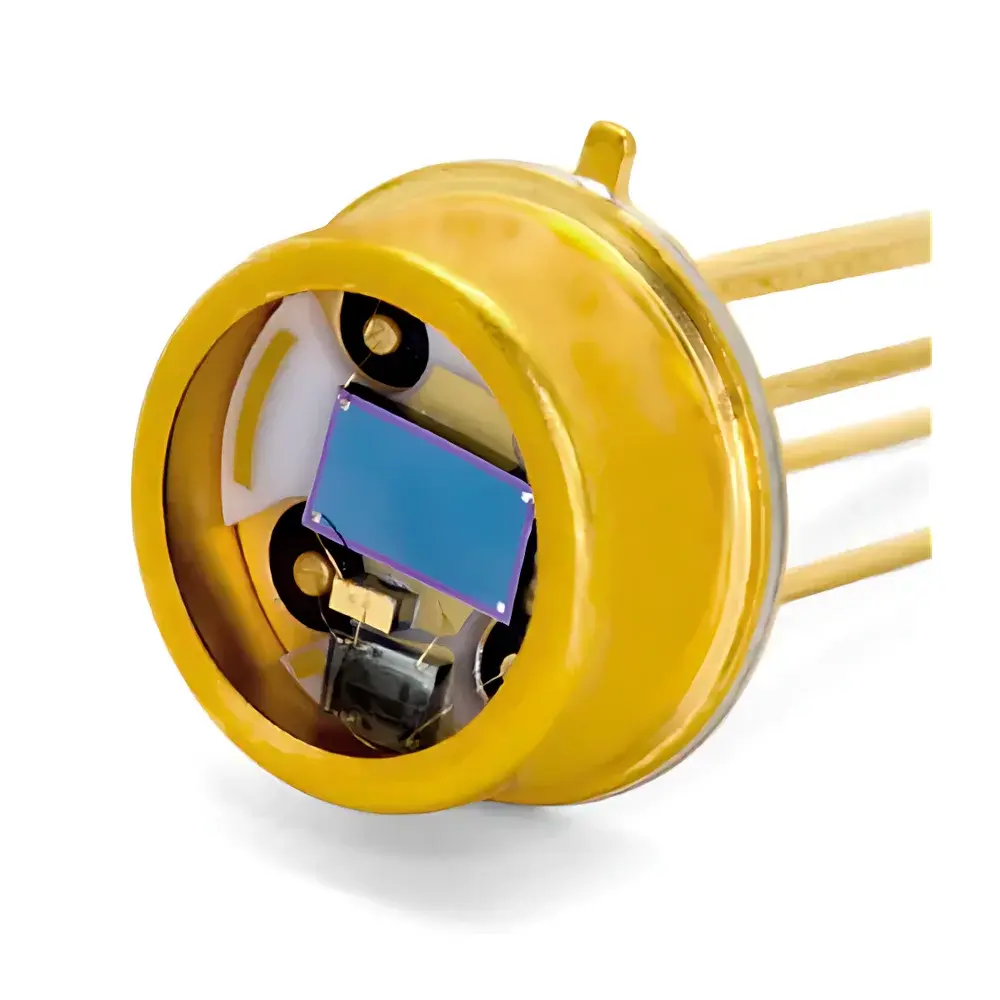
Opto Diode ODA-6W-500M NIR/Red-Enhanced Photodiode with Integrated Transimpedance Amplifier
| Brand | Other brands |
|---|---|
| Origin | Imported |
| Manufacturer Type | General Distributor |
| Model | With Integrated Transimpedance Amplifier |
| Price | Upon Request |
| Active Area | 6 mm² |
| Spectral Range | 200–1800 nm |
| Package | Hermetically Sealed TO-39 |
| NEP (λ=940 nm) | 1.2 fW/√Hz |
| Dark Bias Noise (0.1–135 kHz, ±5 V) | 283–500 µV rms |
| Sensitivity (λ=940 nm, ±5 V) | 275–315 V/µW |
| Bandwidth (−3 dB, ±5 V) | 100–130 Hz |
| Supply Current | 850–950 µA |
| Supply Voltage Range (±V) | 5–15 V |
| Operating Temperature | −25 to +100 °C |
Overview
The Opto Diode ODA-6W-500M is a high-performance, integrated photodetector module engineered for precision optical power and radiant flux measurement in near-infrared (NIR) and red spectral bands. Unlike discrete photodiode + external amplifier configurations, this device embeds a low-noise transimpedance amplifier (TIA) directly within a hermetically sealed TO-39 metal can package—minimizing parasitic capacitance, shielding against EMI, and ensuring stable gain calibration across thermal and mechanical stress cycles. Its extended spectral response—from deep UV (200 nm) through visible red to mid-infrared (1800 nm)—is achieved via a specially doped silicon photodiode structure optimized for quantum efficiency peaking at 940 nm (QE > 85%), with enhanced responsivity in the 650–1050 nm range critical for laser diode monitoring, pulse oximetry reference channels, and industrial NIR spectroscopy source characterization. The 6 mm² active area enables robust signal capture from divergent or defocused beams without spatial averaging artifacts, while the integrated 500 MΩ transimpedance gain provides direct voltage output proportional to incident irradiance—eliminating post-acquisition signal conditioning for many OEM instrumentation applications.
Key Features
- Integrated transimpedance amplifier with fixed 500 MΩ gain, factory-trimmed for linearity and offset stability
- Hermetically sealed TO-39 package with gold-plated Kovar leads, rated for operation up to +100 °C and compatible with standard reflow and hand-soldering profiles (≤3 s at +260 °C)
- Low dark bias noise floor of 283–500 µVrms over 0.1–135 kHz bandwidth under ±5 V supply—enabling sub-pW-level optical detection resolution
- Typical noise-equivalent power (NEP) of 1.2 fW/√Hz at 940 nm, supporting high-dynamic-range measurements in low-light environments
- DC-coupled analog output with <100 ppm/°C gain drift and <2 mV dark offset under ±5 V bias—suitable for absolute radiometric calibration traceable to NIST standards
- Supply current tightly specified at 850–950 µA, facilitating low-power portable and battery-operated instrument designs
Sample Compatibility & Compliance
The ODA-6W-500M is designed for integration into laboratory-grade photometric systems, automated test equipment (ATE), and embedded optical sensors where long-term repeatability and environmental resilience are required. Its sealed construction meets MIL-STD-883 Class H requirements for moisture resistance and thermal shock survivability. While not certified to IEC 61000-4-x EMC standards as a standalone unit, its low-EMI topology and grounded metal housing support compliance when installed per PCB layout guidelines in EN 61326-1 (industrial measurement equipment). For regulated industries—including medical device manufacturing (ISO 13485) and pharmaceutical process analytics—the module supports GLP-compliant documentation packages (including lot-specific calibration reports, traceable to NIST-traceable reference detectors) upon request. It is compatible with standard 25-mm-diameter lens mounts and fiber-optic adapters (e.g., SMA-905), and its linear response up to 10 mW/cm² irradiance enables use in laser safety interlock circuits per IEC 60825-1 Annex D.
Software & Data Management
As a purely analog front-end component, the ODA-6W-500M does not include onboard firmware or digital interfaces. However, it is fully interoperable with industry-standard data acquisition platforms—including National Instruments PXIe chassis with 24-bit delta-sigma ADC modules (e.g., NI PXIe-4309), Keysight 34972A LXI DAQ systems, and Raspberry Pi-based ADC HATs using ADS1256 or LTC2499 converters. When paired with calibrated light sources and temperature-stabilized housings, the module supports audit-ready data logging compliant with FDA 21 CFR Part 11 requirements—provided the host system implements electronic signatures, audit trails, and data integrity controls. Opto Diode provides application notes detailing gain compensation algorithms for temperature-induced responsivity drift (±0.05%/°C typical), enabling software-based correction in LabVIEW, Python (NumPy/SciPy), or MATLAB environments.
Applications
- Laser diode output monitoring in telecom pump modules and fiber amplifier control loops
- Reference channel detection in benchtop and portable NIR spectrometers (e.g., 900–1700 nm chemometrics systems)
- Pulse oximetry sensor development requiring stable red/NIR ratio tracking under variable ambient light
- Industrial flame detection systems leveraging 760 nm O2 absorption band sensing
- Calibration transfer standards for ISO/IEC 17025-accredited photometry labs
- High-stability optical encoder feedback in semiconductor lithography stages
FAQ
Is the ODA-6W-500M suitable for pulsed laser detection?
Yes—its 100–130 Hz small-signal bandwidth supports DC to quasi-static measurements; for nanosecond-scale pulses, external AC-coupling and high-speed amplification are required.
Can the transimpedance gain be modified?
No—the 500 MΩ gain is fixed and laser-trimmed during wafer-level testing; custom gain variants (e.g., 100 MΩ or 1 GΩ) are available under OEM agreement.
What is the maximum permissible optical power before saturation?
Saturation occurs at approximately 12 mW total incident power on the 6 mm² area (2 mW/cm² irradiance), assuming uniform illumination and ±5 V supply.
Does the device require external temperature compensation?
For metrology-grade accuracy (<0.5% uncertainty), software-based temperature compensation using the provided TC coefficients is recommended above ±10 °C ambient deviation.
Is RoHS and REACH compliance documented?
Yes—full substance declaration and certificate of conformity are supplied with each production lot per EU Directive 2011/65/EU and Regulation (EC) No 1907/2006.