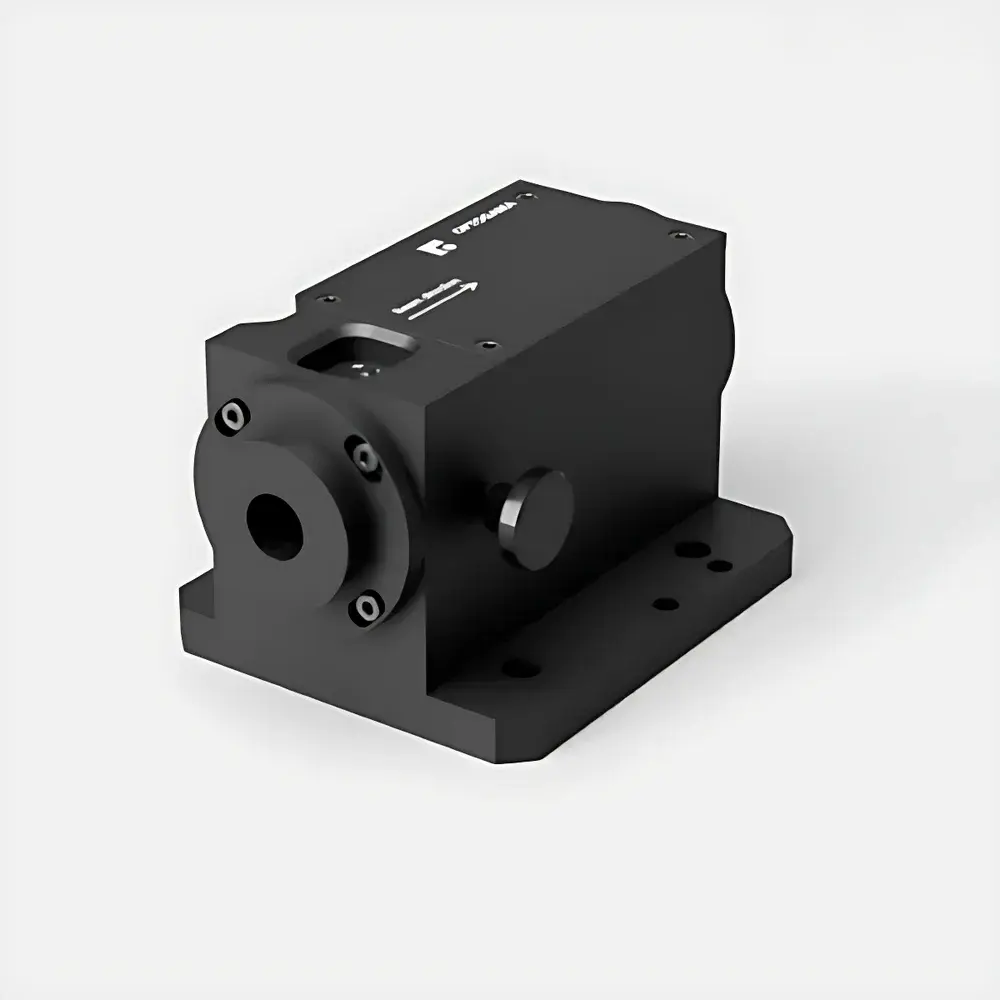
Optogama LPA-M Manual Laser Power Attenuator
| Brand | Optogama |
|---|---|
| Origin | Shanghai, China |
| Manufacturer Type | Authorized Distributor |
| Product Category | Domestic (PRC-manufactured) |
| Model | LPA-M |
| Wavelength Range | 240–2000 nm |
| Design Wavelength | 1064 nm (customizable) |
| Clear Aperture | 8 mm |
| Attenuation Range | 0.1–98% |
| Laser-Induced Damage Threshold (LIDT) | 10 J/cm² (10 ns pulse @ 1064 nm) |
| Adjustment | Manual (precision micrometer-driven rotation) |
| Resolution | < 0.1% |
| Dimensions | 57 × 72 × 105 mm |
| Optical Architecture | Polarization-based, dual-rotating waveplate design |
Overview
The Optogama LPA-M Manual Laser Power Attenuator is an optomechanically engineered device designed for precise, repeatable attenuation of continuous-wave (CW) and pulsed laser beams across the ultraviolet, visible, and near-infrared spectral ranges (240–2000 nm). It operates on the principle of polarization-dependent attenuation: two high-durability zero-order waveplates—configured in a rotating half-waveplate / quarter-waveplate pair—rotate relative to each other to control the output intensity via vector projection of the incident polarization state. This architecture eliminates absorption-based thermal loading, enabling stable operation with high-power lasers without beam distortion or thermal drift. Unlike fixed-ratio neutral density filters or motorized attenuators, the LPA-M delivers deterministic, analog-level control through calibrated manual adjustment—making it ideal for laboratory alignment, laser safety setup, optical system prototyping, and calibration workflows where real-time, hands-on power tuning is required.
Key Features
- Polarization-based attenuation mechanism ensures minimal thermal lensing and zero insertion loss at nominal transmission points
- High laser-induced damage threshold (10 J/cm² @ 10 ns, 1064 nm) validated per ISO 21254-1, supporting integration with industrial-grade CW and nanosecond-pulsed lasers up to multi-watt average power
- Sub-0.1% attenuation resolution achieved via precision-ground micrometer actuator with engraved angular scale and locking collar for positional retention
- Compact monolithic housing (57 × 72 × 105 mm) constructed from black-anodized aluminum alloy, optimized for vibration resistance and thermal stability in benchtop and OEM integration environments
- Optimized for broadband use: anti-reflection coatings are specified per wavelength band (UV-AR, VIS-AR, NIR-AR), with custom coating options available for 240–2000 nm coverage including deep-UV (240–280 nm) and extended-NIR (1550–2000 nm)
- No electronic components or external power required—fully passive, EMI-immune, and intrinsically compatible with ultra-high-vacuum (UHV) feedthrough adaptations upon request
Sample Compatibility & Compliance
The LPA-M is compatible with collimated free-space beams up to 8 mm diameter and divergence < 1 mrad. It maintains polarization extinction ratio > 100:1 across its full attenuation range when used with linearly polarized input light. For unpolarized or partially polarized sources, output polarization state varies predictably with attenuation setting—a behavior documented in the included calibration report. The device complies with ISO 9001 manufacturing traceability standards; optical substrates meet MIL-O-13830 scratch-dig specifications; mechanical tolerances adhere to ISO 2768-mK. While not a medical or safety-certified device per se, its attenuation performance supports alignment with IEC 60825-1:2014 Class 1/Class 1M enclosure design requirements when integrated into interlocked laser systems.
Software & Data Management
As a fully manual, analog instrument, the LPA-M requires no firmware, drivers, or software interface. However, it is routinely integrated into automated test benches via third-party motion controllers (e.g., Thorlabs KDC101, Newport ESP300) using optional encoder-equipped rotary adapters (sold separately). Calibration data—including wavelength-specific attenuation curves and angular position vs. transmission maps—is provided in CSV and MATLAB .mat formats for traceable system modeling. All units ship with a NIST-traceable calibration certificate documenting LIDT verification and angular repeatability (< ±0.05° over 1000 cycles) under controlled environmental conditions (23 ± 1°C, 40–60% RH).
Applications
- Laser power stabilization during interferometric alignment and cavity locking procedures
- Safe reduction of beam intensity prior to sensitive detectors (e.g., photodiodes, EMCCDs, single-photon counters)
- Calibration of optical power meters and energy sensors across multiple wavelengths
- Beam profiling system input conditioning to prevent detector saturation
- OEM integration into laser marking, LIBS, and time-resolved spectroscopy platforms requiring deterministic, low-noise attenuation
- Educational labs demonstrating polarization optics, Malus’ law, and laser safety protocols
FAQ
Is the LPA-M suitable for femtosecond laser pulses?
No—the specified LIDT applies only to nanosecond pulses (10 ns @ 1064 nm). For ultrashort pulses (< 1 ps), consult Optogama’s LPA-F series, which uses chirped mirror-based dispersion-compensated designs.
Can I use the LPA-M with circularly polarized input light?
Yes, but output intensity will vary sinusoidally with rotation angle and exhibit reduced dynamic range; linear polarization input is recommended for full 0.1–98% control.
Does the device introduce beam displacement or angular deviation?
Beam deviation is limited to < 15 arcsec (typ.) and lateral shift < 10 µm across full rotation—verified by interferometric testing and reported in the unit-specific calibration sheet.
Are custom wavelength coatings available?
Yes—standard configurations cover 240–280 nm (UV), 400–700 nm (VIS), and 750–2000 nm (NIR); dual-band and triple-band AR coatings can be quoted per ISO 13697 specification.
What maintenance is required?
None under normal operation; periodic inspection of waveplate surfaces with 100× magnification is recommended every 12 months in high-use environments; cleaning follows ISO 10110-7 protocols using spectroscopic-grade acetone and lint-free wipes.