
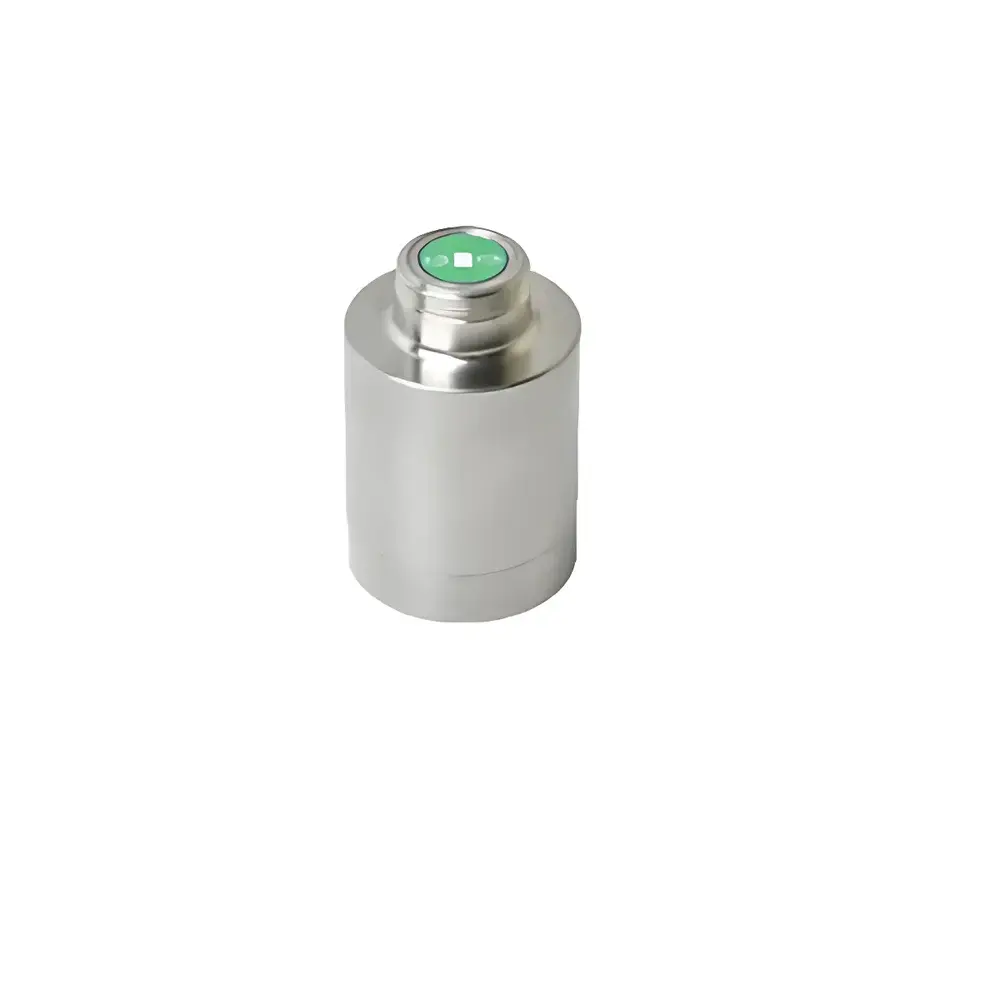
Optosky IR2110 Miniature Near-Infrared Spectrometer
| Brand | Optosky |
|---|---|
| Model | IR2110 |
| Detector | InGaAs Linear Diode Array |
| Wavelength Range | 900–1700 nm (standard configuration) |
| Optical Resolution | ≤ 8 nm (FWHM) |
| Signal-to-Noise Ratio | > 10,000:1 (at full integration time) |
| Integration Time | 1 ms – 10 s |
| Interface | USB 3.0, RS232, Ethernet (optional) |
| IP Rating | IP65/IP67 |
| Operating Temperature | −10 °C to +50 °C |
| Light Source Lifetime | > 40,000 h |
| Software Compatibility | Windows 10/11, Linux (SDK available) |
| Compliance | CE, RoHS, ISO/IEC 17025 applicable for method validation |
Overview
The Optosky IR2110 is a miniature, high-integrity near-infrared (NIR) spectrometer engineered for robust in-line and at-line process analytical technology (PAT) applications. Based on a fixed-grating optical design and a thermoelectrically stabilized InGaAs linear diode array detector, the IR2110 delivers stable spectral acquisition across the 900–1700 nm range—covering key overtones and combination bands of C–H, O–H, and N–H functional groups. Its compact monolithic architecture eliminates moving parts, ensuring long-term mechanical stability and immunity to vibration-induced misalignment. Designed for direct immersion or fiber-coupled probe integration, the instrument supports real-time spectral collection from reactors, dryers, mixers, and conveyors without sample extraction. The system operates under industrial environmental constraints—including humidity, particulate exposure, and thermal fluctuation—thanks to its sealed optical path, positive-pressure purge port for lens protection, and IP65/IP67-rated enclosure.
Key Features
- Miniaturized optical bench with no moving components: Ensures high reproducibility and minimal drift over extended operation cycles.
- InGaAs detector with TE cooling: Maintains spectral stability across ambient temperature variations (−10 °C to +50 °C), critical for uncontrolled factory environments.
- Integrated positive-pressure air purge interface: Prevents lens contamination and condensation during continuous operation in humid or dusty settings.
- High dynamic range and SNR (>10,000:1): Enables reliable quantification of low-concentration analytes (e.g., moisture < 0.5% w/w) in complex matrices.
- Multi-interface connectivity: Native support for USB 3.0 (for lab integration), RS232 (for legacy PLC communication), and optional Gigabit Ethernet (for SCADA/MES synchronization).
- Extended light source lifetime (>40,000 h): Reduces scheduled maintenance intervals and total cost of ownership in 24/7 production environments.
Sample Compatibility & Compliance
The IR2110 is compatible with liquid, semi-solid, and granular samples via immersion probes, flow cells, or reflectance contact probes. It supports ASTM E1655–22 (Standard Practices for Infrared Multivariate Quantitative Analysis) and aligns with ICH Q2(R2) guidelines for analytical procedure validation in pharmaceutical development. When deployed with validated chemometric models, the system meets data integrity requirements under FDA 21 CFR Part 11 when used with compliant software platforms featuring electronic signatures, audit trails, and role-based access control. Its construction adheres to RoHS and CE directives; optical performance can be verified per ISO/IEC 17025 when operated within an accredited laboratory quality system.
Software & Data Management
The IR2110 is supported by OptoSpectra Pro—a modular software suite designed for PAT workflows. It enables real-time spectral acquisition, multivariate calibration (PLS, PCR, SVM), model transfer between instruments, and batch-wise statistical process monitoring (SPC). Users may import/export models in .nirs or .jdx formats, configure up to eight concurrent probe channels, and trigger external actuators via TTL or Modbus TCP upon threshold violations. An open SDK (C/C++, Python, MATLAB) allows integration into DeltaV, PI System, or custom MES platforms. All spectral data, model metadata, and user actions are timestamped and logged—supporting GLP/GMP traceability when paired with secure network storage and backup protocols.
Applications
- Pharmaceutical manufacturing: Real-time monitoring of blend uniformity in fluidized bed dryers and granulators; endpoint detection in wet granulation and lyophilization cycles.
- Food & feed processing: Quantitative prediction of fat, moisture, protein, and crude fiber in raw materials, intermediates, and finished products—aligned with AOAC 2016.07 and ISO 12099:2017.
- Polymer synthesis: In-reactor tracking of monomer conversion, copolymer composition, and residual solvent content during batch or continuous polymerization.
- Petrochemical refining: On-stream analysis of hydrocarbon composition (e.g., octane number estimation, olefin saturation) in distillation sidestreams and hydrotreater effluents.
- Agricultural QA/QC: Rapid screening of grain moisture and protein content pre-storage or post-harvest without grinding or solvent extraction.
FAQ
What wavelength range does the IR2110 cover, and is it customizable?
The standard configuration spans 900–1700 nm using an InGaAs detector array. Custom configurations with extended ranges (e.g., 1100–2500 nm with extended-InGaAs or PbS detectors) are available upon request and require optical recalibration.
Can the IR2110 operate in hazardous areas (e.g., Class I Div 2)?
The base unit is not intrinsically safe certified; however, it may be installed outside classified zones with fiber-optic probe extension (up to 10 m) to meet ATEX/IECEx Zone 2 requirements.
How is chemometric model validation performed for regulatory submissions?
Model validation follows ICH Q2(R2) principles—comprising specificity, linearity, accuracy, precision (repeatability & intermediate precision), range, and robustness testing—using reference methods traceable to NIST SRMs or pharmacopoeial standards.
Does the system support remote diagnostics and firmware updates?
Yes—via Ethernet-connected devices, authorized users can initiate secure firmware upgrades, retrieve diagnostic logs, and perform spectral baseline verification using built-in reference LEDs.
Is the IR2110 suitable for GMP-regulated environments?
When deployed with validated software, documented change control procedures, and periodic performance qualification (PQ) per ASTM E2500–22, the IR2110 meets core GMP expectations for analytical instrumentation used in release testing and process monitoring.
Related Products



