
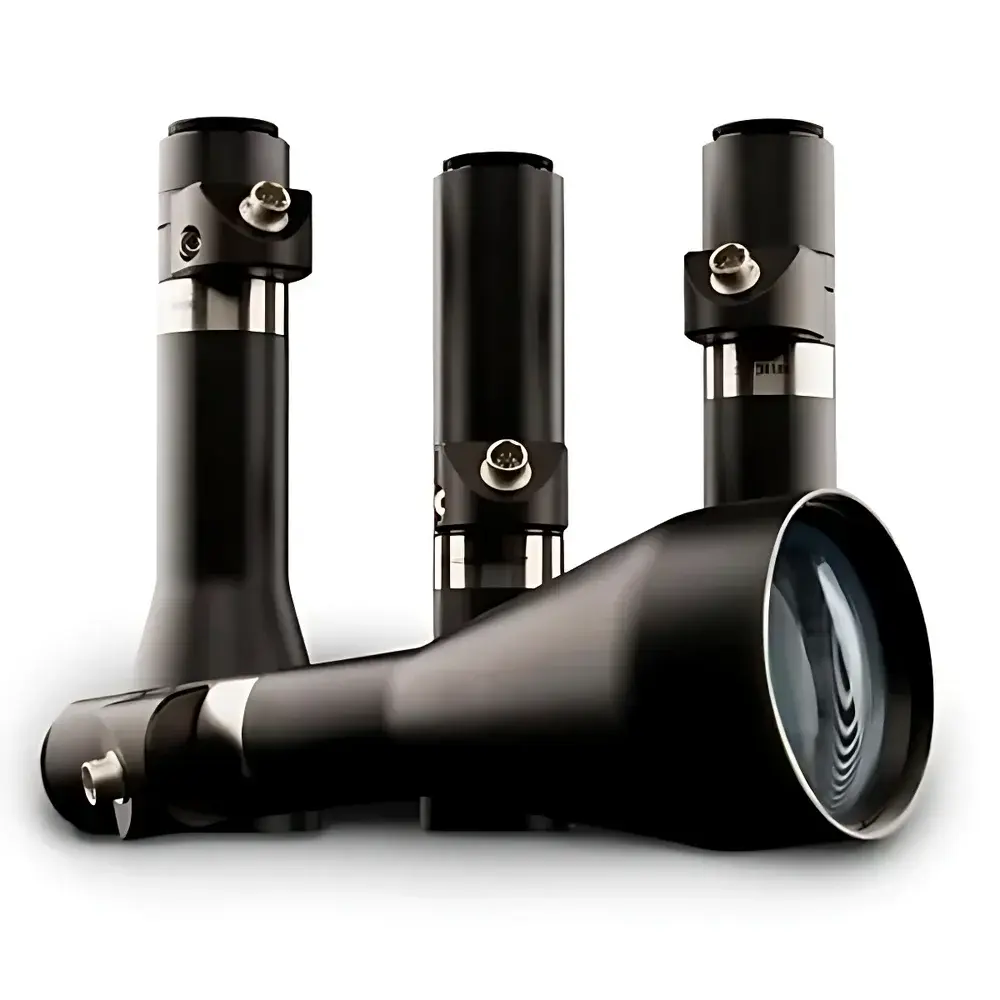
Optotune ELM-T Series Electrically Tunable Telecentric Lenses
| Brand | Auniontech (Distributor) |
|---|---|
| Origin | Switzerland |
| Manufacturer Type | Authorized Distributor |
| Product Category | Imported Optical Instrument Component |
| Model Designation | ELM-T Series Telecentric Lens Module |
| Pricing | Available Upon Request |
Overview
The Optotune ELM-T Series represents a class of electrically tunable telecentric lens modules engineered for high-precision machine vision and metrology applications requiring dynamic focus and magnification control without mechanical repositioning. Unlike conventional fixed-focal-length telecentric optics, the ELM-T series integrates Optotune’s proprietary electrowetting-based liquid lens technology directly into a mechanically stabilized telecentric optical path. This architecture enables real-time, millisecond-scale adjustment of focal position while preserving telecentricity—defined as constant chief ray angle across the field of view—and minimizing parallax-induced measurement error. The system operates on the principle of voltage-controlled surface curvature modulation in a sealed liquid–liquid interface, resulting in predictable, hysteresis-compensated optical power tuning. Designed for integration into automated inspection platforms, semiconductor metrology stations, and high-resolution industrial microscopy systems, the ELM-T series delivers diffraction-limited imaging performance across its entire tuning range, with MTF > 85% at Nyquist frequency for compatible sensor formats.
Key Features
- True telecentric design maintained across full focus tuning range—chief ray deviation < 0.1° over ±2 mm object distance variation
- Electronically adjustable focus via analog voltage input (0–5 V or 0–10 V), enabling closed-loop Z-height compensation in real time
- Linear, repeatable magnification scaling vs. working distance—calibration coefficients provided per unit for traceable dimensional metrology
- Available magnifications from 0.133× to 6×, supporting sensor formats from 1/2″ to full-frame 35 mm (diagonal up to 43.3 mm)
- Integrated mechanical housing with standardized C-mount or F-mount interfaces; optional motorized aperture and filter thread compatibility
- Optimized for monochromatic and broadband illumination (400–1100 nm AR-coated variants available); RMS wavefront error < λ/10 @ 633 nm
Sample Compatibility & Compliance
The ELM-T series is compatible with standard industrial cameras featuring global shutter CMOS sensors and pixel pitches ≥ 2.2 µm. It supports both reflective and transmissive sample geometries typical in PCB solder paste inspection, wafer alignment, IC bond pad verification, and MEMS device characterization. All units comply with CE marking requirements for electromagnetic compatibility (EN 61326-1) and low-voltage directive (2014/35/EU). Optical designs adhere to ISO 10110-3 surface quality standards (scratch-dig 20-10), and mechanical assemblies meet IP52 ingress protection for dust resistance during cleanroom-adjacent operation. For regulated environments—including ISO 13485-certified medical device manufacturing—the modules support documentation packages aligned with supplier qualification protocols under IATF 16949 and FDA QSR (21 CFR Part 820).
Software & Data Management
Optotune provides native SDKs for Windows and Linux (C/C++, Python, LabVIEW, MATLAB) enabling seamless integration with custom vision software stacks. Firmware supports synchronous triggering via TTL input for synchronized image capture and lens actuation—critical for multi-focus Z-stacking workflows. All lens units include non-volatile memory storing serial-numbered calibration data (including focus–voltage lookup tables, distortion maps, and telecentricity correction coefficients), accessible via USB-C or RS-422 interface. Audit trails for parameter changes are exportable in CSV format, supporting GLP/GMP-aligned validation requirements. Optional firmware updates maintain backward compatibility and introduce new features such as temperature-compensated tuning curves and multi-lens synchronization protocols.
Applications
- Automated optical inspection (AOI) of printed circuit boards, where consistent magnification and zero perspective error enable sub-micron solder joint dimensioning
- Wafer-level metrology in semiconductor packaging lines, including bump height, pitch, and coplanarity measurement under varying stand-off distances
- High-speed autofocus in laser micromachining monitoring systems, where thermal drift compensation is achieved via real-time focus recalibration
- Biomedical slide scanning systems requiring depth-of-field extension without mechanical stage movement
- Calibration reference systems for coordinate measuring machines (CMMs) and structured light 3D scanners
FAQ
What is the maximum tuning speed of the ELM-T lens?
Focus adjustment is completed within 15–25 ms depending on voltage step size and ambient temperature; settling time to < ±0.5 µm axial repeatability is typically < 40 ms.
Can the ELM-T be used with UV or NIR illumination?
Standard models cover 400–1100 nm; custom AR coatings are available for deep-UV (266 nm) or SWIR (1550 nm) bands upon request and qualification.
Is telecentricity verified independently for each production unit?
Yes—every shipped module includes a factory-measured telecentricity report generated using a collimated beam profiler and angular deviation mapping across the full field of view.
Does the lens require external cooling or active thermal management?
No—passive thermal design ensures stable optical performance across 10–40 °C ambient operating range; no condensation risk below 80% RH.
How is long-term stability validated?
Accelerated life testing includes 10⁶ tuning cycles at full voltage range, followed by MTF and telecentricity re-measurement; all units exceed ISO 9001 reliability thresholds for optical components.





