Optotune LSR Series Transmissive Laser Speckle Reducer
| Brand | auniontech (distributor) |
|---|---|
| Origin | Switzerland |
| Product Type | Transmissive Laser Speckle Reducer |
| Core Technology | Electromagnetically Driven Resonant Scattering Element |
| Clear Aperture | 18.5 × 18.5 mm |
| Diffuser Material Compatibility | Glass or Polycarbonate |
| Transmission Efficiency | Up to 98% |
| Oscillation Mode | 1D Linear |
| Peak Oscillation Amplitude | 800 µm |
| Resonant Frequency | ~120 Hz (load-dependent) |
| Drive Voltage | 5 VDC (pulsed coil current) |
| Mass | 11 g |
| Operational Lifetime | >40,000 hours |
| Environmental Robustness | Industrial-grade mechanical housing, flexible cable-integrated driver electronics |
| Compliance | Designed for integration into ISO/IEC 61000-6-3-compliant optical subsystems |
Overview
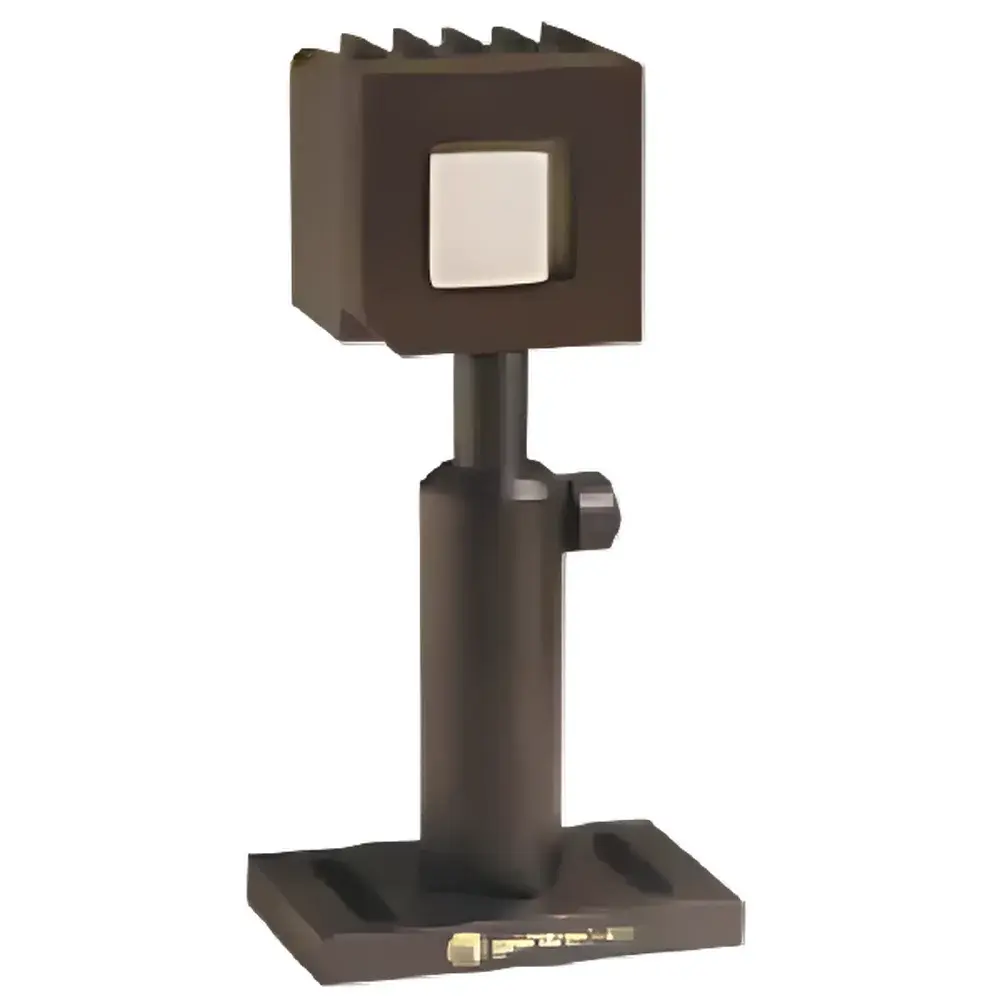
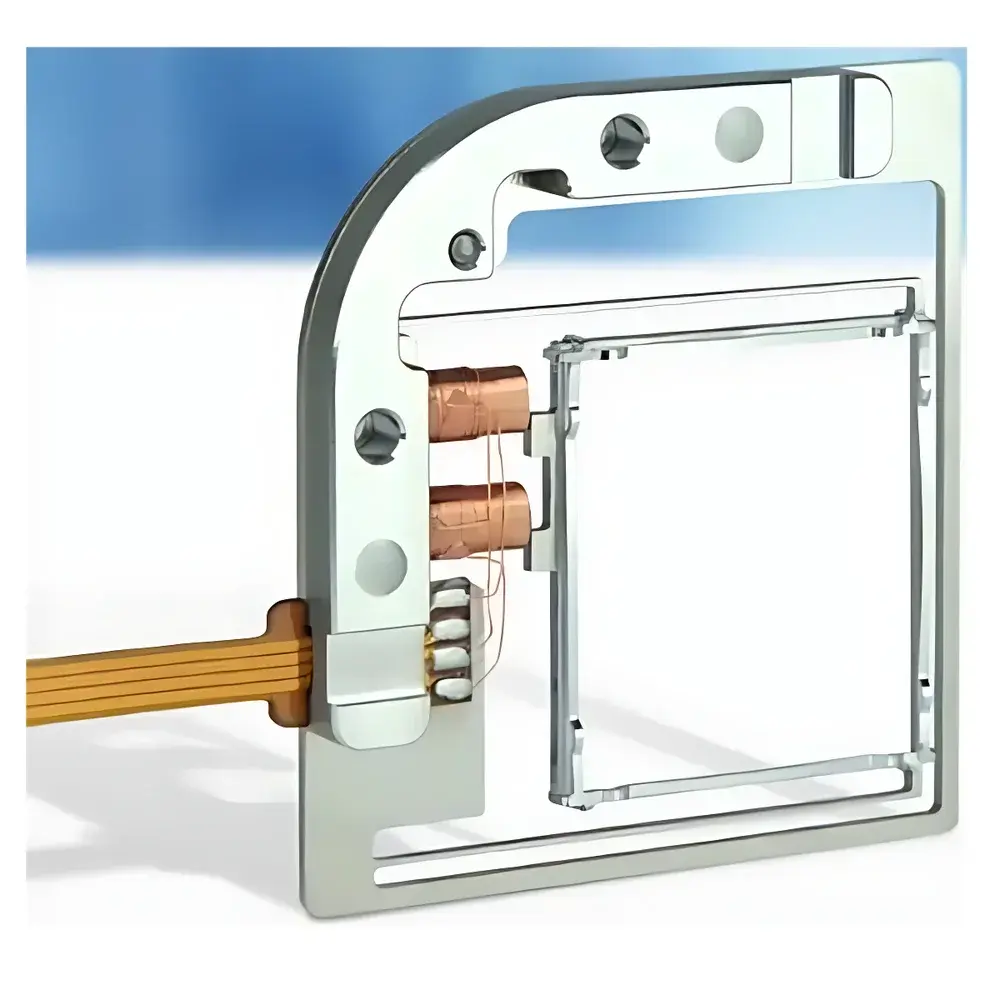
The Optotune LSR Series Transmissive Laser Speckle Reducer is an electromagnetically actuated, resonant-scattering optical component engineered to suppress laser speckle in high-coherence illumination systems. Unlike static diffusers or rotating ground-glass elements, the LSR operates on the principle of controlled mechanical resonance: a thin ferromagnetic stator structure is driven by pulsed coil currents to induce precise linear oscillation of an attached optical diffuser at its mechanical resonance frequency (~120 Hz). This dynamic scattering mechanism homogenizes spatial coherence without degrading beam transmission—achieving up to 98% optical throughput while eliminating temporal and spatial speckle contrast. The device is fundamentally a transmissive, non-imaging optical modulator optimized for integration into laser projection, structured illumination microscopy, automotive head-up displays (HUD), and precision interferometric metrology systems where speckle-induced noise compromises measurement fidelity or visual quality.
Key Features
- Transmissive architecture with 18.5 × 18.5 mm clear aperture—enables in-line integration without beam folding or path length extension
- Resonant electromagnetic actuation delivering 800 µm peak linear displacement at low power (5 VDC supply, pulsed coil drive)
- High-Q mechanical design ensures stable amplitude response across >40,000 hours of continuous operation—validated under accelerated lifetime testing per IEC 60068-2-64
- Fully integrated driver electronics embedded in a flexible, shielded ribbon cable—minimizing EMI coupling and simplifying OEM system integration
- Material-agnostic diffuser interface: compatible with fused silica, BK7, or polycarbonate substrates—enabling customization for UV–NIR spectral ranges (250–2000 nm)
- Compact form factor (11 g mass) with no cover glasses or external alignment optics—reducing optical train complexity and back-reflection risk
Sample Compatibility & Compliance
The LSR supports interchangeable diffuser substrates ranging from 1.0 to 3.0 mm thickness, provided surface flatness remains within λ/4 PV over the clear aperture. It is routinely deployed in Class 1 and Class 3R laser safety configurations compliant with IEC 60825-1:2014. Its low-voltage, current-pulsed drive architecture meets conducted emission limits per EN 55032 Class B. When integrated into regulated instrumentation (e.g., medical endomicroscopy platforms or automotive HUD validation rigs), the LSR’s deterministic oscillation behavior supports traceable calibration protocols aligned with ISO/IEC 17025 requirements. No firmware or software certification is required—the device functions as a passive electro-mechanical transducer with no embedded processors or network interfaces.
Software & Data Management
The LSR operates as a hardware-level analog actuator with no onboard intelligence or digital interface. System-level control is implemented externally via TTL-compatible pulse generators or arbitrary waveform generators capable of producing 120 Hz square-wave or sinusoidal current pulses (±10% frequency tolerance). For synchronized operation in time-gated imaging or pulsed laser applications, the flexible cable includes dedicated trigger input lines supporting edge-triggered start/stop sequencing. While the device itself does not generate telemetry, its operational stability enables long-term drift monitoring through external photodiode arrays or CMOS sensor-based speckle contrast analysis—data which may be logged and archived in accordance with 21 CFR Part 11-compliant laboratory information management systems (LIMS) when used in GxP environments.
Applications
- Laser-based flat-panel display metrology—reducing speckle-induced uncertainty in luminance uniformity measurements per VESA DisplayHDR™ test specifications
- Confocal and light-sheet fluorescence microscopy—providing temporally stable, speckle-free illumination for quantitative intensity calibration and photobleaching mitigation
- Automotive HUD combiner testing—ensuring MTF and contrast ratio measurements are free from coherence artifacts during ISO 15008-compliant evaluation
- Interferometric surface profiling—eliminating speckle noise that degrades phase unwrapping accuracy in white-light or laser-based profilometers
- Industrial laser material processing beam shaping—acting as a real-time coherence filter upstream of galvo scanners or fiber-coupled delivery optics
FAQ
Does the LSR require active temperature stabilization?
No—the resonant frequency shift with ambient temperature is <0.02 Hz/°C, and drive electronics compensate dynamically via closed-loop amplitude feedback in OEM-integrated controllers.
Can the LSR be operated in vacuum environments?
Yes—mechanical housing is hermetically sealed; outgassing rate complies with ECSS-Q-ST-70-02C for space-qualified optical components (tested at 10⁻⁶ mbar).
Is there a recommended mounting orientation?
Horizontal mounting is preferred to minimize gravitational loading effects on oscillation symmetry; vertical mounting requires mechanical preload verification per manufacturer’s torque specification sheet.
How is optical alignment verified post-installation?
Alignment is confirmed using a HeNe reference beam and quadrant photodiode; residual beam deviation must remain <5 µrad RMS over 24 hours to meet factory calibration tolerances.
What maintenance is required over its operational lifetime?
None—no lubricants, consumables, or recalibration intervals are specified; periodic visual inspection of cable integrity and connector seating is recommended per ISO 13849-1 Category 3 maintenance schedules.