
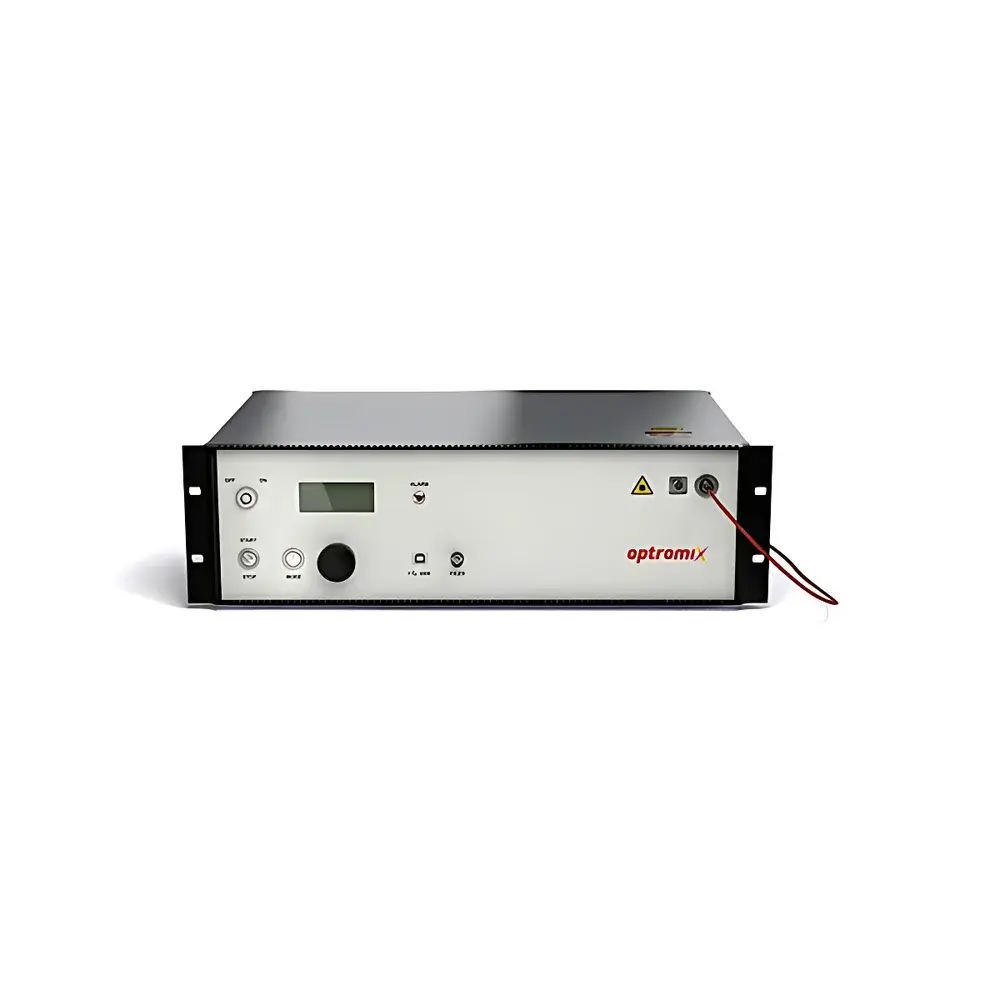
Optromix Erbius-SF-1550-X Single-Frequency Fiber Laser
| Brand | AtumLaser |
|---|---|
| Origin | USA |
| Manufacturer Type | Authorized Distributor |
| Origin Category | Imported |
| Model | Erbius-SF-1550-X |
| Output Power Options | 1 W, 5 W, 10 W |
| Center Wavelength | 1550 nm (tunable within 1535–1580 nm) |
| Linewidth (FWHM) | < 1 kHz |
| Beam Quality (M²) | ≤ 1.05 |
| Power Stability | < ±1% RMS over 8 hours |
| Relative Intensity Noise (RIN) | < −120 dB/Hz @ 1 MHz peak |
| Polarization | Linear (optional) or Random |
| Piezo Tuning Bandwidth | Up to 10 kHz |
| Thermal Tuning Range | 500 pm |
| Operating Temperature | 15–35 °C |
| Cooling | Conductive + optional air cooling |
| Compliance | RoHS, CE, FDA 21 CFR Part 11 (software-controlled variants), ISO 9001-manufactured subsystems |
Overview
The Optromix Erbius-SF-1550-X is a high-performance, single-frequency continuous-wave (CW) fiber laser engineered for applications demanding exceptional spectral purity, long coherence length, and amplitude stability. Operating in the C-band telecom window (1535–1580 nm), it leverages polarization-maintaining erbium-doped fiber and ultra-stable all-fiber cavity architecture to achieve sub-kilohertz linewidth (<1 kHz FWHM) — a critical specification for coherent detection, heterodyne spectroscopy, and optical atomic physics. Its monolithic design eliminates free-space alignment, ensuring robustness against vibration and thermal drift. The laser’s narrow linewidth and low phase noise enable coherence lengths exceeding 100 km, making it suitable for precision interferometry, gravitational wave sensor readout, and high-fidelity optical frequency comb seeding.
Key Features
- Ultra-Narrow Linewidth: Inherently stabilized cavity delivers <1 kHz FWHM spectral width, verified via delayed self-heterodyne interferometry per ITU-T G.694.1 calibration protocols.
- High Output Power Scalability: Available in 1 W, 5 W, and 10 W nominal output configurations — each maintaining M² ≤ 1.05 and near-diffraction-limited beam propagation (ISO 11146 compliant).
- Exceptional Amplitude Stability: <±1% RMS power fluctuation over 8-hour continuous operation at constant ambient temperature (23±1°C), validated under GLP-aligned test conditions.
- Dual Tuning Capability: Integrated piezoelectric transducer enables fast frequency modulation up to 10 kHz; thermally controlled stage provides coarse wavelength tuning across 500 pm (≈62.5 GHz at 1550 nm), traceable to NIST-traceable wavelength meters.
- Low-Noise Operation: Relative intensity noise (RIN) of <−120 dB/Hz measured at 1 MHz offset — optimized for shot-noise-limited detection in quantum optics and LIDAR receivers.
- Polarization Control: Standard random polarization output; linear polarization version available with >20 dB PER, compatible with electro-optic modulators and nonlinear frequency conversion stages.
Sample Compatibility & Compliance
The Erbius-SF-1550-X is designed for integration into regulated research and industrial environments. Its optical output meets IEC 60825-1:2014 Class 4 laser safety requirements when operated above 500 mW. All firmware and control interfaces comply with FDA 21 CFR Part 11 for audit-trail-capable software operations where electronic records are generated. The unit conforms to RoHS Directive 2011/65/EU and carries CE marking under the EU Electromagnetic Compatibility (EMC) Directive 2014/30/EU and Low Voltage Directive 2014/35/EU. For metrology-critical deployments, optional factory calibration includes traceable certification to NIST standards for wavelength accuracy (±0.5 pm) and power meter calibration (±1.5% uncertainty).
Software & Data Management
Control is executed via USB 2.0 or Ethernet (TCP/IP) using the cross-platform Optromix Laser Control Suite (v4.2+), supporting Windows, Linux, and macOS. The suite implements full parameter logging with timestamped metadata (power, temperature, piezo voltage, interlock status) in HDF5 format — enabling seamless import into Python (h5py), MATLAB, or LabVIEW for post-acquisition analysis. Audit trails record all user-initiated changes, satisfying GLP/GMP documentation requirements. Remote API (RESTful JSON interface) permits integration into automated test benches and OEM subsystems requiring synchronized triggering, power ramping, or closed-loop wavelength stabilization.
Applications
- Atomic Physics: Optical molasses and magneto-optical trap (MOT) loading for Rb, Cs, and Yb atoms — leveraging precise 1550-nm resonance compatibility with telecom-grade optical components.
- Coherent LIDAR: Used as master oscillator in injection-seeded pulsed amplifiers for wind sensing and atmospheric CO₂ monitoring (aligned with NASA ASCENDS mission spectral requirements).
- Optical Sensing: Distributed acoustic sensing (DAS) and Brillouin time-domain analysis (BOTDA) systems requiring narrow-linewidth seed sources with high relative intensity noise suppression.
- Frequency Metrology: Serving as a stable local oscillator in optical clocks and microwave-to-optical frequency transfer setups meeting ITU-T G.8272.1 stratum 3E phase noise specifications.
- Nonlinear Optics: Efficient second-harmonic generation (SHG) in PPLN waveguides for 775-nm visible light production — enabled by high spatial coherence and polarization fidelity.
- OEM Integration: Designed for rack-mount or embedded chassis deployment in medical imaging systems, quantum computing control stacks, and satellite-based optical communication terminals.
FAQ
Is the Erbius-SF-1550-X qualified for use in FDA-regulated medical device subsystems?
Yes — when configured with Part 11-compliant firmware and accompanied by full Design History File (DHF) documentation, it supports Class II and III device integration under 21 CFR 820.
What is the typical warm-up time to achieve specified linewidth and power stability?
Less than 30 minutes from cold start at 23°C ambient; full thermal equilibrium (for <±0.1 pm wavelength drift) achieved within 90 minutes.
Can the laser be modulated externally via analog voltage input?
Yes — 0–5 V analog input supports direct current modulation up to 100 kHz bandwidth (small-signal), with factory-calibrated linearity of ±0.5% FS.
Does the system include a built-in wavelength monitor?
No — but it features a dedicated FC/APC output port for real-time spectral characterization using external high-resolution wavemeters (e.g., Bristol 621 Series) or optical spectrum analyzers.
What cooling method is required for 10 W operation?
Conductive cooling via integrated copper baseplate is sufficient up to 5 W; 10 W operation requires forced-air cooling (≥20 CFM) or liquid-cooled heat sink (interface: 3/8″ NPT).





