
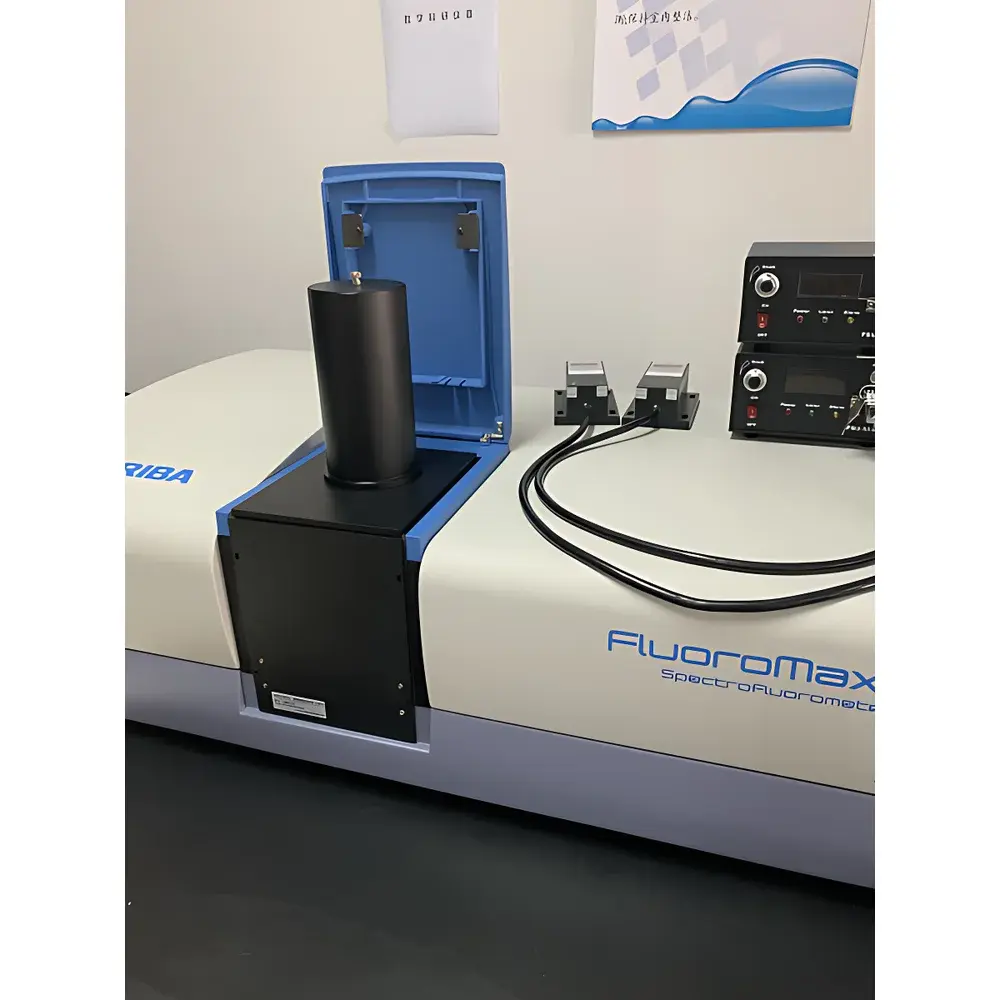
Orient KOJI LN-QE Cryogenic Absolute Photoluminescence Quantum Yield System
| Brand | Orient KOJI |
|---|---|
| Origin | Tianjin, China |
| Model | LN-QE |
| Temperature Range | 77 K (liquid nitrogen) and ambient |
| Spectral Range | 300–850 nm (dependent on coupled spectrofluorometer) |
| Integrating Sphere Lining | Spectral-grade PTFE |
| Dewar Capacity | 150 mL |
| Calibration | Factory-performed with sphere correction file |
| Data Acquisition Method | Dual-curve or quadruple-curve protocol |
| Scatter Correction | Reference-based scatter subtraction with noise-normalized blank/signal processing |
| Compliance | Designed for ASTM E1002, ISO 11664-7, and USP <1031> compliant quantum yield workflows when paired with HORIBA FluoroMax+P |
Overview
The Orient KOJI LN-QE Cryogenic Absolute Photoluminescence Quantum Yield System is a precision-engineered accessory module designed for integration with high-end spectrofluorometers—specifically the HORIBA FluoroMax+P platform—to enable absolute photoluminescence quantum yield (PLQY) measurements under controlled cryogenic conditions. Operating at 77 K via liquid nitrogen cooling, the system extends conventional room-temperature PLQY analysis to low-temperature regimes where non-radiative decay pathways are suppressed, phosphorescence lifetimes are extended, and triplet-state populations become more accessible. This capability is essential for rigorous characterization of emissive materials including thermally activated delayed fluorescence (TADF) emitters, room-temperature phosphors, aggregation-induced emission (AIE) systems, and triplet-harvesting organic semiconductors. The LN-QE employs a calibrated integrating sphere with spectral-grade PTFE coating (reflectance >99% across 300–850 nm), enabling accurate collection of both excitation scatter and total emitted photons—critical for absolute quantum yield determination per the IUPAC-recommended relative actinometry method.
Key Features
- Cryogenic compatibility: Integrated 150 mL liquid nitrogen Dewar enables stable, long-duration 77 K operation without mechanical refrigeration
- PTFE-coated integrating sphere: High-diffuse reflectance (>99%) ensures uniform photon collection and minimizes wavelength-dependent artifacts
- Scatter-corrected dual-curve acquisition: Simultaneous measurement of blank (Al powder reference) and sample spectra under identical optical geometry
- Noise-normalized signal processing: Automatic subtraction of dark current and scatter background; fluorescence peak intensities normalized to detector response stability
- Factory-calibrated sphere correction file: Pre-installed spectral correction matrix accounts for sphere wall non-uniformity and port losses
- Modular design: Seamless mechanical and optical coupling with HORIBA FluoroMax+P; no realignment required after installation
- Multi-modal spectral acquisition: Supports concurrent acquisition of absorption (via diffuse reflectance), steady-state fluorescence, phosphorescence, and absolute PLQY in a single thermal cycle
Sample Compatibility & Compliance
The LN-QE accommodates solid-state samples—including powders, thin films, single crystals, and polymer composites—in standard quartz cuvettes or custom holders compatible with the FluoroMax+P sample compartment. Its design supports both front-face and integrating-sphere-based diffuse reflectance measurements, making it suitable for highly scattering or opaque materials where conventional transmission absorbance fails. All data acquisition protocols align with internationally recognized photometric standards: ASTM E1002 (standard practice for measuring absolute quantum yields), ISO 11664-7 (colorimetry—CIE standard illuminants and observers), and USP <1031> (photometric assay validation). When operated under documented instrument qualification (IQ/OQ/PQ), the system supports GLP-compliant reporting and FDA 21 CFR Part 11–ready audit trails when used with validated FluoroMax+P software configurations.
Software & Data Management
The LN-QE operates exclusively through HORIBA’s FluoroMax+P native software environment (v5.5 or later), leveraging its built-in quantum yield calculation engine. Users define temperature setpoints, acquisition sequences (e.g., stepwise cooling from 298 K → 77 K), and multi-wavelength excitation scans—all synchronized with sphere shutter control and detector gain optimization. Raw spectral datasets include timestamped metadata (temperature, dewar fill level, integration time, grating position), enabling full traceability. Export formats include ASCII (.txt), CSV, and HDF5 for downstream analysis in MATLAB, Python (SciPy/NumPy), or OriginLab. Sphere correction files are embedded as encrypted binary headers within exported spectra, ensuring reproducibility across laboratories and instrument platforms.
Applications
- Quantitative evaluation of phosphorescence quantum yield enhancement at 77 K for metal-free organic phosphors and heavy-atom-free TADF systems
- Temperature-dependent PLQY mapping to deconvolute radiative vs. non-radiative decay channels using the energy gap law
- AIE mechanistic studies: Correlating cryogenic rigidity with conformational locking and suppression of non-radiative torsional decay
- Diffuse reflectance absorbance profiling of solid-state OLED emitters and perovskite precursors under cryogenic conditions
- Validation of triplet harvesting efficiency in host-guest emissive layers for next-generation display architectures
- Interlaboratory round-robin testing of certified reference materials for low-temperature quantum yield standards
FAQ
What spectrofluorometer models are compatible with the LN-QE system?
The LN-QE is mechanically and optically optimized for HORIBA FluoroMax+P systems only. Integration with other platforms requires custom optical alignment and software API development—not supported by Orient KOJI.
Does the system support automated temperature ramping between 77 K and 300 K?
No. The LN-QE provides static 77 K operation via liquid nitrogen immersion. For variable-temperature studies, users must manually refill the Dewar and allow thermal equilibration; no active cryostat or heater integration is included.
How is the integrating sphere calibrated, and how often must recalibration occur?
A full sphere correction file is acquired during factory installation using NIST-traceable Al powder standards. Recalibration is recommended annually or after any physical impact to the sphere housing or port assemblies.
Can the LN-QE measure time-resolved PLQY?
No. The system performs steady-state quantum yield determination only. Time-resolved quantum yield requires TCSPC-capable detectors and gated acquisition not supported by this configuration.
Is the PTFE sphere lining resistant to liquid nitrogen thermal cycling?
Yes. The spectral-grade PTFE coating is rated for repeated thermal cycling between 77 K and 298 K without delamination, reflectance degradation, or microcracking—verified over 500 cycles in accelerated lifetime testing.





