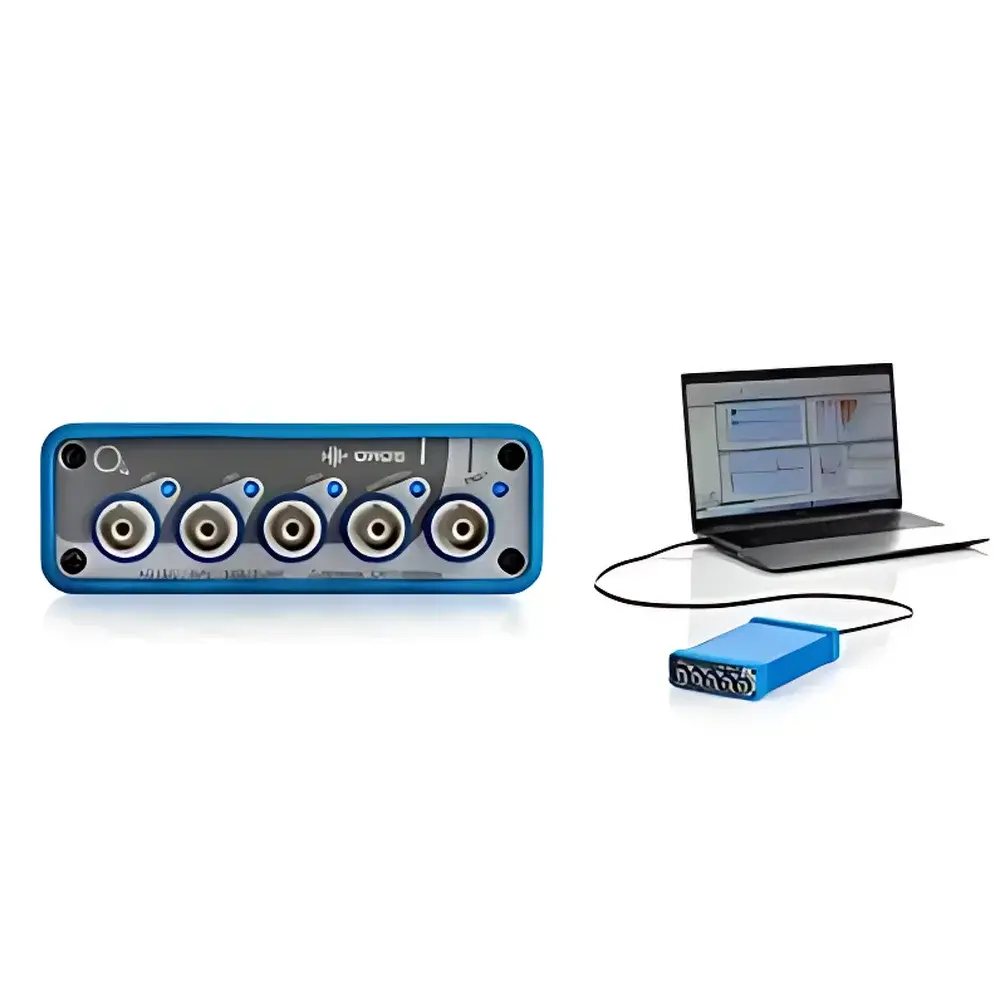
OROS O4 USB Portable 4-Channel FFT Analyzer
| Brand | OROS |
|---|---|
| Origin | France |
| Model | O4 |
| Input Channels | 4 analog (±40 V), 2 tachometer, 1 analog output |
| Phase Accuracy | ±0.02° |
| Amplitude Accuracy | ±0.02 dB |
| Dynamic Range | 140 dB |
| Max Sampling Rate | 256 kHz |
| Oversampling Rate | 32.8 MHz |
| Dimensions | 185 × 110 × 35 mm |
| Weight | 534 g |
| Interface | USB Type-C (bus-powered) |
| Compliance | ISO 9001:2015 certified design and manufacturing |
Overview
The OROS O4 is a high-fidelity, USB-powered 4-channel FFT analyzer engineered for real-time vibration and acoustic signal acquisition and spectral analysis in demanding engineering environments. Based on advanced digital signal processing (DSP) architecture developed in-house at OROS’ Grenoble headquarters since 1985, the O4 implements true hardware-accelerated Fast Fourier Transform computation with deterministic latency—enabling time-synchronized acquisition, live spectrum display, order tracking, and modal parameter extraction without reliance on host CPU resources. Its core measurement principle leverages anti-aliasing-filtered analog-to-digital conversion followed by coherent averaging, windowing (Hanning, Flat Top, Kaiser-Bessel), and zero-padding to ensure high-resolution frequency-domain representation compliant with ISO 10816 (vibration severity), ISO 5347 (vibration transducer calibration), and ANSI S2.6 (octave-band analysis). Designed specifically for R&D validation, production line NVH testing, and rotating machinery diagnostics, the O4 delivers laboratory-grade spectral integrity in a field-deployable form factor.
Key Features
- USB Type-C single-cable operation: Simultaneous data streaming, power delivery, and synchronization—no external power supply or auxiliary clock required.
- Compact industrial enclosure: 185 × 110 × 35 mm, 534 g—optimized for integration into mobile test rigs, vehicle cabins, cleanroom equipment bays, and benchtop QA stations.
- Four high-linearity analog input channels: ±40 V input range, 24-bit sigma-delta ADCs with programmable gain, anti-aliasing filtering, and channel-to-channel isolation >100 dB.
- Two dedicated tachometer inputs: Compatible with TTL, open-collector, and magnetic pickup sensors; supports rpm-based order analysis and angle-domain resampling.
- One analog output channel: Programmable waveform generation (sine, swept sine, burst random) for closed-loop excitation control or reference signal injection.
- Real-time performance: Up to 256 kHz per channel sampling rate with 32.8 MHz internal oversampling—ensuring Nyquist compliance for broadband transient capture up to 128 kHz.
- Measurement fidelity: Amplitude accuracy ±0.02 dB, phase accuracy ±0.02° across 1 Hz–100 kHz, dynamic range >140 dB (A-weighted, RMS).
Sample Compatibility & Compliance
The O4 supports direct connection to IEPE accelerometers (4 mA constant current), piezoelectric sensors (with external charge amplifiers), microphones (via preamplifiers), and voltage-output transducers. Its input protection meets IEC 61000-4-2 (ESD) Level 4 and IEC 61000-4-4 (EFT) Level 3. All firmware and hardware design processes adhere to ISO 9001:2015 quality management standards. The device operates within environmental specifications of –10 °C to +50 °C ambient temperature and 20–80% non-condensing humidity. When used with NVGate software, measurement workflows support audit-trail logging, electronic signatures, and configuration locking—facilitating alignment with GLP, GMP, and FDA 21 CFR Part 11 requirements for regulated industries including automotive Tier-1 suppliers and semiconductor equipment manufacturers.
Software & Data Management
The O4 is fully integrated with OROS NVGate—a modular, Windows-based analysis platform supporting FFT, PSD, spectrogram, waterfall, coherence, transfer function (FRF), and order tracking. NVGate implements IEEE 1451.4 TEDS auto-configuration, allows scripting via Python API (PyNVGate), and exports data in HDF5, UFF58, and MATLAB .mat formats. Raw time-history and processed spectra are stored with embedded metadata (channel calibration, sensor ID, test conditions, operator stamp). Version-controlled project files include full traceability of analysis parameters—including window type, overlap ratio, resolution bandwidth, and averaging method—enabling reproducible reprocessing and inter-laboratory comparison. Optional modules support automated pass/fail reporting per ISO 1996-2 (environmental noise) or SAE J1211 (vehicle interior noise).
Applications
- Automotive NVH development: Powertrain vibration source identification, electric motor whine characterization, battery pack structural resonance mapping, and ADAS sensor mount stability verification.
- Rotating machinery health monitoring: Bearing fault frequency detection (BPFO/BPFI), gear mesh harmonics analysis, imbalance and misalignment diagnosis using synchronous averaging.
- Electronics reliability testing: PCB-level vibration sensitivity assessment, fan noise spectrum decomposition, and EMI-induced acoustic emission correlation.
- Acoustic material evaluation: Transmission loss measurement of lightweight composites, absorption coefficient derivation via impedance tube coupling.
- Production QA/QC: Pass/fail go/no-go spectral templates for electric motor subassemblies, brake caliper rattle screening, and HVAC blower unit tonality grading.
FAQ
Is the O4 compatible with third-party DAQ software such as LabVIEW or MATLAB?
Yes—the O4 provides a documented C/C++ SDK and NI-DAQmx-compatible driver layer, enabling seamless integration with LabVIEW, MATLAB Data Acquisition Toolbox, and Python (via PyDAQmx or custom ctypes bindings).
Does the O4 support real-time streaming to disk at maximum sample rate?
Yes—continuous 4-channel streaming at 256 kHz is supported via NVGate’s ring-buffer recording mode with lossless compression (LZ4), sustaining write throughput >120 MB/s on NVMe SSDs.
Can the tachometer inputs be used for closed-loop speed control during run-up/down tests?
Yes—NVGate’s built-in RPM governor module accepts tach feedback and modulates analog output or external PWM signals to maintain precise rotational speed profiles.
What calibration documentation is provided with the O4?
Each unit ships with a factory calibration certificate traceable to LNE (Laboratoire National de Métrologie et d’Essais, France), covering amplitude linearity, frequency response, and phase matching across all channels.
Is remote operation over Ethernet or Wi-Fi supported?
No—the O4 is USB-native only; however, it can be operated remotely via Windows Remote Desktop or TeamViewer when connected to a host PC with USB redirection enabled.