
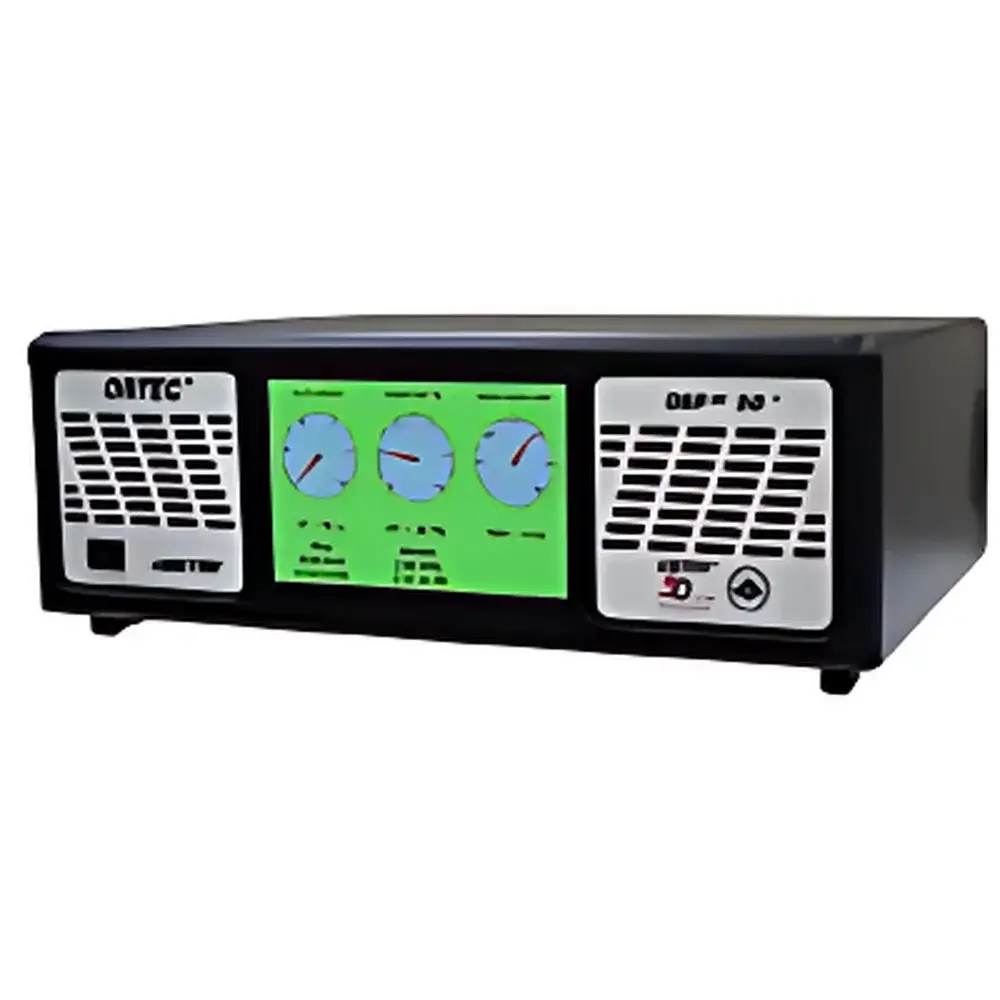
ORTEC DSPEC-50 Desktop Digital Gamma Spectrometer
| Brand | ORTEC |
|---|---|
| Origin | USA |
| Model | DSPEC-50 |
| Interface | USB 2.0 & Ethernet (TCP/IP) |
| Display | Integrated large LCD panel |
| Detector Compatibility | HPGe, Si(Li), NaI(Tl), and other pulse-mode radiation detectors |
| Dead Time Correction | Advanced real-time algorithm |
| LFR (Low-Frequency Noise Rejection) | Enabled |
| Count Rate Capability | Up to 30% higher throughput at ultra-high count rates |
| Resolution Enhancement | Mitigates EC-induced resolution degradation |
| Form Factor | Benchtop digital multichannel analyzer (MCA) |
Overview
The ORTEC DSPEC-50 is a high-performance benchtop digital gamma spectrometer engineered for precision nuclear spectroscopy in environmental monitoring, health physics, nuclear safeguards, and research laboratories. Built upon ORTEC’s five-decade legacy in multichannel analyzer (MCA) design, the DSPEC-50 implements advanced digital signal processing (DSP) architecture to replace traditional analog shaping and peak detection circuits. It acquires, processes, and analyzes pulses from radiation detectors—including high-purity germanium (HPGe), silicon lithium-drifted [Si(Li)], and sodium iodide [NaI(Tl)]—using pulse-height analysis with 16,384-channel memory depth. The system operates on the principle of gamma-ray energy spectroscopy: incident photons interact with the detector crystal, generating charge pulses proportional to photon energy; the DSPEC-50 digitizes these pulses at high sampling rates, applies real-time baseline restoration, trapezoidal filtering, and precise timing discrimination to deliver energy-calibrated spectra with high statistical fidelity and minimal spectral distortion.
Key Features
- Dual high-speed communication interfaces: USB 2.0 and 10/100 Mbps Ethernet (TCP/IP), enabling remote operation, network integration, and seamless data streaming to host PCs or centralized monitoring systems.
- Integrated 7-inch high-resolution LCD display with intuitive graphical user interface—provides real-time system status, live spectrum preview, acquisition parameters, and diagnostic feedback without requiring external software.
- Advanced dead time correction using predictive algorithmic modeling, ensuring accurate activity quantification across dynamic count rate ranges—from background-level measurements to >500 kcps—without manual correction factors.
- Low-Frequency Rejection (LFR) circuitry actively suppresses mechanical microphonics and low-frequency electronic noise, preserving energy resolution under non-ideal lab conditions (e.g., shared optical tables, HVAC vibration).
- Electron capture (EC) compensation logic mitigates resolution broadening caused by delayed charge trapping effects in HPGe detectors, maintaining FWHM stability across extended acquisition periods.
- Optimized throughput architecture increases effective system count rate capacity by up to 30% compared to prior-generation MCAs, reducing measurement time for high-activity environmental samples (e.g., soil, air filters, water concentrates).
Sample Compatibility & Compliance
The DSPEC-50 supports direct coupling with all standard pulse-output radiation detectors used in environmental radioactivity analysis, including coaxial and planar HPGe detectors (with cryostat integration), scintillation detectors, and proportional counters. Its firmware and gain-stabilization algorithms are optimized for long-term spectral stability required in unattended field deployments or regulatory compliance labs. The instrument complies with IEC 61000-4 electromagnetic compatibility standards and meets essential requirements of ISO/IEC 17025 for testing and calibration laboratories. When operated with validated detector configurations and certified reference materials, it supports analytical workflows aligned with EPA Method 901.1, ASTM D3648, and ISO 11929 for uncertainty evaluation of radionuclide activity concentrations.
Software & Data Management
The DSPEC-50 is fully compatible with ORTEC’s GammaVision® spectroscopy software suite (v7.0+), which provides automated nuclide identification, efficiency calibration, self-absorption correction, and customizable reporting templates compliant with GLP and 21 CFR Part 11 audit-trail requirements. Raw spectral data are stored in standard ORTEC MCA (.CNF) format, ensuring interoperability with third-party analysis tools (e.g., Genie 2000, InterWinner, and custom Python-based processing pipelines). All acquisition metadata—including detector ID, HV settings, live time, real time, temperature logs, and firmware revision—are embedded in spectrum headers to support traceable data lineage and laboratory information management system (LIMS) integration.
Applications
- Environmental surveillance: Radionuclide screening in soil, sediment, vegetation, and airborne particulate filters per IAEA Safety Standards Series No. RS-G-1.8.
- Decommissioning and site remediation: In-situ gamma scanning and isotopic mapping of contaminated surfaces and waste streams.
- Nuclear forensics and non-proliferation: Isotopic ratio analysis of uranium and plutonium signatures using high-resolution HPGe spectroscopy.
- Drinking water and food safety monitoring: Detection and quantification of 137Cs, 90Sr (via 90Y bremsstrahlung), 40K, and naturally occurring radioactive material (NORM) series.
- Research-grade spectroscopy: Pulse shape analysis, coincidence timing, and low-background measurements in shielded laboratories.
FAQ
Does the DSPEC-50 require liquid nitrogen cooling for HPGe operation?
No—the DSPEC-50 itself does not provide cryogenic cooling; it interfaces with externally cooled HPGe detectors via standard preamplifier outputs. Users must maintain appropriate detector cryostats (electromechanical or LN2) separately.
Can the DSPEC-50 be integrated into an automated environmental monitoring station?
Yes—its Ethernet TCP/IP interface, programmable SCPI command set, and support for Modbus TCP gateways enable integration with SCADA systems and remote telemetry platforms.
Is firmware upgrade supported in-field?
Yes—firmware updates are delivered via ORTEC’s secure customer portal and installed through USB or Ethernet without hardware modification.
What calibration standards are recommended for environmental gamma spectroscopy?
Traceable multi-nuclide point sources (e.g., IAEA RGU-1, NIST SRM 4357) and matrix-matched environmental standards (e.g., IAEA-375, NIST SRM 4350B) are recommended for energy and efficiency calibration.
Does the system support list-mode acquisition?
No—the DSPEC-50 operates in histogram mode only; list-mode capability is available in the DSPEC-502 variant.
Related Products







