
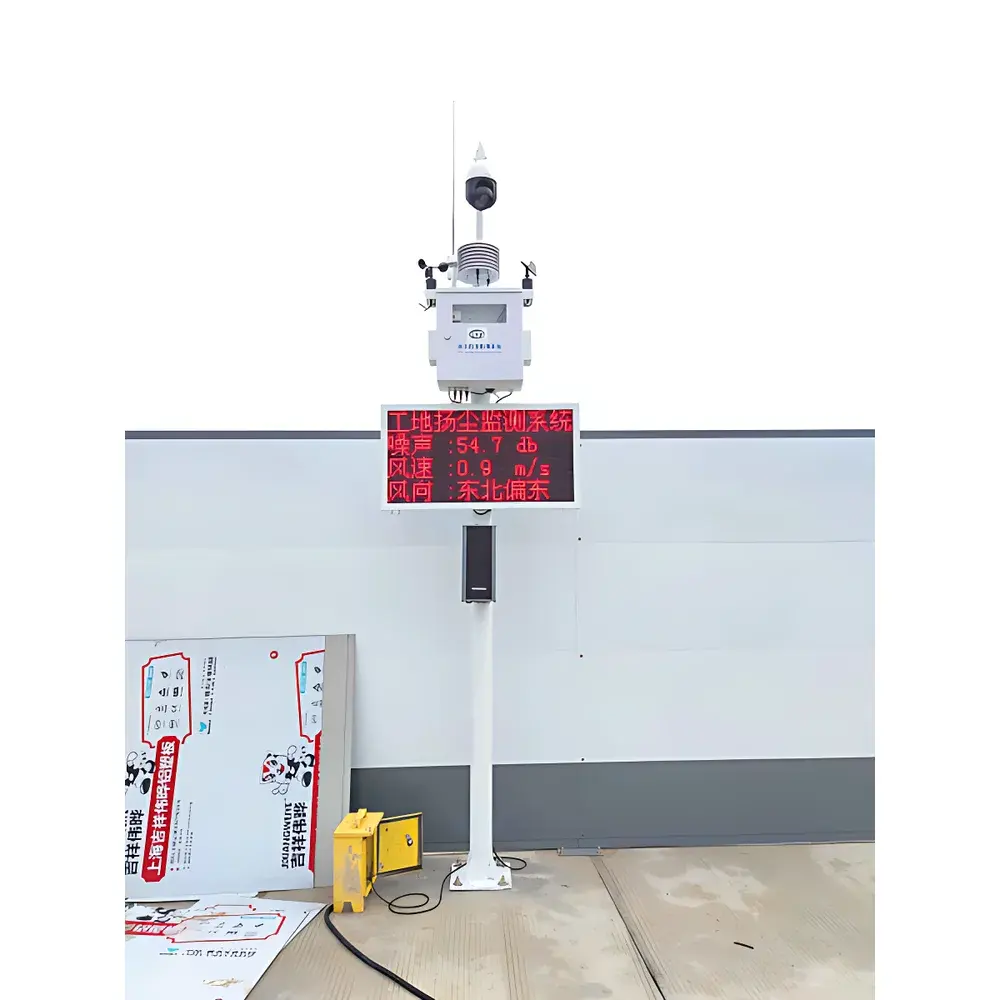
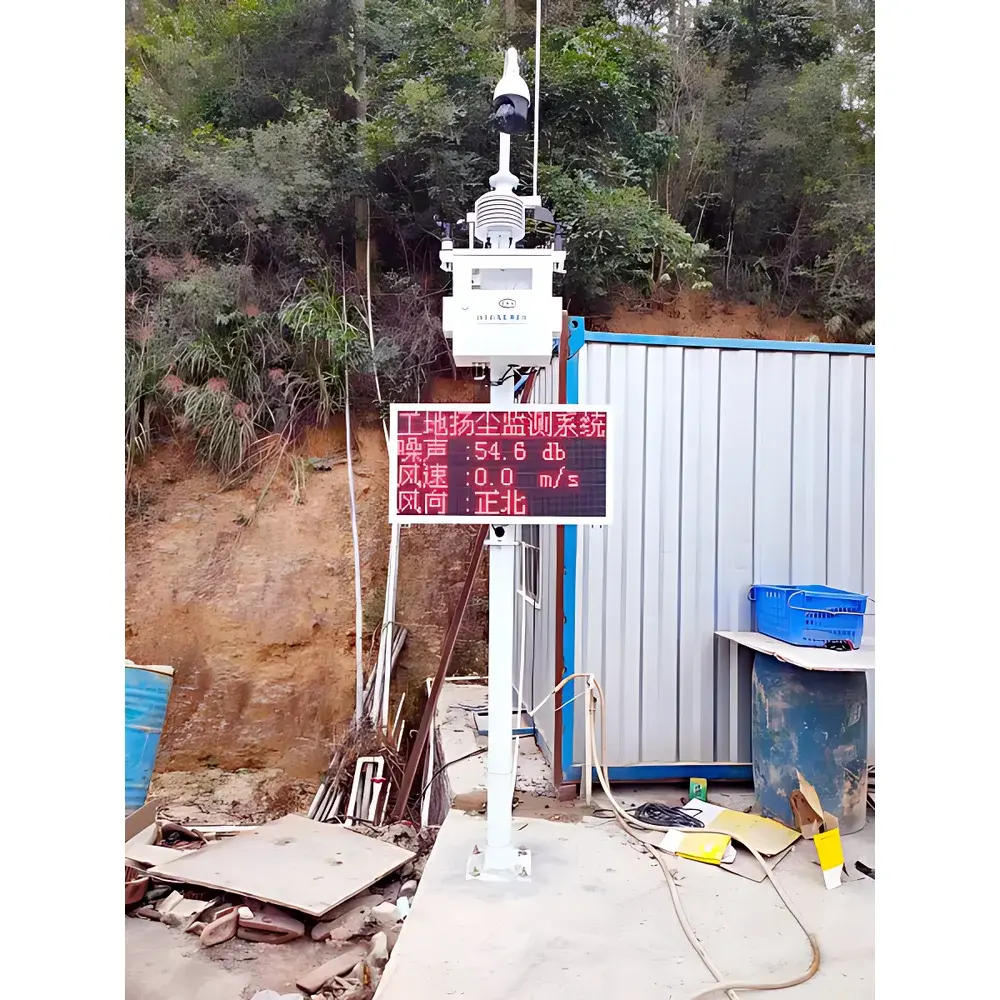
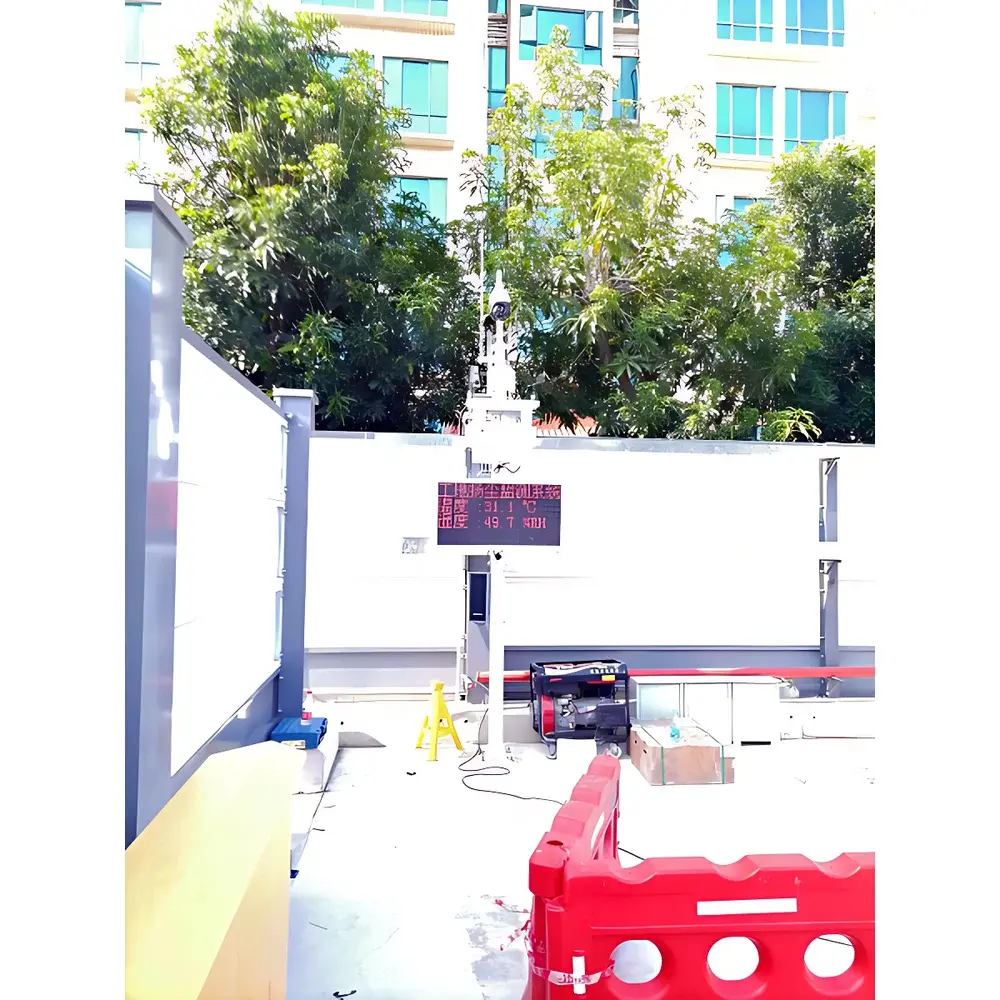
OSEN-6C-05 Integrated Construction Site Dust & Noise Real-Time Monitoring System
| Brand | OSEN |
|---|---|
| Origin | Guangdong, China |
| Model | OSEN-6C-05 |
| Instrument Type | Online Continuous Monitoring System |
| Measurement Principle | Optical Light Scattering (Nephelometry) |
| Measured Parameter | TSP (Total Suspended Particulates) |
| Sampling Method | Pump-aspirated |
| Measurement Range | 0–50 mg/m³ |
| Detection Limit | 0.01 mg/m³ |
| Compliance Certifications | CCEP (China Environmental Protection Product Certification), CPA (Metrological Type Approval by Provincial Institute of Metrology) |
| Mounting Height | 3 m pole |
| Optional Add-ons | Meteorological 5-parameter module (wind speed/direction, temperature, humidity, atmospheric pressure), noise sensor (Leq, Lmax, Lmin), GPS positioning, real-time clock with BeiDou time synchronization, LED information display unit |
Overview
The OSEN-6C-05 Integrated Construction Site Dust & Noise Real-Time Monitoring System is an industrial-grade, fixed-position environmental monitoring solution engineered for continuous, unattended operation at construction sites, demolition zones, material stockpiles, and urban roadworks. It employs optical light scattering (nephelometry) — a standardized physical principle widely adopted in regulatory-grade particulate monitoring — to quantify total suspended particulates (TSP) in ambient air. The system operates on a pump-aspirated sampling architecture, ensuring representative airflow through the sensing chamber under controlled volumetric flow conditions. Designed for compliance with Chinese environmental monitoring protocols (e.g., HJ 618-2011, HJ 93-2013), it delivers traceable, repeatable concentration data aligned with national reference methodologies. Its 3-meter mast-mounted configuration — with inlet height adjustable between 2.0 and 4.0 meters above ground level and a maximum sampling line length of 2.5 meters — conforms to field deployment guidelines for urban particulate monitoring, minimizing boundary layer interference and inlet aspiration bias.
Key Features
- Modular, multi-parameter integration: Core TSP measurement is expandable with optional meteorological sensors (wind speed/direction, temperature, relative humidity, atmospheric pressure), Class 2 sound level meter (IEC 61672-1 compliant), and GPS positioning module with BeiDou time synchronization.
- Embedded 24/7 data acquisition: High-reliability ARM-based embedded controller performs automatic zero calibration, linearization, and temperature/humidity compensation, enabling stable long-term operation without manual intervention.
- Multi-network telemetry: Dual-mode 4G LTE cellular transmission with fallback logic ensures uninterrupted data upload to central servers; supports MQTT, HTTP(S), and TCP/IP protocols for secure, low-latency communication.
- Field-serviceable mechanical design: Tool-free sensor module replacement, quick-release mounting brackets, and IP65-rated enclosure facilitate rapid site redeployment and routine maintenance under harsh outdoor conditions.
- Regulatory-grade validation: Certified under China’s Environmental Protection Product Certification (CCEP) and Metrological Type Approval (CPA) frameworks — both issued by authorized national institutions — confirming metrological traceability and functional conformity.
Sample Compatibility & Compliance
The OSEN-6C-05 is validated for ambient air sampling in non-explosive, non-corrosive environments typical of civil infrastructure projects. It meets structural and operational requirements specified in HJ 93-2013 (Technical Specification for Particulate Matter Samplers) and HJ 653-2013 (Environmental Air Quality Monitoring Technical Specifications). While not certified to international standards such as ISO 12103-1 or EN 12341, its nephelometric detection principle aligns with the physical basis of ISO 20679 (Respirable dust — Determination of mass concentration using light scattering instruments). The system supports audit-ready data logging with timestamped metadata (including GPS coordinates, instrument status flags, and calibration event logs), facilitating GLP-aligned recordkeeping for municipal environmental oversight agencies.
Software & Data Management
Data are ingested into a cloud-hosted platform supporting role-based access control (RBAC), time-series visualization, statistical aggregation (hourly/daily/weekly averages, percentiles, exceedance counts), and configurable threshold alerts (email/SMS/web push). All data transmissions comply with TLS 1.2+ encryption; local edge storage retains 30 days of raw sensor readings onboard in case of network interruption. The backend architecture supports CSV/JSON export, RESTful API integration with municipal environmental information systems (EIS), and optional 21 CFR Part 11-compliant audit trail modules for regulated reporting workflows.
Applications
- Real-time compliance monitoring for construction project environmental impact assessments (EIA) under China’s Environmental Protection Law and local “Dust Control Regulations” (e.g., Beijing Municipal Regulation No. 291).
- Dynamic source attribution during excavation, loading/unloading, and earthmoving operations via synchronized video overlay (optional RTSP stream integration) and geotagged concentration heatmaps.
- Long-term trend analysis for municipal air quality management departments assessing spatial-temporal patterns of fugitive dust emissions across urban development corridors.
- Supporting third-party environmental supervision services performing periodic verification audits against contractual dust suppression KPIs.
FAQ
Does the OSEN-6C-05 support PM₂.₅ and PM₁₀ measurement?
Yes — while the base model measures TSP via light scattering, optional optical particle counters (OPCs) calibrated per ISO 21501-4 can be integrated to report PM₂.₅ and PM₁₀ mass concentrations concurrently.
Is remote firmware update capability available?
Yes — over-the-air (OTA) firmware updates are supported via authenticated HTTPS POST requests, with rollback functionality and version-controlled release management.
What power supply options does the system accept?
Standard configuration includes 220 VAC ±10%, 50 Hz input with integrated surge protection; solar-battery hybrid power kits (12 VDC nominal, 50 Ah LiFePO₄) are available as optional accessories for off-grid deployment.
Can historical data be exported in machine-readable formats?
Yes — the platform provides automated daily exports in CSV and JSON formats, including raw sensor values, derived metrics, metadata headers, and QC flags, compatible with Python/Pandas, MATLAB, and SQL-based analytics pipelines.
Related Products







