
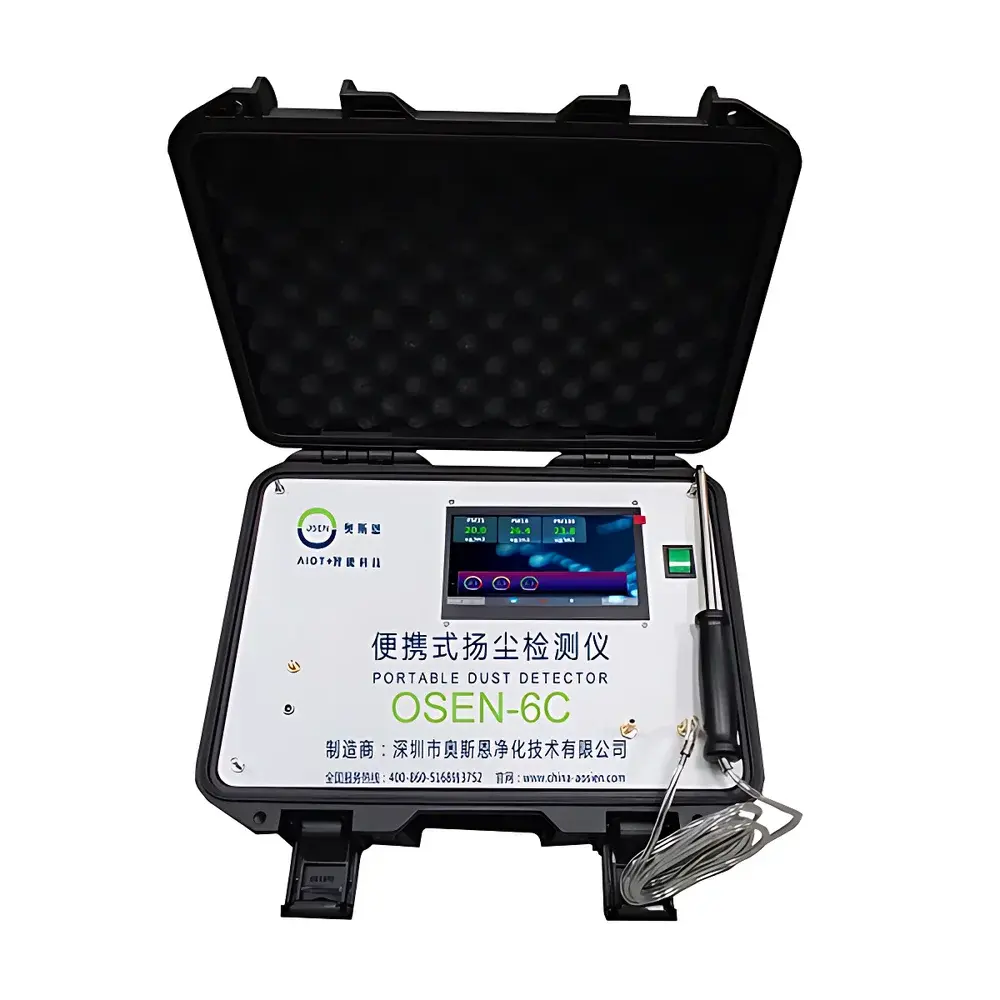
OSEN-6C-16 Portable Ambient Air Quality & TSP/PM2.5/PM10 Dust Monitoring Instrument
| Brand | OSEN |
|---|---|
| Origin | Guangdong, China |
| Manufacturer Type | Authorized Distributor |
| Country of Manufacture | China |
| Model | OSEN-6C-16 |
| Detection Targets | Particulate Matter (PM₂.₅, PM₁₀) |
| Response Time | ≤30 s |
| Power Supply | Integrated Rechargeable Lithium Battery |
| Display | TFT LCD Touchscreen Interface |
| Data Storage | Onboard High-Capacity Flash Memory |
| Connectivity | GPRS Module for Real-Time Telemetry |
| Positioning | Dual-Mode GPS + BeiDou GNSS Receiver |
| Environmental Rating | IP54 (Dust-Resistant, Splash-Protected) |
| Compliance | Meets GB/T 31947–2015 (Chinese National Standard for Portable PM Monitors), Supports ISO 12103-1 Reference Dust Calibration Protocols |
Overview
The OSEN-6C-16 is a field-deployable, battery-powered ambient particulate matter monitor engineered for rapid, on-site assessment of airborne dust concentrations in dynamic environmental and industrial settings. It operates on the principle of laser scattering photometry—where an integrated diode laser beam interacts with suspended particles in a controlled sampling chamber, and the intensity and angular distribution of scattered light are converted into mass concentration values for PM₂.₅ and PM₁₀ using Mie theory-based algorithms calibrated against gravimetric reference methods. Designed specifically for transient monitoring scenarios—including construction site compliance verification, road resuspension studies, stockpile emissions screening, and emergency response deployments—the instrument delivers real-time, traceable measurements without requiring fixed infrastructure or external power sources. Its compact form factor (285 × 120 × 85 mm), ergonomic hand-held sampling probe, and dual GNSS positioning capability enable seamless mobility across heterogeneous terrain while maintaining measurement continuity and geospatial context.
Key Features
- Laser scattering optical module with factory-calibrated sensitivity to PM₂.₅ and PM₁₀, validated per ISO 29463-3:2011 filter test protocols and aligned with GB/T 31947–2015 performance criteria.
- Integrated rechargeable lithium-ion battery providing ≥8 hours of continuous operation under typical field conditions; supports hot-swap charging via USB-C port without interrupting data acquisition.
- TFT LCD touchscreen interface with full Chinese GUI and configurable display modes—real-time concentration curves, peak-hold values, time-weighted averages (TWA), and scrolling historical trends (up to 30 days stored locally).
- Optional heated inlet system (operating range: 0–60 °C, RH <95% non-condensing) mitigates hygroscopic bias in high-humidity environments by maintaining sample air at dew-point-suppressed temperature prior to optical detection.
- GPRS-enabled telemetry module compliant with TCP/IP stack standards; supports configurable upload intervals (1 min to 24 h), automatic reconnection after signal loss, and secure TLS 1.2 encrypted data transmission to cloud platforms or local SCADA systems.
- Dual-mode satellite positioning (GPS L1 + BeiDou B1I) delivering sub-5 m CEP accuracy; enables geotagged data logging, route-based emission profiling, and GIS-integrated reporting for regulatory documentation.
Sample Compatibility & Compliance
The OSEN-6C-16 is optimized for ambient air sampling in non-explosive, non-corrosive atmospheres with particulate loadings ranging from background levels (<10 µg/m³) up to occupational ceiling limits (e.g., 150 µg/m³ for PM₁₀ per OSHA PEL). It accepts standard 4–20 mA analog outputs and Modbus RTU over RS-485 for integration into third-party environmental management systems. While not certified for Class I Div 1 hazardous locations, its IP54 ingress protection rating ensures reliable operation in outdoor industrial zones subject to dust ingress and incidental water exposure. The device conforms to electromagnetic compatibility requirements outlined in EN 61326-1:2013 and meets the metrological traceability framework specified in JJF 1600–2016 (Calibration Specification for Portable Dust Monitors). All firmware updates undergo version-controlled validation and include audit logs compliant with GLP data integrity principles.
Software & Data Management
Data collected by the OSEN-6C-16 is stored internally in a timestamped binary format with embedded metadata (GPS coordinates, battery voltage, sensor status flags, ambient temperature/humidity if optional sensors are installed). A dedicated Windows-based desktop utility (OSEN DataLink v3.2) enables encrypted export to CSV, Excel, or SQLite formats, with built-in tools for gap-filling interpolation, outlier flagging based on IQR thresholds, and batch generation of summary reports aligned with EPA Method 201A and EU Directive 2008/50/EC Annex IX reporting templates. Cloud connectivity supports MQTT and HTTP POST endpoints compatible with AWS IoT Core, Microsoft Azure IoT Hub, and custom LORAWAN gateways via bridge configuration. Remote firmware updates are digitally signed and verified before installation, preserving cryptographic integrity throughout the device lifecycle.
Applications
- Construction site boundary monitoring per local municipal dust control ordinances (e.g., Shenzhen Municipal Regulation No. 298, Beijing Local Standard DB11/968–2022).
- Roadside fugitive dust mapping during traffic surveys and pavement condition assessments.
- Stackless source identification at material handling facilities—including coal stockyards, cement silos, and bulk terminal loading zones.
- Post-incident environmental baseline establishment following demolition, excavation, or natural disaster events.
- Mobile QA/QC verification of fixed-site monitoring networks—serving as a portable reference for cross-calibration and spatial interpolation validation.
FAQ
Is the OSEN-6C-16 suitable for indoor air quality assessments?
No—it is engineered exclusively for outdoor and semi-outdoor ambient particulate monitoring; its flow path design and calibration matrix do not account for recirculation dynamics or low-velocity indoor airflow profiles.
Does the instrument support simultaneous gas co-monitoring (e.g., NO₂, SO₂)?
Not natively; however, the modular chassis accommodates optional electrochemical sensor cartridges for targeted gaseous pollutants when ordered as a configured OEM variant (OSEN-6C-Gas).
Can raw scattering signals be accessed for algorithmic reprocessing?
Yes—via UART debug interface and documented register map; raw pulse-count histograms and photodiode voltage traces are available upon request under NDA for academic or method development use.
What is the recommended recalibration interval?
Annual field verification against NIST-traceable aerosol generators (e.g., Palas RBG 1000) is advised; internal zero checks and span adjustments can be performed biweekly using clean-air purge and certified PM reference filters.
Is the device compliant with EU CE marking requirements?
It carries CE marking under the EMC Directive 2014/30/EU and RoHS Directive 2011/65/EU; however, it does not fall under the scope of the Measuring Instruments Directive (MID) due to its non-legal metrology application classification.
Related Products







