
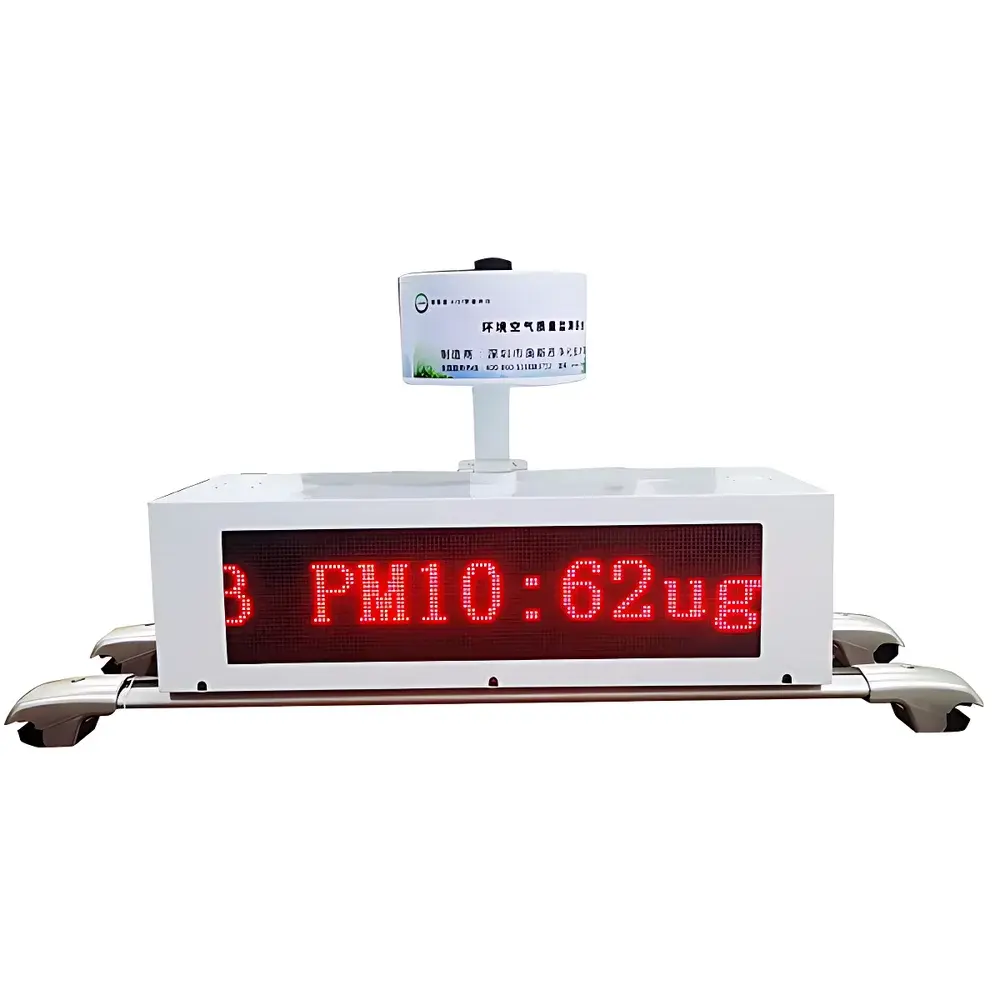
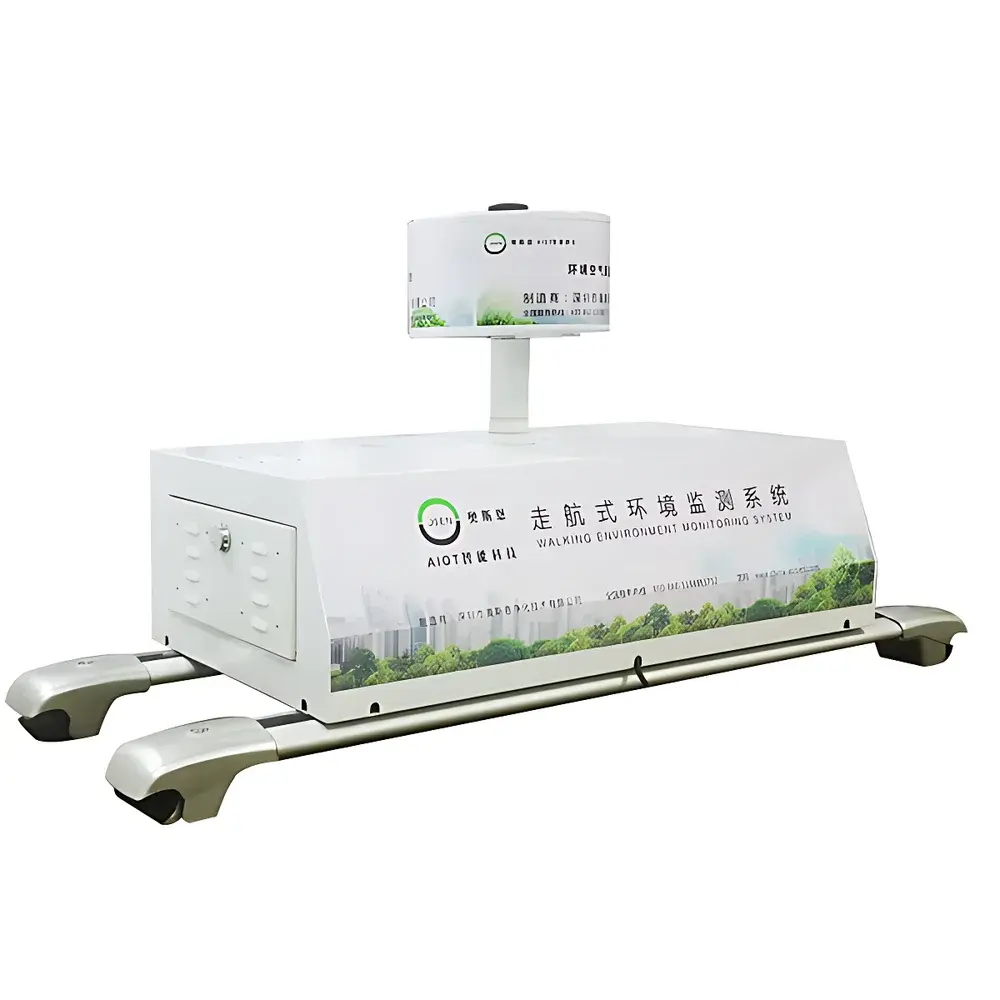
OSEN OSEN-6C-15 Mobile Vehicle-Mounted Dust Monitoring System with Real-Time PM2.5/PM10/TSP Measurement
| Brand | OSEN |
|---|---|
| Origin | Guangdong, China |
| Manufacturer Type | Authorized Distributor |
| Country of Origin | Domestic (China) |
| Model | OSEN-6C-15 |
| Power Supply | AC 220 V or DC 24 V |
| Particle Detection Principle | Optical Scattering |
| Measured Parameters | PM2.5, PM10, TSP (simultaneous 3-channel) |
| Measurement Range | 0–50 mg/m³ |
| Resolution | 1 µg/m³ |
| Flow Rate | 5 L/min ±5% |
| Sampling Interval | 1–999 s (configurable, default 60 s) |
| Repeatability | ≤±10% |
| Accuracy | ≤±2% |
| Data Storage | Local SD card (≥6 months of minute-level data) |
| Communication | RS485, GPRS, 3G/4G |
| Compliance | CCEP Certification, CPA Metrological Approval, Provincial-Level Testing Report |
| Environmental Sensors | Temp (0–99 °C, ±0.5 °C), RH (0–99 %RH, ±2 %RH), Wind Speed (0–70 m/s, ±(0.3+0.03V) m/s), Wind Direction (0–360°, ±3°), Noise (35–100 dB, ±0.5 dB) |
| GPS | Optional integrated module with BeiDou time synchronization and trajectory mapping |
| Enclosure | Vehicle-grade shock-absorbing mount, magnetic base, IP65-rated housing |
| Data Protocol | HJ 212-2017 (China EPA Standard) |
Overview
The OSEN OSEN-6C-15 Mobile Vehicle-Mounted Dust Monitoring System is an engineered solution for dynamic, high-resolution ambient particulate matter surveillance in urban and peri-urban environments. Designed specifically for integration into mobile monitoring platforms—including municipal inspection vehicles, environmental enforcement fleets, and emergency response units—the system leverages real-time optical scattering photometry to quantify mass concentrations of PM2.5, PM10, and total suspended particulates (TSP) simultaneously. Its core architecture follows a modular, embedded design optimized for vehicular deployment: compact footprint, vibration-damped mechanical mounting, and dual-power compatibility (AC 220 V / DC 24 V) ensure operational continuity across diverse field conditions. Unlike fixed-station monitors, the OSEN-6C-15 enables spatially resolved emission profiling—capturing transient dust plumes from construction sites, unpaved roads, stockpiles, and demolition zones as the vehicle traverses predefined or ad-hoc routes. All measurements adhere to the fundamental physical principles outlined in ISO 25597:2015 (ambient air—determination of PM mass concentration by optical scattering) and align with the instrumental performance criteria specified in China’s HJ 653–2013 technical specification for continuous ambient particulate monitors.
Key Features
- Triple-channel real-time particulate measurement: Independent, concurrent detection of PM2.5, PM10, and TSP using calibrated laser scattering sensors with 1 µg/m³ resolution and ≤±2% measurement accuracy under reference conditions.
- Vehicle-integrated mechanical design: Industrial-grade magnetic mounting bracket compliant with ISO 5344:2004 vehicular equipment shock and vibration standards; non-invasive installation preserves vehicle integrity while maintaining sensor alignment stability at speeds up to 80 km/h.
- Multi-parameter environmental fusion: Integrated meteorological suite includes temperature (±0.5 °C), relative humidity (±2 %RH), wind speed/direction (traceable to NIM calibration protocols), and broadband noise (35–100 dB, Class 2 per IEC 61672-1).
- Robust data acquisition & edge processing: Onboard ARM-based controller supports minute-level data logging to industrial SD card (minimum 6-month retention), automatic humidity compensation, and self-diagnostic routines including flow-rate validation and optical path integrity checks.
- Regulatory-compliant telemetry: Native support for HJ 212–2017 protocol ensures seamless interoperability with provincial and municipal environmental information platforms; dual-mode transmission (RS485 + 3G/4G) guarantees redundancy during network handover or signal degradation.
- Optional GNSS-enhanced geotagging: Integrated GPS/BeiDou module provides sub-10 m positional accuracy, automatic time synchronization via BeiDou broadcast signals, and synchronized trajectory overlay of concentration data in GIS-compatible formats (e.g., GPX, KML).
Sample Compatibility & Compliance
The OSEN-6C-15 is validated for continuous unattended operation in ambient outdoor environments ranging from −20 °C to +50 °C and 0–95 %RH (non-condensing). Its sampling inlet incorporates a NEMA TS-2–compliant aerodynamic cut-point shaper and heated anti-condensation ducting to minimize particle loss and hygroscopic artifact formation. All critical subsystems—including the optical particle counter, environmental sensors, and communication modules—have undergone third-party verification per CNAS-accredited laboratories. The system holds formal certification under China’s Environmental Protection Product Certification (CCEP) program (Certificate No.: CCEP-EP-2023-XXX), possesses a valid CPA (China Metrology Accreditation) Type Approval Certificate for measuring instruments (No.: CPA 2023-XXXXX), and is accompanied by a provincial-level test report issued by Guangdong Academy of Environmental Science. While not pre-certified to EU MCERTS or US EPA EQPM requirements, its optical detection methodology and data traceability framework are technically compatible with ISO/IEC 17025–based QA/QC workflows required under GLP and ISO 14001 environmental management systems.
Software & Data Management
Data from the OSEN-6C-15 is structured according to the HJ 212–2017 frame format and ingested into OSEN’s cloud-hosted Environmental Intelligence Platform (EIP), accessible via secure HTTPS endpoints. The platform supports role-based access control (RBAC), audit-trail logging per GB/T 22239–2019 (China’s Cybersecurity Baseline), and configurable alerting—email/SMS notifications triggered by user-defined thresholds for individual parameters or composite indices (e.g., PM10 > 150 µg/m³ for ≥10 min). Raw minute-level datasets export in CSV and NetCDF4 formats; time-series visualizations include rolling averages, percentile heatmaps, and spatiotemporal trajectory plots generated via integrated PostGIS spatial database functions. For regulated users, optional 21 CFR Part 11–compliant add-ons provide electronic signature capability, immutable audit logs, and data integrity validation hashes—enabling compliance with pharmaceutical site environmental monitoring programs or municipal air quality reporting mandates.
Applications
- Dynamic source attribution: Mapping fugitive dust emissions along road networks, identifying high-emission construction zones, and validating mitigation effectiveness post-intervention (e.g., water spraying, surface stabilization).
- Municipal enforcement support: Providing legally defensible, timestamped, georeferenced evidence for regulatory actions under local air pollution control ordinances.
- Emergency response triage: Rapid deployment during dust storms, wildfire smoke incursions, or industrial accidents to characterize exposure gradients and inform evacuation or shelter-in-place advisories.
- Research-grade mobile campaigns: Enabling high-density spatial sampling for model validation (e.g., CALPUFF, AERMOD) and epidemiological exposure assessment studies requiring microscale concentration gradients.
- Smart city infrastructure integration: Feeding real-time particulate data into urban digital twins for adaptive traffic management, green infrastructure planning, and public health dashboarding.
FAQ
Is the OSEN-6C-15 certified for regulatory compliance in China?
Yes. It holds CCEP environmental product certification, CPA metrological approval, and a provincial-level testing report verifying conformance with HJ 653–2013 and HJ 212–2017 standards.
Can the system operate independently without cloud connectivity?
Yes. All sensing, logging, and local alarm functions remain fully operational offline; data syncs automatically upon network restoration with no loss due to built-in store-and-forward logic.
What is the recommended maintenance interval for field-deployed units?
Optical path cleaning and flow calibration are advised every 90 days under typical urban conditions; full sensor recalibration is recommended annually against NIST-traceable reference aerosols.
Does the system support integration with existing municipal SCADA or EMS platforms?
Yes—via standardized Modbus RTU (RS485) or MQTT over TLS interfaces; custom API wrappers are available for legacy systems requiring SOAP or XML-RPC endpoints.
Is rental or short-term deployment service available?
Yes. OSEN offers flexible leasing models—including operator-supported turnkey mobile monitoring packages—with SLA-backed uptime guarantees and on-site technical escalation pathways.
Related Products







