
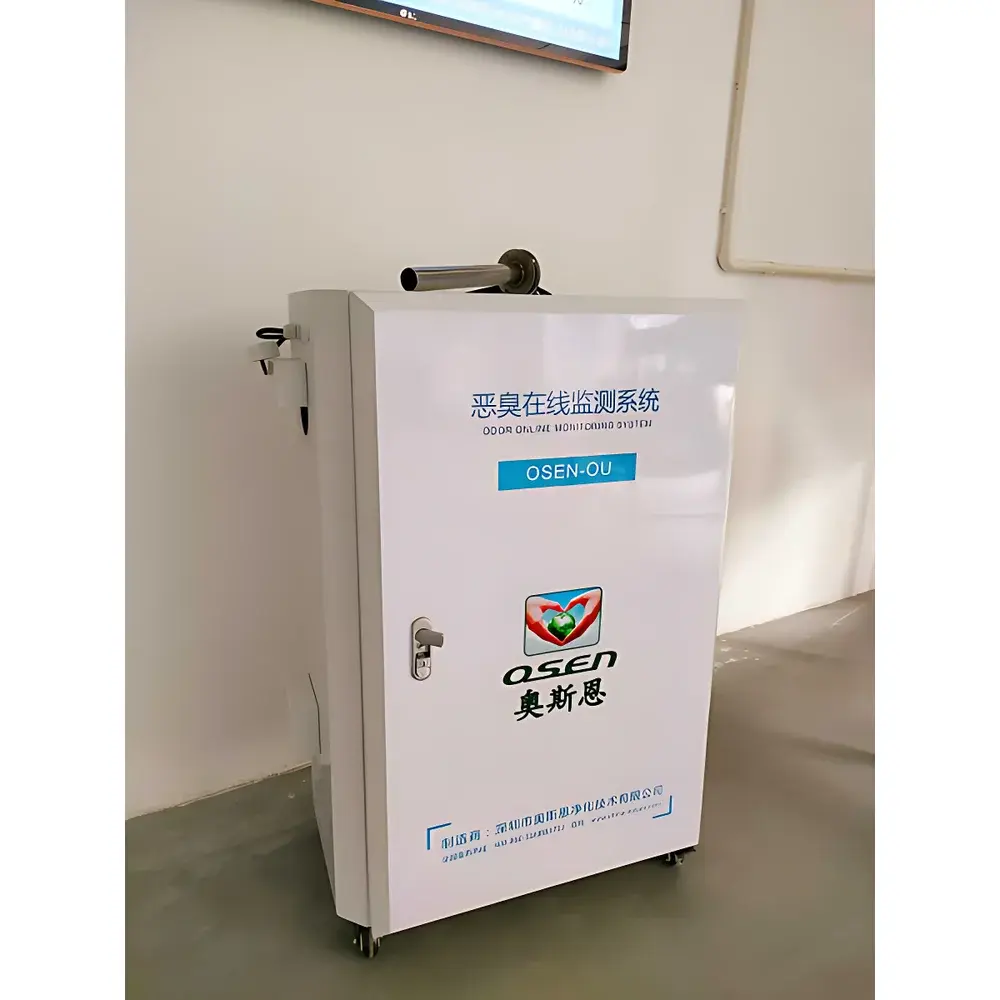
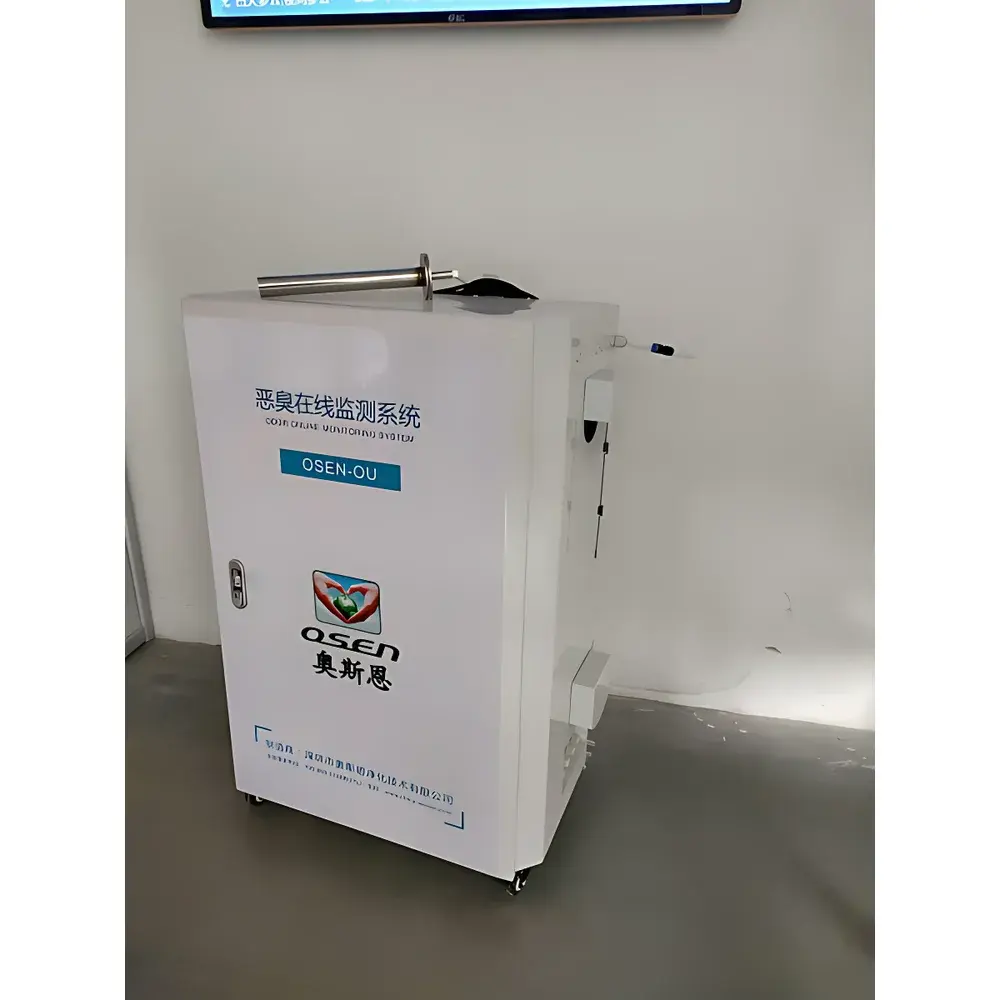
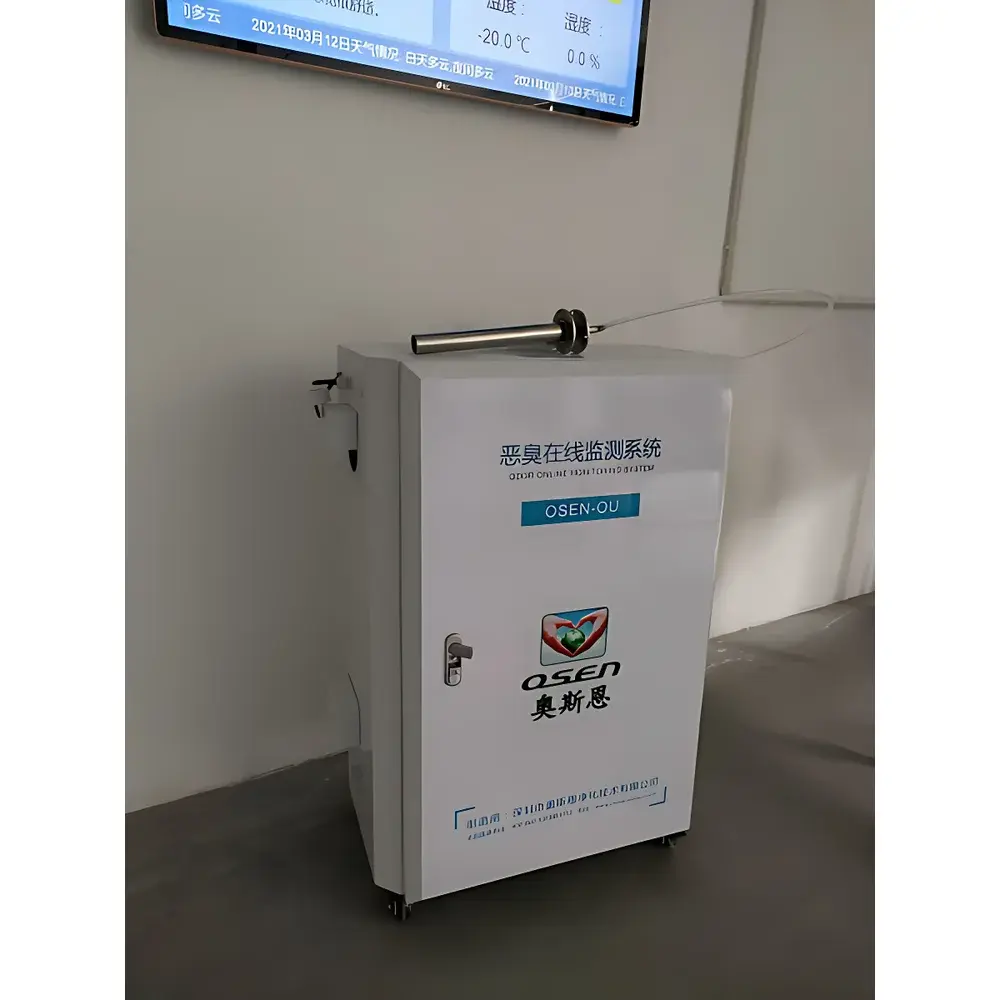
OSEN OSEN-OU-09 Real-Time Odor Emission Monitoring System for Industrial Sources
| Brand | OSEN |
|---|---|
| Origin | Guangdong, China |
| Manufacturer Type | Authorized Distributor |
| Regional Classification | Domestic (China) |
| Model | OSEN-OU-09 |
| Instrument Type | Online Gas Monitoring System |
| Price | USD 5,600 (approx. ex-works) |
| Sensor Technology | Electrochemical & Metal Oxide Semiconductor (MOS) with ppb-level detection limit |
| Pre-treatment | Three-stage (condensation, particulate filtration, desiccation) |
| Communication | GPRS + RS485 + Ethernet |
| Display | Integrated LCD touchscreen (Chinese UI) |
| Power Backup | Built-in UPS support |
| Data Integrity | Offline storage & auto-resume transmission upon network recovery |
| Calibration | Cloud-based automatic zero/span correction |
| Compliance | Designed to support compliance with HJ 1227–2021 (China), EN 13725:2003 (odor concentration), and ISO 16000-28:2012 (indoor air – odor assessment) |
Overview
The OSEN OSEN-OU-09 Real-Time Odor Emission Monitoring System is an industrial-grade, fixed-position online gas monitoring platform engineered specifically for continuous, unattended measurement of odor-causing compounds at regulated emission sources. It operates on a multi-sensor fusion architecture combining high-selectivity electrochemical sensors and temperature-stabilized metal oxide semiconductor (MOS) elements, enabling simultaneous quantification of key odorants including ammonia (NH₃), hydrogen sulfide (H₂S), methyl mercaptan (CH₃SH), trimethylamine (C₃H₉N), and total reduced sulfur (TRS) analogs. Unlike ambient odor screening systems, the OSEN-OU-09 is designed for direct integration into exhaust ducts, stack outlets, and process vent lines—where gas matrices exhibit elevated temperature, humidity, particulate load, and chemical aggressiveness. Its core measurement principle relies on calibrated sensor response curves validated against reference gas standards traceable to NIM (National Institute of Metrology, China), ensuring metrological integrity in regulatory reporting contexts.
Key Features
- Dedicated duct-mount sampling probe with Teflon-lined stainless-steel body (316L), rated for continuous operation up to 120 °C and 0.5 MPa pressure, resistant to H₂S, Cl₂, NH₃, and organic acid vapors.
- Three-stage sample conditioning system: thermoelectric condenser (dew point controlled to 5 °C), sintered stainless-steel particulate filter (≥0.3 µm efficiency), and Nafion™ membrane dryer—minimizing water vapor interference and sensor poisoning.
- ppb-level detection capability for NH₃ (LOD: 0.5 ppb) and H₂S (LOD: 0.2 ppb) under dynamic flow conditions (0.5–2.0 L/min); response time (T90) < 60 s across full scale.
- Embedded data acquisition unit featuring dual-core ARM Cortex-A7 processor, real-time OS, and proprietary compensation algorithms for cross-sensitivity correction (e.g., humidity, VOC interference).
- Local HMI via 7-inch capacitive LCD touchscreen with full Chinese GUI; supports historical trend visualization (7-day local storage), alarm threshold configuration, and manual zero calibration override.
- GPRS/4G LTE + RS485 + 10/100BASE-TX Ethernet redundancy ensures >99.5% data upload success rate; onboard 2 GB flash memory enables 30 days of gapless logging during comms outages.
Sample Compatibility & Compliance
The OSEN-OU-09 is validated for use with heterogeneous industrial effluents containing suspended solids ≤10 mg/m³, relative humidity 10–95% RH (non-condensing), and particulate concentrations compliant with ISO 8573-1 Class 4. It meets mechanical and electrical safety requirements per GB/T 18268.1–2010 (IEC 61326-1) and electromagnetic compatibility (EMC) per GB/T 17626 series. While not certified to UL/CE for hazardous area installation (Class I Div 1), it is routinely deployed in Zone 2/22 classified environments when installed with appropriate barrier systems. The system architecture supports audit-ready data handling per China’s HJ 212–2017 communication protocol and aligns with functional requirements of HJ 1227–2021 for odor source monitoring. Raw sensor outputs are timestamped with millisecond precision and retain full traceability for GLP-aligned QA/QC workflows.
Software & Data Management
Data from the OSEN-OU-09 is transmitted via encrypted MQTT or HTTP(S) to cloud-hosted platforms (e.g., OSEN Cloud, third-party SCADA, or municipal environmental monitoring centers). The embedded firmware implements secure TLS 1.2 handshake, device authentication via X.509 certificates, and write-protected local database (SQLite3) with SHA-256 hashing of all records. Cloud-based calibration management enables remote zero/span verification using certified permeation tubes or dynamic dilution standards, with drift logs automatically appended to each data packet. All modifications—threshold changes, calibration events, or firmware updates—are logged with user ID, timestamp, and IP origin. Audit trails comply with basic 21 CFR Part 11 principles (electronic signature equivalence, record retention ≥5 years), though formal validation documentation must be generated per site-specific IQ/OQ protocols.
Applications
- Continuous compliance monitoring at regulated point sources: wastewater treatment plant headworks and sludge dewatering lines, chemical reactor vent stacks, livestock manure handling facilities, and pharmaceutical fermentation off-gas streams.
- Odor impact assessment for permit renewal: correlation of real-time emission data with meteorological parameters (wind speed/direction, stability class) to model downwind dispersion using AERMOD-compatible output formats.
- Process optimization feedback loop: detecting abnormal NH₃ spikes during urea hydrolysis or H₂S surges in biogas desulfurization units, triggering automated scrubber duty cycle adjustments.
- Community complaint investigation: time-synchronized correlation between fence-line measurements and citizen-reported odor events, supporting root-cause analysis and mitigation planning.
- Research applications: long-term dataset generation for developing empirical odor intensity models (e.g., linking GC-MS speciation with sensory panel data per EN 13725).
FAQ
Does the OSEN-OU-09 meet international odor standards such as EN 13725 or ASTM D6920?
It provides quantitative concentration data for individual odorants referenced in EN 13725 Annex B and ASTM D6920 Table 1; however, it does not replace dynamic olfactometry for odor concentration (ouE/m³) determination.
Can the system operate without internet connectivity for extended periods?
Yes—local data logging continues uninterrupted; all buffered records transmit automatically once network connectivity is restored, with no data loss.
Is third-party software integration supported?
Yes—open API (RESTful JSON over HTTPS) and Modbus TCP protocol support enable seamless integration with PI System, Ignition SCADA, or custom environmental dashboards.
What maintenance intervals are recommended for the pre-treatment subsystem?
Condenser heat sink cleaning every 3 months; particulate filter replacement every 6 months; Nafion™ dryer inspection annually—frequency increases proportionally with particulate loading.
Are calibration gases included with the system?
No—certified calibration standards (e.g., 10 ppm NH₃ in N₂, 5 ppm H₂S in air) must be procured separately per local metrology lab requirements.







