
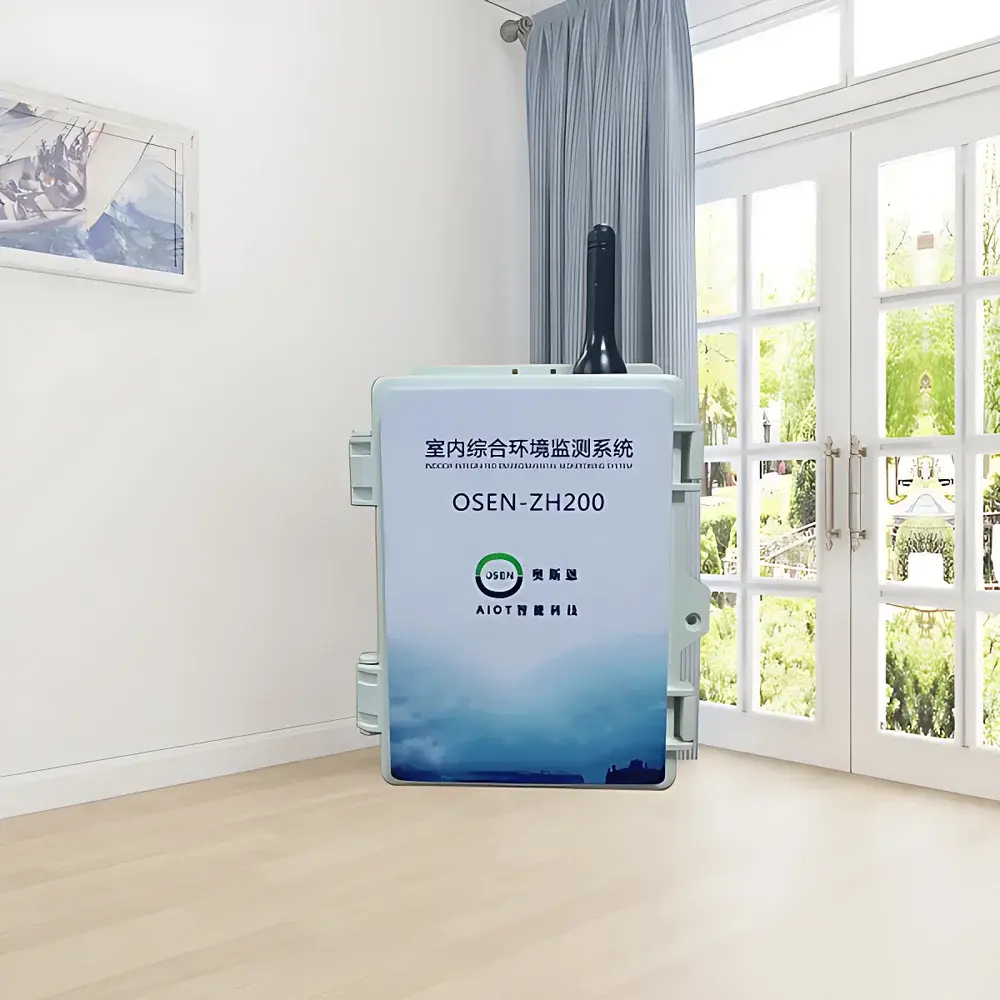
OSEN-ZH100 Indoor Multi-Parameter Environmental Monitoring Station
| Brand | OSEN |
|---|---|
| Model | OSEN-ZH100 |
| Type | Online Fixed-Station Monitor |
| Origin | Guangdong, China |
| Sensor Integration | PM2.5, PM10, SO₂, NO₂, CO, O₃ (standard) |
| Data Transmission | GPRS + Ethernet |
| Mounting | Wall-Mounted |
| Alarm Output | Visual (LED), Audible (Buzzer), Relay Control |
| Cloud Platform | Web & WeChat Access |
| Compliance | Designed for indoor IAQ monitoring per GB/T 18883–2022 and ISO 16000 series principles |
| Software Features | Remote threshold configuration, audit-log-enabled alarm history, parameter-specific hysteresis setting |
Overview
The OSEN-ZH100 Indoor Multi-Parameter Environmental Monitoring Station is an integrated, fixed-position environmental sensing platform engineered for continuous, real-time assessment of indoor air quality (IAQ) and ambient microclimate conditions. Unlike single-parameter gas detectors or standalone particulate monitors, the ZH100 employs a multi-sensor architecture grounded in standardized electrochemical (for SO₂, NO₂, CO, O₃, Cl₂, H₂S, NH₃), metal-oxide semiconductor (for VOCs), and laser scattering (for PM2.5/PM10) detection principles—each calibrated traceably to NIST-traceable reference standards. It operates under controlled indoor airflow conditions to minimize sampling bias and ensure reproducible mass concentration readings. The system is purpose-built for deployment in office buildings, schools, hospitals, cleanrooms, and public service facilities where regulatory compliance with national IAQ guidelines (e.g., China’s GB/T 18883–2022) and international frameworks (e.g., ISO 16000-22 for indoor VOC measurement) is required. Its modular design enables field-upgradable sensor configurations without hardware replacement, supporting long-term adaptability to evolving monitoring mandates.
Key Features
- Simultaneous real-time monitoring of six core parameters: PM2.5, PM10, SO₂, NO₂, CO, and O₃ — all conforming to EN 14662 and EPA EQOA reference methods for equivalent performance.
- Optional expansion modules for hazardous gases including chlorine (Cl₂), hydrogen sulfide (H₂S), ammonia (NH₃), and total volatile organic compounds (TVOC), each with factory-calibrated zero/span stability verified over 90-day intervals.
- Dual-mode communication: GPRS cellular transmission for remote sites + 10/100 Mbps Ethernet interface for LAN integration; supports MQTT v3.1.1 and HTTP RESTful API for third-party SCADA or BMS interoperability.
- Programmable alarm logic engine: Independent upper/lower thresholds per parameter with user-defined hysteresis (deadband) to prevent nuisance triggering; visual (high-intensity LED strobe) and audible (85 dB @ 1 m) alerts activated within ≤2 seconds of threshold breach.
- Relay output interface (NO/NC) for direct control of HVAC dampers, air purifiers, or exhaust fans—enabling closed-loop mitigation response per preconfigured IAQ action plans.
- Wall-mount enclosure (IP54-rated) with internal temperature/humidity compensation circuitry; operating range: 0–45°C, 15–90% RH non-condensing.
Sample Compatibility & Compliance
The OSEN-ZH100 is validated for use in non-explosive, non-corrosive indoor environments with typical ventilation rates (0.5–2 ACH). It does not require sample conditioning (e.g., drying or filtration) for standard office or classroom applications but includes optional heated inlet kits for high-humidity zones. All gas sensors meet IEC 60079-29-1 requirements for functional safety in non-hazardous locations. While not certified for occupational exposure limit (OEL) enforcement per OSHA or ACGIH protocols, its measurement uncertainty (k=2) aligns with ISO 17025-accredited laboratories’ routine QA/QC benchmarks for screening-level IAQ verification. Data logging complies with GLP-aligned metadata tagging (timestamp, sensor ID, calibration status, battery voltage).
Software & Data Management
Data is transmitted to the OSEN Cloud Platform—a secure, ISO/IEC 27001-aligned infrastructure supporting role-based access control (RBAC), encrypted TLS 1.2+ transport, and immutable audit trails. Users access real-time dashboards and historical trends via responsive web interface or WeChat Mini Program using shared account credentials. The platform stores raw sensor outputs at 1-minute resolution for ≥180 days and supports CSV/Excel export with ISO 8601 timestamps. Alarm events are timestamped with pre- and post-trigger snapshots (±30 sec), and all threshold modifications are logged with operator ID and UTC timestamp—meeting foundational requirements for FDA 21 CFR Part 11 electronic record integrity (audit trail, electronic signature readiness).
Applications
- Continuous IAQ surveillance in LEED-certified commercial buildings and green schools to verify ventilation efficacy and pollutant removal rates.
- Baseline monitoring prior to and during renovation activities involving adhesives, coatings, or composite materials (VOCs tracking).
- Occupational health support in laboratories or maintenance rooms where intermittent release of Cl₂, NH₃, or H₂S may occur.
- Integration into smart building management systems (BMS) for demand-controlled ventilation (DCV) logic based on real-time CO₂-equivalent and PM load signals.
- Public health surveillance in community health centers and elderly care facilities where respiratory vulnerability necessitates proactive air quality intervention.
FAQ
Can the OSEN-ZH100 be used for outdoor ambient air monitoring?
No — it is engineered exclusively for indoor environments with stable thermal and humidity profiles. Outdoor deployment requires weatherproof enclosures, radiation shields, and inlet heating not included in the base configuration.
Is factory calibration traceable to national metrology institutes?
Yes — all gas and particulate sensors undergo end-of-line calibration using NIST-traceable standard gases and aerosol generators; calibration certificates are provided with each unit.
Does the system support Modbus RTU or BACnet MS/TP protocols?
Not natively; however, protocol translation gateways (e.g., Modbus TCP-to-MQTT bridges) can be deployed between the ZH100’s Ethernet port and legacy BMS networks.
What is the recommended recalibration interval?
Every 6 months for gas sensors under normal indoor conditions; PM sensor optical path cleaning is advised quarterly. Field verification with portable reference instruments is recommended before critical compliance reporting.
Can historical data be exported in a format compatible with statistical analysis software?
Yes — time-series data exports as UTF-8 CSV with header metadata, directly importable into MATLAB, Python (pandas), or R for regression modeling, trend decomposition, or anomaly detection workflows.







