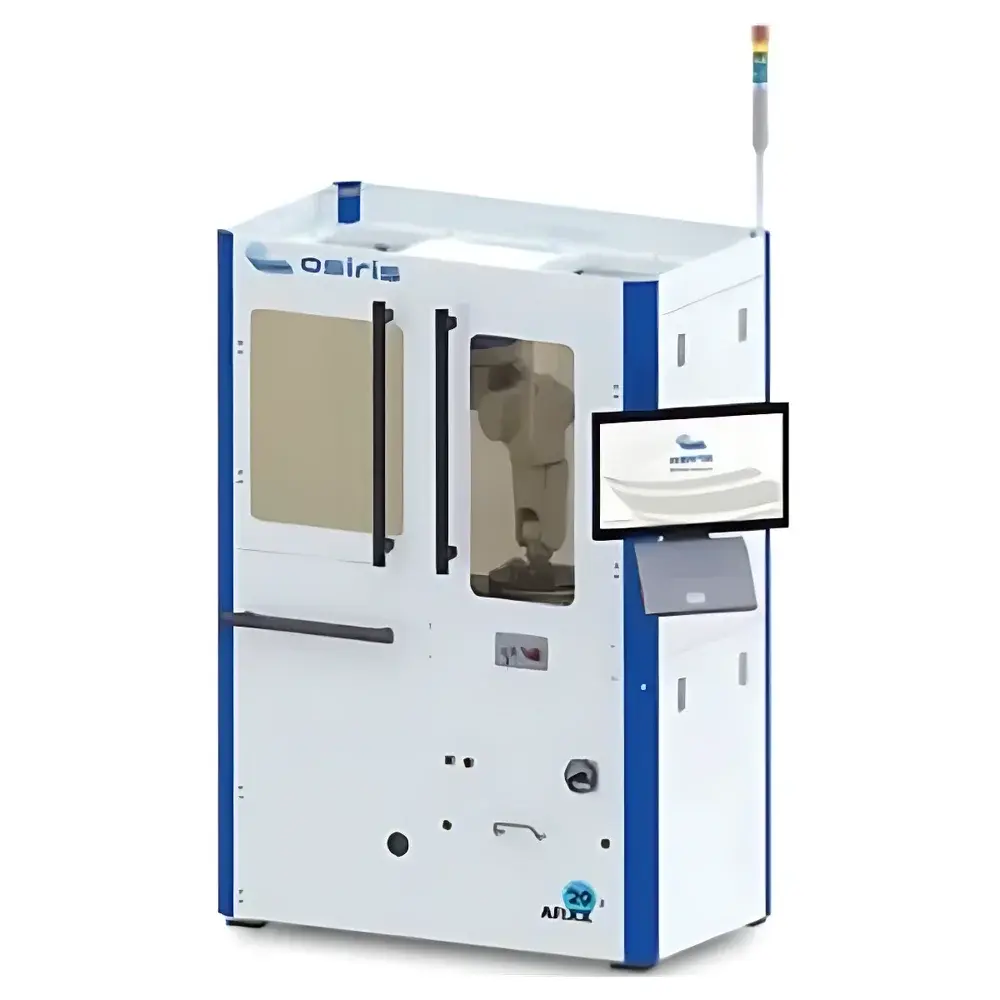
Osiris AFIXX 30s Semi-Automatic Temporary Wafer Bonding System
| Brand | Osiris |
|---|---|
| Origin | Germany |
| Model | AFIXX 30s |
| Maximum Wafer Size | 200 mm |
| Temperature Range | Up to 650 °C (Independent Top/Bottom Plate Control) |
| Bonding Processes Supported | Thermal Compression, Adhesive Bonding, Glass Frit Bonding, Anodic Bonding, Eutectic Bonding, Direct Si–Si Bonding, SOI Bonding |
| Compatibility | Silicon, Compound Semiconductors (GaAs, SiC, GaN), Glass, Quartz, and SOI Wafers |
| System Architecture | Modular Bonding Chamber with In-Situ Alignment & Activation |
| Nanopatterning Capability | Integrated Nanoimprint Functionality |
| Compliance | Designed for GLP/GMP-aligned R&D and low-volume production environments |
| Operating Interface | Windows 10-based GUI with 22" Touchscreen HMI |
| Safety | Transparent Viewport Door for Real-Time Process Monitoring |
Overview
The Osiris AFIXX 30s is a semi-automatic temporary wafer bonding system engineered for precision alignment, surface activation, and thermally driven bonding in semiconductor R&D and pilot-line fabrication. Built upon a robust mechanical architecture and calibrated thermal-pressure control platform, the AFIXX 30s implements in-situ optical alignment—enabling sub-micron overlay accuracy between carrier and device wafers—followed by controlled surface activation (e.g., plasma or thermal treatment) and final bond formation under programmable temperature and force profiles. Its design integrates key functionalities required for temporary bonding applications: carrier wafer lamination prior to backside processing (e.g., CMP, grinding, thinning, etching), followed by debonding after device layer completion. Unlike fully manual systems, the AFIXX 30s automates all process-critical steps—including alignment verification, vacuum chamber evacuation, heating ramping, pressure application, dwell time execution, and cooldown sequencing—while retaining manual wafer loading/unloading for operational flexibility.
Key Features
- In-situ optical alignment system with real-time image capture and overlay metrology, supporting both global and local alignment strategies on 150 mm and 200 mm wafers.
- Independent dual-zone heating plates (top and bottom) with PID-controlled thermal uniformity ≤ ±1.5 °C across 200 mm diameter, enabling precise thermal budget management for sensitive devices.
- Modular bonding chamber compatible with multiple bonding chemistries: adhesive films (e.g., BCB, polyimide), glass frit pastes, and direct oxide fusion—all without hardware modification.
- Integrated nanoimprint module allowing pattern transfer during bonding, supporting hybrid processes such as imprint-assisted temporary bonding for high-aspect-ratio MEMS release.
- Full process automation from alignment through bond consolidation; only wafer loading/unloading requires operator intervention.
- Transparent quartz viewport door with integrated LED illumination for visual inspection and safety-compliant process observation.
- Windows 10-based human-machine interface with 22-inch capacitive touchscreen, supporting recipe-driven operation, parameter logging, and event-triggered data export.
Sample Compatibility & Compliance
The AFIXX 30s accommodates standard semiconductor substrates including silicon (100, 111), SOI, fused silica, borosilicate glass (e.g., Pyrex 7740), quartz, and compound semiconductors such as GaAs, SiC, and GaN. It supports wafer thicknesses from 50 µm to 1,000 µm and is qualified for use with temporary bonding adhesives compliant with SEMI standards for outgassing (SEMI F57) and residue-free debonding. The system’s control architecture meets foundational requirements for audit-ready environments: full parameter traceability, user access levels (admin/operator), electronic signature support, and timestamped log files—facilitating alignment with ISO 9001 quality management frameworks and preliminary assessments toward FDA 21 CFR Part 11 compliance when deployed in regulated development workflows.
Software & Data Management
Control software provides a hierarchical recipe structure: process templates (e.g., “BCB Lamination”, “Glass Frit Seal”), stage-specific parameter sets (alignment offset, vacuum setpoint, ramp rate, hold time), and calibration-aware actuator mapping. All executed runs generate structured CSV logs containing thermal profiles, pressure curves, vacuum decay rates, and alignment error metrics. Data export supports integration with MES platforms via OPC UA or FTP protocols. Optional software modules include statistical process monitoring (SPC) dashboards and cross-chamber recipe synchronization—ensuring consistency when scaling from AFIXX 30s to higher-throughput Osiris AFIXX 60 or AFIXX 100 platforms.
Applications
The AFIXX 30s serves critical functions across advanced packaging and microfabrication domains: temporary bonding for TSV (through-silicon via) wafer thinning and backside metallization; carrier-supported processing of fragile ultra-thin (< 50 µm) MEMS dies; wafer-level encapsulation of microfluidic channels using glass frit seals; SOI handle wafer bonding in Smart Cut™-derived processes; and hybrid nanoimprint-temporary bonding for nanoscale feature preservation during mechanical stress. It is widely adopted in university cleanrooms, IDMs’ process development labs, and OSAT facilities engaged in heterogeneous integration prototyping.
FAQ
What wafer sizes does the AFIXX 30s support?
Standard configuration supports 150 mm and 200 mm wafers; optional adaptors enable down-to-100 mm substrate handling.
Is the system capable of anodic bonding?
Yes—the AFIXX 30s includes high-voltage electrode integration and vacuum-compatible electrode carriers suitable for anodic bonding of silicon-glass stacks.
Can it be integrated into a Class 100 cleanroom environment?
The system meets ISO Class 5 particulate specifications when operated with HEPA-filtered tool exhaust and optional nitrogen purge kit.
Does it support automated recipe transfer from EVG or SUSS platforms?
While not natively compatible, Osiris provides ASCII-based recipe import/export utilities that map process parameters to industry-standard formats used by leading bonding equipment vendors.
What maintenance intervals are recommended for the heating platens and vacuum seals?
Platen recalibration is advised every 12 months or after 500 bonding cycles; Viton® vacuum gaskets require replacement every 2,000 hours of cumulative pump runtime or per visual inspection criteria.