
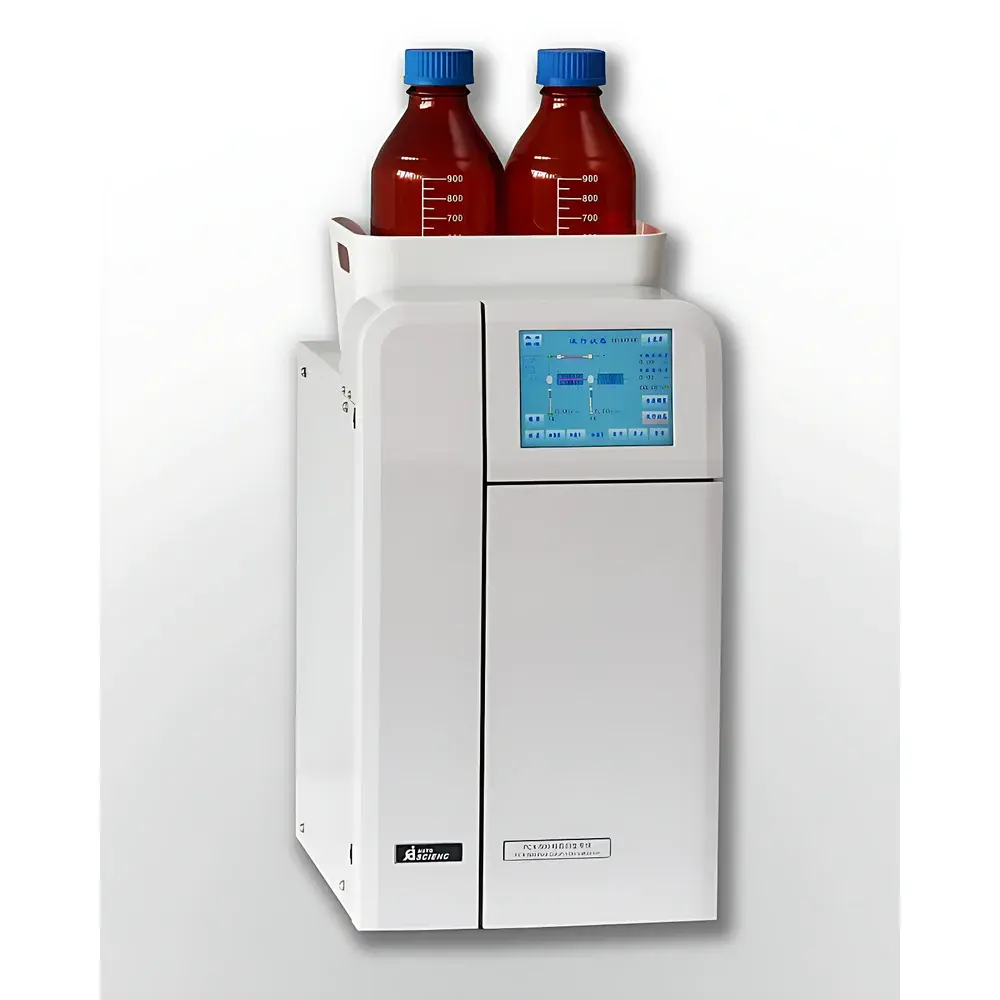
Otisens PCX-500 Post-Column Derivatization System
| Brand | Otisens |
|---|---|
| Origin | Tianjin, China |
| Model | PCX-500 |
| Temperature Range | +5 °C above ambient to 150 °C |
| Derivatization Reagent Flow Rate | 5 µL/min to 2500 µL/min (or 5 µL/min to 10 mL/min) |
| Reaction Coil | Stainless Steel, 10 mm × 0.2 mm ID |
Overview
The Otisens PCX-500 Post-Column Derivatization System is an engineered solution for enhancing detection sensitivity and selectivity in high-performance liquid chromatography (HPLC) and ultra-high-performance liquid chromatography (UHPLC) workflows. It operates on the principle of controlled chemical derivatization—introducing a selective reagent downstream of the separation column to convert non-fluorescent or weakly detectable analytes into highly fluorescent, UV-absorbing, or electrochemically active derivatives immediately prior to detection. This system is especially critical for regulatory-compliant analysis where native analyte response is insufficient for meeting required limits of quantitation (LOQ), such as in food safety, pharmaceutical quality control, and environmental monitoring applications.
Designed for integration with standard HPLC platforms, the PCX-500 features dual thermal management zones: one dedicated to precise heating of the derivatization reaction coil, and another for independent temperature control of the analytical column and guard column. Its architecture supports both isocratic and gradient elution methods without compromising reaction kinetics or peak integrity.
Key Features
- Programmable reaction coil heater with temperature range from +5 °C above ambient to 150 °C and thermal stability better than ±0.3 °C—ensuring reproducible derivatization kinetics across method transfers.
- High-precision dual-range syringe pump delivering derivatization reagent at flow rates from 5 µL/min to 2500 µL/min (low-flow mode) or 5 µL/min to 10 mL/min (high-flow mode), compatible with both microbore and conventional bore HPLC systems.
- Stainless steel reaction coil (10 mm × 0.2 mm ID) optimized for minimal band broadening and rapid heat transfer; available coil volumes from 0.1 mL to 3 mL to accommodate varying residence time requirements.
- Dedicated column oven with independent temperature control: heating range from +5 °C above ambient to 100 °C (±0.2 °C accuracy); optional Peltier-based refrigeration/heating module extends control to −20 °C below ambient up to 75 °C (±0.3 °C accuracy).
- Integrated safety protocols including overtemperature cutoff at 155 °C for the reaction coil, real-time leak detection with automatic pump shutdown, and post-column pressure monitoring with automatic pump halt if backpressure exceeds 500 psi.
- Compact footprint (540 mm × 270 mm × 425 mm H×W×D) and low power consumption (200 W, AC 198–242 V) enable seamless benchtop deployment in regulated laboratory environments.
Sample Compatibility & Compliance
The PCX-500 is validated for use in official methods requiring post-column derivatization per international standards including AOAC Official Method®s, ISO 15141 (aflatoxins), ISO 11892 (sulfonamides), and USP chromatographic separations. It supports derivatization chemistries for a broad spectrum of analytes: aflatoxin B₁/B₂/G₁/G₂/M₁, carbamate pesticides (e.g., carbaryl, aldicarb), amino acids and taurine (o-phthalaldehyde/ninhydrin), fumonisins (OPA/FTC), saxitoxins and paralytic shellfish toxins (PSP), aminoglycoside antibiotics (orthophthalaldehyde), biogenic amines (dansyl chloride), phenylketonuria metabolites (2,4-dinitrofluorobenzene), polyether antibiotics (acid hydrolysis + OPA), formaldehyde (acetylacetone), cholesterol (ferric chloride), and more. All thermal and fluidic parameters are traceable and configurable to support GLP/GMP documentation requirements.
Software & Data Management
While the PCX-500 operates as a standalone hardware module, its analog I/O ports (0–5 V DC) allow synchronization with third-party HPLC data systems (e.g., Waters Empower, Thermo Chromeleon, Agilent OpenLab) for coordinated event triggering and timestamp alignment. Temperature setpoints, pump flow rates, and alarm thresholds are manually configured via front-panel keypad and LCD interface. All operational logs—including temperature deviations, pressure excursions, leak events, and pump stop/start cycles—are retained in non-volatile memory for audit trail generation. The system meets foundational requirements for FDA 21 CFR Part 11 compliance when deployed within a validated laboratory information management system (LIMS) framework that enforces user authentication, electronic signatures, and change control.
Applications
- Regulatory food safety testing: Quantification of mycotoxins in cereals, dairy, and nuts per EU Commission Regulation (EC) No 1881/2006 and China GB 2761–2023.
- Pesticide residue analysis in fruits and vegetables using AOAC 2007.01 and SANTE/11312/2021 guidelines.
- Pharmaceutical impurity profiling and stability-indicating assays involving amino-containing compounds.
- Clinical toxicology screening for endogenous amines and neurotoxic alkaloids in biological matrices.
- Environmental water analysis for formaldehyde and hydrazine derivatives under EPA Method 550.1 and ISO 11395.
FAQ
Is the PCX-500 compatible with UHPLC systems operating above 1000 bar?
Yes—the derivatization flow path is rated for continuous operation up to 500 psi (34.5 bar), and the stainless steel reaction coil maintains mechanical integrity under typical UHPLC post-column pressures when properly integrated with appropriate backpressure regulation.
Can the column oven and reaction coil be programmed independently?
Yes—both thermal modules feature separate PID controllers with independent setpoint entry, enabling simultaneous optimization of separation efficiency and derivatization yield.
What safety certifications does the PCX-500 carry?
The system complies with IEC 61010-1:2010 for electrical safety in laboratory equipment and includes CE marking for EMC and LVD directives. Full conformity documentation is provided upon request for IQ/OQ validation.
Is remote monitoring or Ethernet connectivity supported?
No—remote control is not natively implemented. However, analog voltage outputs and digital relay signals can be interfaced with PLCs or SCADA systems for centralized status monitoring.
Does Otisens provide application notes or method development support?
Yes—validated derivatization protocols for major analyte classes (e.g., aflatoxins, carbamates, amino acids) are available upon purchase, including reagent preparation, coil selection guidance, and HPLC method transfer templates.





