
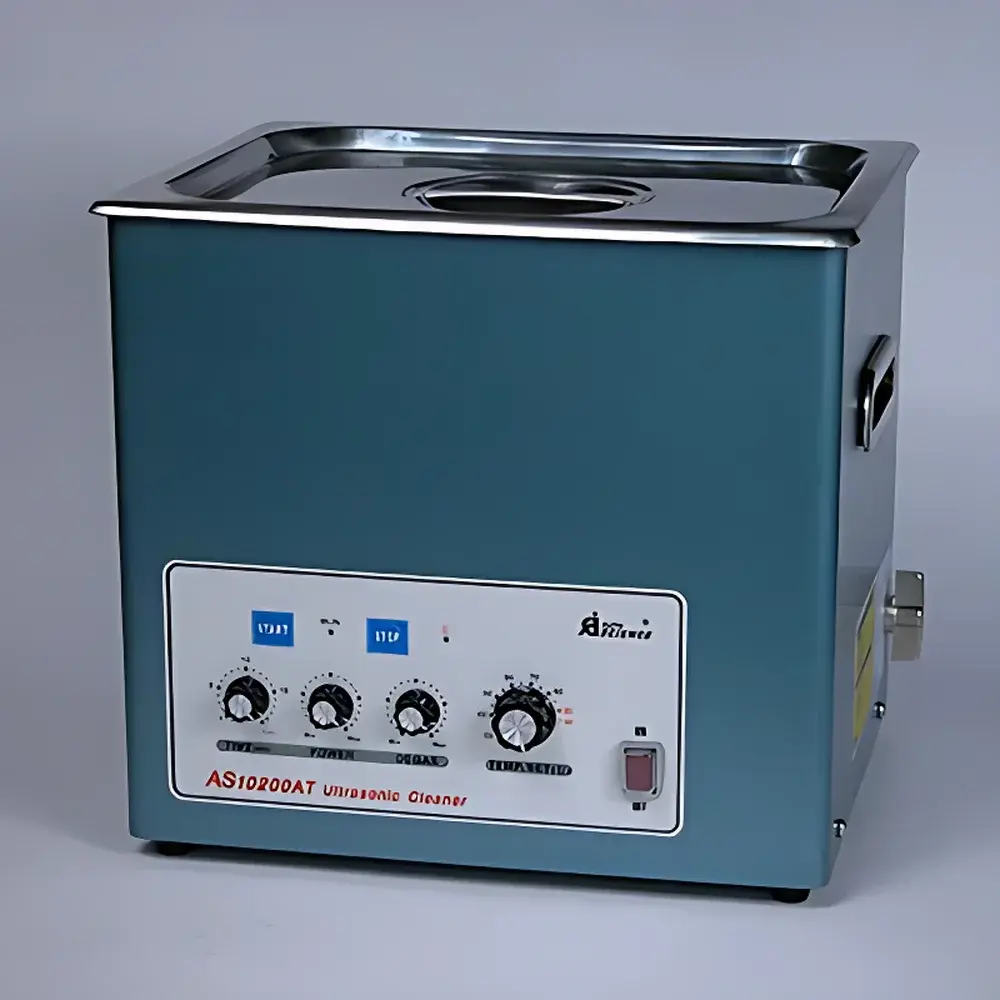
Otisience AS10200AT(H) Ultrasonic Cleaner
| Brand | Otisience |
|---|---|
| Origin | Tianjin, China |
| Model | AS10200AT(H) |
| Capacity | 10 L |
| Ultrasonic Frequency | 40–60 kHz |
| Ultrasonic Power | 300 W |
| Power Adjustment Range | 30–100% |
| Heating Temperature Range | +5 °C to 80 °C |
| Heating Power | 500 W |
| Timer Function | 0–18 min or Continuous Operation |
| Noise Reduction Lid | Yes |
| Manual Drain Valve | Yes |
| External Dimensions (W×L×H) | 330 × 270 × 290 mm |
| Tank Dimensions (W×L×D) | 300 × 250 × 150 mm |
| Housing Material | Aluminum Alloy |
Overview
The Otisience AS10200AT(H) Ultrasonic Cleaner is a benchtop, general-purpose ultrasonic cleaning system engineered for reproducible, non-destructive removal of particulate, organic, and ionic contaminants from laboratory components, precision parts, glassware, and small instrumentation. It operates on the principle of cavitation—high-frequency sound waves (40–60 kHz) generate microscopic vacuum bubbles in the cleaning solution; their implosive collapse delivers localized energy sufficient to dislodge surface-bound residues without mechanical abrasion. Designed for routine QC labs, analytical chemistry workspaces, and R&D environments, this unit integrates controlled heating, adjustable power output, and robust aluminum construction to support consistent cleaning performance across diverse solvent chemistries—including aqueous detergents, ethanol, isopropanol, and low-surface-tension solvents.
Key Features
- Adjustable ultrasonic power output (30–100% of 300 W nominal), enabling optimization for delicate substrates (e.g., optical lenses, microfluidic chips) or heavily soiled metal tools
- Integrated heating system with precise digital temperature control (+5 °C to 80 °C), powered by a dedicated 500 W heater—critical for enhancing detergent efficacy and accelerating solvent-based degreasing
- Acoustically damped lid with sealing gasket reduces airborne noise and suppresses solvent evaporation during extended cycles
- Stainless-steel tank interior (standard configuration) ensures corrosion resistance and long-term compatibility with alkaline, acidic, and organic cleaning media
- Aluminum alloy housing provides structural rigidity, thermal stability, and electromagnetic shielding for stable frequency transmission
- Manual drain valve located at the tank base allows complete, residue-free solution exchange—essential for multi-step cleaning protocols requiring sequential rinses or solvent swaps
- Included stainless-steel mesh basket and rack facilitate uniform part suspension and prevent direct contact with transducer surfaces
Sample Compatibility & Compliance
The AS10200AT(H) accommodates a wide range of sample geometries and materials: glass vials, HPLC columns, syringe filters, pipette tips, surgical instruments, printed circuit boards, and ceramic substrates. Its 10 L capacity supports batch processing of up to 24 standard 15-mL centrifuge tubes or six 100-mm Petri dishes. The unit complies with IEC 61000-6-3 (EMC emission limits) and meets CE safety requirements for Class I electrical equipment. While not certified for sterile processing per ISO 13485 or FDA 21 CFR Part 820, its temperature and power stability support GLP-aligned documentation when integrated into validated cleaning SOPs. Users performing critical applications (e.g., residual solvent analysis, pharmaceutical component cleaning) are advised to validate cycle parameters per ASTM D2606 (Standard Guide for Cleaning Validation in Pharmaceutical Manufacturing) or USP (Cleaning and Sanitization).
Software & Data Management
This model operates via an analog-digital hybrid interface: a rotary encoder for power and temperature setting, LED display for real-time feedback, and tactile push-button controls. No embedded software or PC connectivity is provided—consistent with its design as a standalone, maintenance-light instrument for high-throughput lab environments. All operational parameters (set temperature, power level, elapsed time) are retained across power cycles. For audit-trail requirements, users may integrate external data loggers (e.g., calibrated thermocouple probes, ultrasonic intensity meters) to record process variables in accordance with ISO/IEC 17025 clause 7.7 (Ensuring Validity of Results). Firmware updates are not applicable; calibration of temperature sensors is recommended annually using NIST-traceable reference standards.
Applications
- Pre-analytical preparation: cleaning HPLC vials, autosampler needles, and chromatographic column fittings to eliminate carryover and baseline drift
- Electronics manufacturing: removal of flux residues, solder paste remnants, and particulate debris from PCB assemblies prior to AOI inspection
- Materials science: deburring sintered metal parts, dispersing nanoparticle suspensions, and preparing TEM grids
- Life sciences: sterilization-preparatory cleaning of reusable pipette tips, electrophoresis combs, and microcentrifuge rotors
- Quality control labs: standardized cleaning of reference standards, calibration weights, and gauge blocks prior to dimensional metrology
- Environmental testing: decontamination of field-collected sampling hardware (e.g., water intake filters, sediment traps) before trace-metal analysis
FAQ
Is the AS10200AT(H) suitable for cleaning delicate optical components?
Yes—when operated at 30–50% power and with low-surface-tension solvents (e.g., 2-propanol), it effectively removes fingerprint oils and dust without micro-scratching coated lenses or mirrors.
Does the unit support automatic shutdown after timer completion?
Yes—the built-in timer defaults to continuous operation but can be set for 1–18 minutes; upon expiration, both ultrasonic output and heating deactivate automatically.
Can the tank temperature be maintained within ±0.5 °C accuracy?
Under stable ambient conditions and with proper load distribution, the system achieves ±1.0 °C repeatability over 30-minute intervals; tighter control requires external PID controllers.
What maintenance is required for long-term reliability?
Transducer coupling integrity should be verified quarterly; tank interior must be rinsed with deionized water after each organic solvent use to prevent residue buildup; ultrasonic generator cooling fans should be cleaned biannually.
Is the AS10200AT(H) compatible with degassing solutions prior to sonication?
Yes—the unit includes a dedicated “degas” mode (typically 2–5 min at reduced power and elevated temperature) to remove dissolved gases that inhibit cavitation efficiency.
Related Products



