
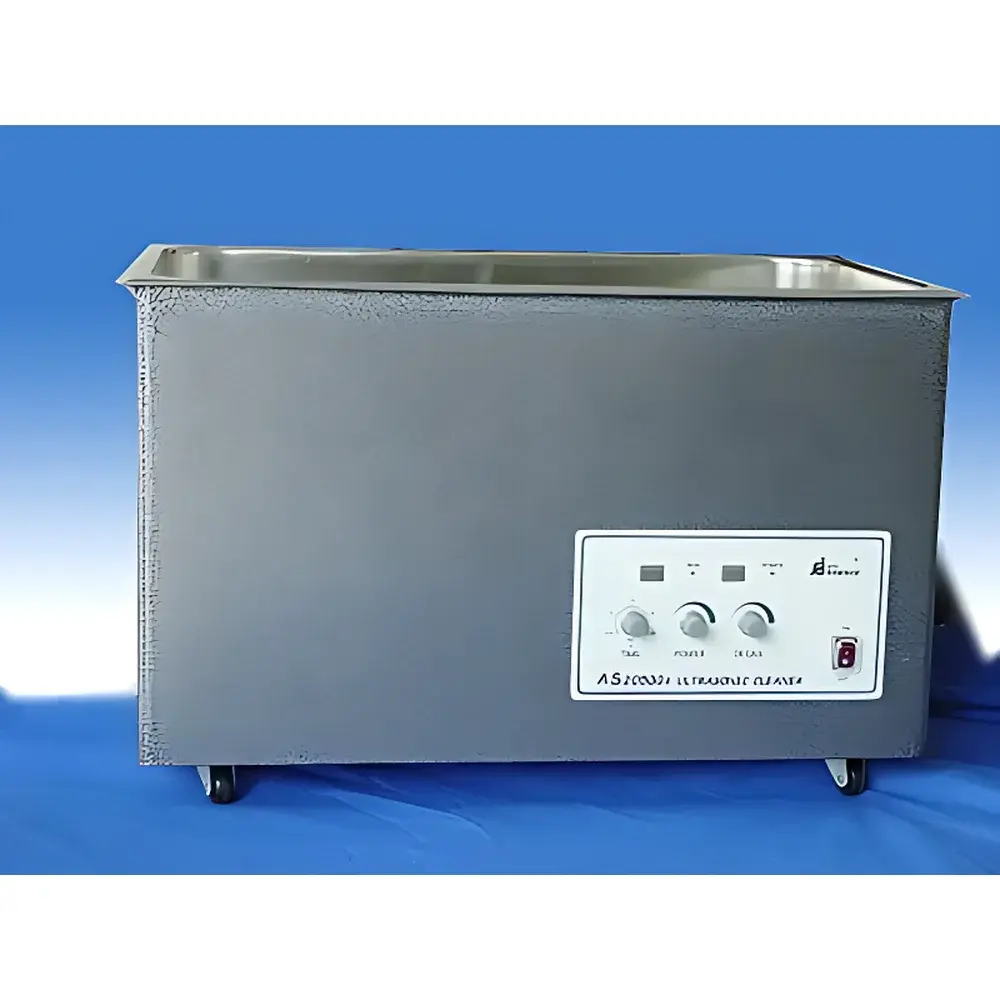
Otisience AS20500A Ultrasonic Cleaner
| Brand | Otisience |
|---|---|
| Model | AS20500A |
| Type | General-purpose ultrasonic cleaner |
| Capacity | 22 L |
| Ultrasonic frequency | 40 kHz |
| Ultrasonic power output | 500 W |
| Power adjustability | Yes, 30–100% in continuous stepless control |
| Timer | Electronic timer (up to 20 min), mechanical timer (up to 30 min), or continuous operation mode |
| Degassing function | Yes |
| Lid with sound-dampening design | Yes |
| Drain valve | Manual |
| Tank material | 304 stainless steel |
| Housing material | Corrosion-resistant anodized aluminum |
| External dimensions (W×L×H) | 530 × 350 × 335 mm |
| Internal tank dimensions (W×L×D) | 490 × 295 × 150 mm |
| Certifications | CE-compliant design, conforms to IEC 61000-6-3 (EMC) and IEC 61000-6-2 (immunity) |
Overview
The Otisience AS20500A Ultrasonic Cleaner is a general-purpose benchtop cleaning system engineered for reproducible, non-destructive removal of particulate contaminants, organic residues, and loosely adhered films from laboratoryware, precision components, and analytical instrumentation parts. It operates on the principle of high-frequency acoustic cavitation—generated by piezoelectric transducers bonded to the bottom and/or side walls of a 304 stainless steel tank—where rapid formation and collapse of microscopic vapor bubbles produce localized shockwaves and microstreaming effects that dislodge surface-bound debris without mechanical abrasion. With a nominal ultrasonic frequency of 40 kHz and a rated output power of 500 W, the AS20500A delivers consistent energy density across its 22-liter working volume (490 × 295 × 150 mm internal dimensions), making it suitable for routine cleaning of volumetric flasks, HPLC vials, chromatography columns, surgical instruments, optical lenses, and printed circuit boards. Its robust architecture—including corrosion-resistant anodized aluminum housing and sealed electronic controls—ensures long-term reliability under standard laboratory environmental conditions (15–35°C, <80% RH).
Key Features
- Adjustable ultrasonic power output (30–100% in continuous stepless control) enables optimization for delicate substrates (e.g., coated optics) or heavily soiled items (e.g., metal tooling).
- Dual-timer configuration: programmable electronic timer (0–20 min) for precision cycle control, plus mechanical timer (0–30 min) for fail-safe backup; both support continuous operation mode when required.
- Integrated degassing function facilitates rapid removal of dissolved gases from cleaning solutions prior to ultrasonic activation—critical for achieving maximum cavitation efficiency and minimizing pitting on sensitive surfaces.
- Sound-dampening hinged lid reduces ambient noise levels to ≤65 dB(A) at 1 m distance, supporting compliance with occupational health guidelines (OSHA 29 CFR 1910.95) in shared lab environments.
- Manual drain valve located at the tank base allows complete solution evacuation without tilting or lifting; compatible with standard laboratory floor drains and waste collection protocols.
- CE-marked electrical design complies with EN 61000-6-2 (electromagnetic immunity) and EN 61000-6-3 (emission limits), ensuring stable operation alongside sensitive analytical instruments such as mass spectrometers and atomic absorption spectrophotometers.
Sample Compatibility & Compliance
The AS20500A accommodates a broad range of sample geometries and materials—including glass, quartz, stainless steel, titanium, silicon wafers, and polymer-based labware—provided they are chemically compatible with aqueous or mild solvent-based cleaning media (e.g., 1–5% sodium hydroxide, isopropanol/water mixtures, or proprietary low-foaming detergents). It is not intended for use with flammable solvents, strong oxidizers, or highly corrosive acids without external ventilation and safety interlocks. While the unit itself does not carry ISO 13485 or FDA 21 CFR Part 11 certification (as it is a Class I non-invasive cleaning aid), its design supports integration into GLP- and GMP-regulated workflows when paired with documented cleaning validation procedures, traceable calibration records, and audit-ready maintenance logs.
Software & Data Management
The AS20500A operates via embedded hardware controls only—no software interface, firmware updates, or data logging capabilities are included. All operational parameters (power level, timer setting, degas activation) are set manually using front-panel rotary dials and push-button switches. This analog architecture eliminates cybersecurity vulnerabilities, ensures deterministic response timing, and avoids compatibility dependencies associated with USB/Bluetooth connectivity or cloud-based platforms. For laboratories requiring electronic recordkeeping, third-party digital timers or PLC-integrated relay modules may be deployed upstream to log start/stop events and duration metadata in accordance with ALCOA+ principles.
Applications
- Routine decontamination of volumetric glassware prior to trace-metal analysis (e.g., ICP-MS, AAS).
- Preparation of HPLC/GC autosampler vials and injection syringes to eliminate carryover artifacts.
- Cleaning of reusable electrophoresis combs, gel trays, and electrode assemblies in molecular biology labs.
- Surface preparation of metal coupons for ASTM B117 salt-spray testing or ISO 8502-3 cleanliness verification.
- Removal of flux residues from PCB assemblies before conformal coating or AOI inspection.
- Supporting ISO 14644-1 cleanroom component cleaning protocols when used with filtered DI water and Class 100 laminar flow hoods.
FAQ
Is the AS20500A suitable for cleaning delicate optical components?
Yes—when operated at reduced power (30–50%) with low-surface-tension, non-ionic detergent solutions and degassed DI water, it effectively removes sub-micron particles without inducing lens coating delamination or surface scratching.
Does the unit include temperature control?
No—this model lacks built-in heating or temperature regulation. For thermally enhanced cleaning, external recirculating chillers or heated water baths must be used in conjunction with appropriate thermal insulation and safety monitoring.
Can the AS20500A be validated for pharmaceutical cleaning processes?
While the device itself is not qualified as a regulated process equipment, its consistent power delivery, repeatable timer functions, and mechanical durability enable successful inclusion in cleaning validation protocols per USP and PDA Technical Report No. 29—provided installation qualification (IQ), operational qualification (OQ), and performance qualification (PQ) are performed using calibrated reference standards.
What maintenance is required to sustain optimal cavitation performance?
Monthly inspection of transducer bonding integrity, quarterly descaling of tank interior with 5% citric acid solution, and annual verification of power output using a calibrated ultrasonic power meter (e.g., CPX-2000 series) are recommended per manufacturer guidelines.



