
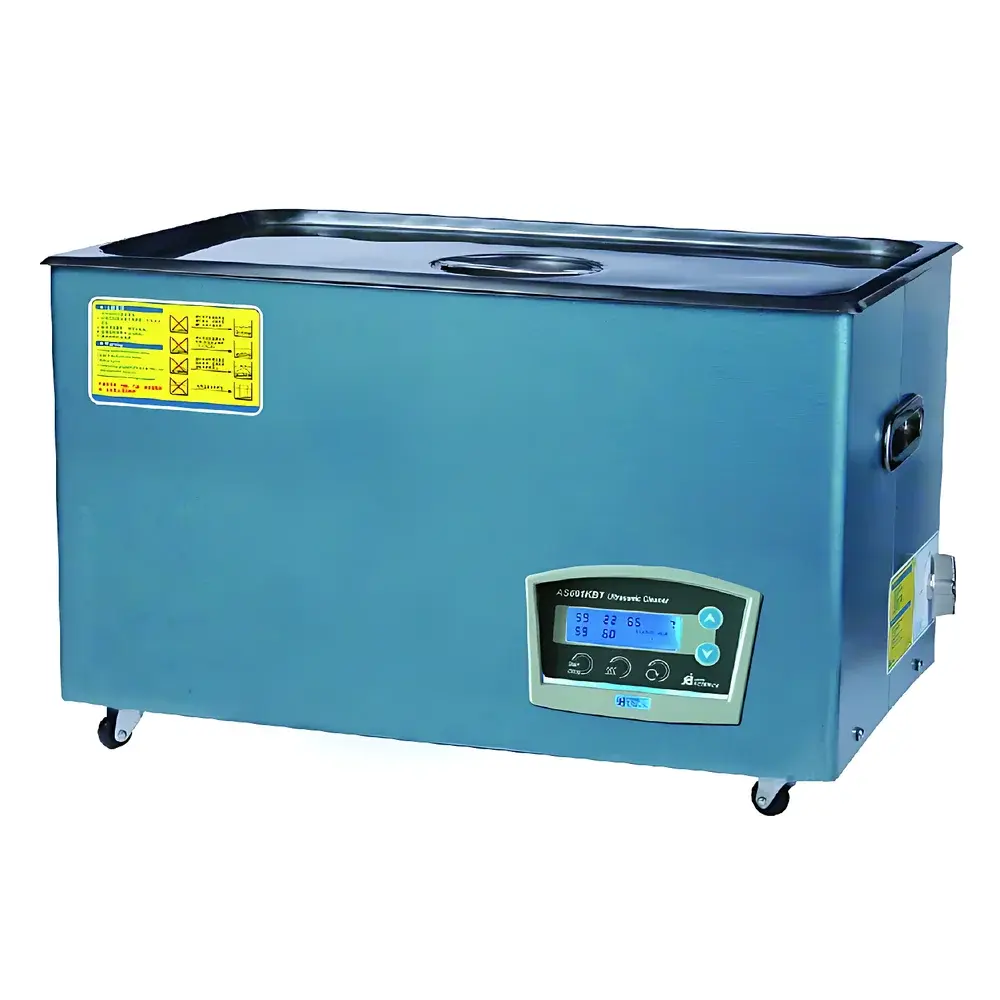
Otisience AS20500BDT Ultrasonic Cleaner
| Brand | Otisience |
|---|---|
| Origin | Tianjin, China |
| Model | AS20500BDT |
| Capacity | 22 L |
| Ultrasonic Frequency | 40 kHz / 60 kHz |
| Ultrasonic Power | 520 W (adjustable 1–100%) |
| Heating Temperature Range | +5 °C to 80 °C |
| Timer Range | 1–999 min |
| Noise-Reduction Lid | Yes |
| Manual Fill/Drain | Yes |
| Construction | Aluminum or Stainless Steel (user-selectable) |
| Dimensions (W×L×H) | 530 × 350 × 335 mm |
| Tank Internal Dimensions (W×L×D) | 490 × 295 × 150 mm |
| Safety Features | Low-water alarm & auto-shutdown, overtemperature protection |
Overview
The Otisience AS20500BDT Ultrasonic Cleaner is a benchtop, microprocessor-controlled cleaning system engineered for precision laboratory applications requiring consistent cavitation-based decontamination. Utilizing dual-frequency ultrasonic transduction (40 kHz and 60 kHz), the unit generates controlled acoustic cavitation in liquid media—producing transient microbubbles that collapse with localized energy sufficient to dislodge particulate matter, organic residues, biofilms, and adsorbed contaminants from complex geometries of labware, instrumentation components, and analytical hardware. Its 22-liter tank volume supports medium-throughput cleaning of beakers, flasks, pipette tips, HPLC vials, filtration assemblies, and small-scale metal or glass parts. Designed for integration into regulated environments, the AS20500BDT operates within defined thermal and temporal parameters compliant with common laboratory quality frameworks—including ISO/IEC 17025–aligned validation protocols and GLP-relevant operational traceability.
Key Features
- Microprocessor-based digital control panel with LCD display for real-time monitoring of time, temperature, power level, and frequency selection.
- Dual-frequency operation (40 kHz / 60 kHz) enables optimization across diverse sample types: lower frequency enhances macro-particle removal; higher frequency improves cleaning efficacy on fine features and delicate substrates.
- Adjustable ultrasonic power output (1–100% in 1% increments) allows precise energy modulation to prevent sample erosion or substrate damage during extended cycles.
- Programmable heating system with PDI (Proportional-Derivative-Integral) temperature control ensures stable thermal setpoints from +5 °C to 80 °C, minimizing overshoot and drift during heated cleaning or degassing protocols.
- Extended timer range (1–999 minutes) supports both rapid pre-cleaning and extended soak-and-cavitate procedures required for stubborn residue removal.
- Integrated safety architecture includes low-water-level detection with audible/visual alarm and automatic shutdown, plus overtemperature cutoff to protect transducers and tank integrity.
- Standard inclusion of stainless steel mesh basket and acoustic noise-reduction lid reduces ambient sound pressure levels and prevents solvent evaporation during operation.
- Optional construction materials—high-strength anodized aluminum or electropolished stainless steel—meet corrosion resistance requirements for aggressive cleaning solvents (e.g., alkaline detergents, ethanol/water mixtures, mild acidic solutions).
Sample Compatibility & Compliance
The AS20500BDT accommodates a broad range of laboratory consumables and instruments, including but not limited to volumetric glassware, stainless steel forceps and tweezers, ceramic crucibles, quartz cuvettes, Teflon-coated stir bars, and reusable chromatography fittings. It is compatible with aqueous, semi-aqueous, and low-volatility solvent systems commonly used in analytical labs. The device complies with IEC 61000-6-3 (EMC emission standards) and IEC 61000-6-2 (immunity requirements). While not certified for medical device reprocessing per ISO 15883, its operational parameters align with ASTM D2291 (standard practice for ultrasonic cleaning of metal parts) and USP guidelines for equipment cleaning validation in pharmaceutical laboratories. All firmware logs—including cycle start/end timestamps, temperature profiles, and power settings—are retained internally for audit readiness.
Software & Data Management
The AS20500BDT operates via embedded firmware without external PC dependency. However, it supports manual documentation of cleaning parameters per batch via printed or handwritten logbooks—a design choice aligned with GMP Annex 11 and FDA 21 CFR Part 11 principles where electronic records are not mandated. For laboratories implementing paperless workflows, the unit’s deterministic parameter sets (time, temp, power, frequency) can be mapped directly into LIMS or ELN entries. Optional RS-232 or USB-to-serial interfaces (available upon request) enable automated logging of operational events into centralized lab data repositories. Audit trails are maintained via internal non-volatile memory storing the last 50 completed cycles with full parameter snapshots.
Applications
- Pre-analytical preparation of HPLC, GC, and ICP-MS sample containers to eliminate carryover contamination.
- Cleaning of optical components (lens mounts, mirrors, cuvette holders) without surface abrasion.
- Removal of solder flux, machining oils, and oxide layers from metallurgical specimens prior to SEM/EDS analysis.
- Reconditioning of reusable filtration housings and membrane support plates in water quality testing labs.
- Degassing of mobile phase solvents prior to LC system priming.
- Supporting ISO 8573-1 compressed air purity testing by cleaning sampling valves and condensate traps.
- Routine maintenance of viscometers, density meters, and Karl Fischer titrators with removable sensor modules.
FAQ
What is the recommended cleaning solution for use with the AS20500BDT?
Aqueous alkaline detergents (pH 9–11) are preferred for general labware; ethanol/water (70:30) mixtures may be used for hydrophobic residue removal. Avoid halogenated solvents unless explicitly approved for your tank material configuration.
Can the AS20500BDT be validated for use in GMP environments?
Yes—the unit’s deterministic controls, repeatability, and built-in safety interlocks support IQ/OQ execution per ASTM E2500. Full PQ requires user-defined acceptance criteria tied to residue limits and surface cleanliness metrics.
Is remote monitoring or network connectivity available?
Standard configuration does not include Ethernet or Wi-Fi. Optional serial interface modules enable integration with building management systems or centralized lab monitoring platforms.
How often should the transducer array be serviced?
Under normal usage (≤8 hrs/day), transducer performance remains stable for ≥5 years. Annual verification of ultrasonic intensity distribution (per ASTM E1729) is recommended for critical applications.
Does the unit meet CE or UL safety certification requirements?
The AS20500BDT conforms to IEC 61010-1:2010 for laboratory electrical equipment. CE marking is applied for EU market distribution; UL listing is available under custom order with third-party certification agency engagement.



