
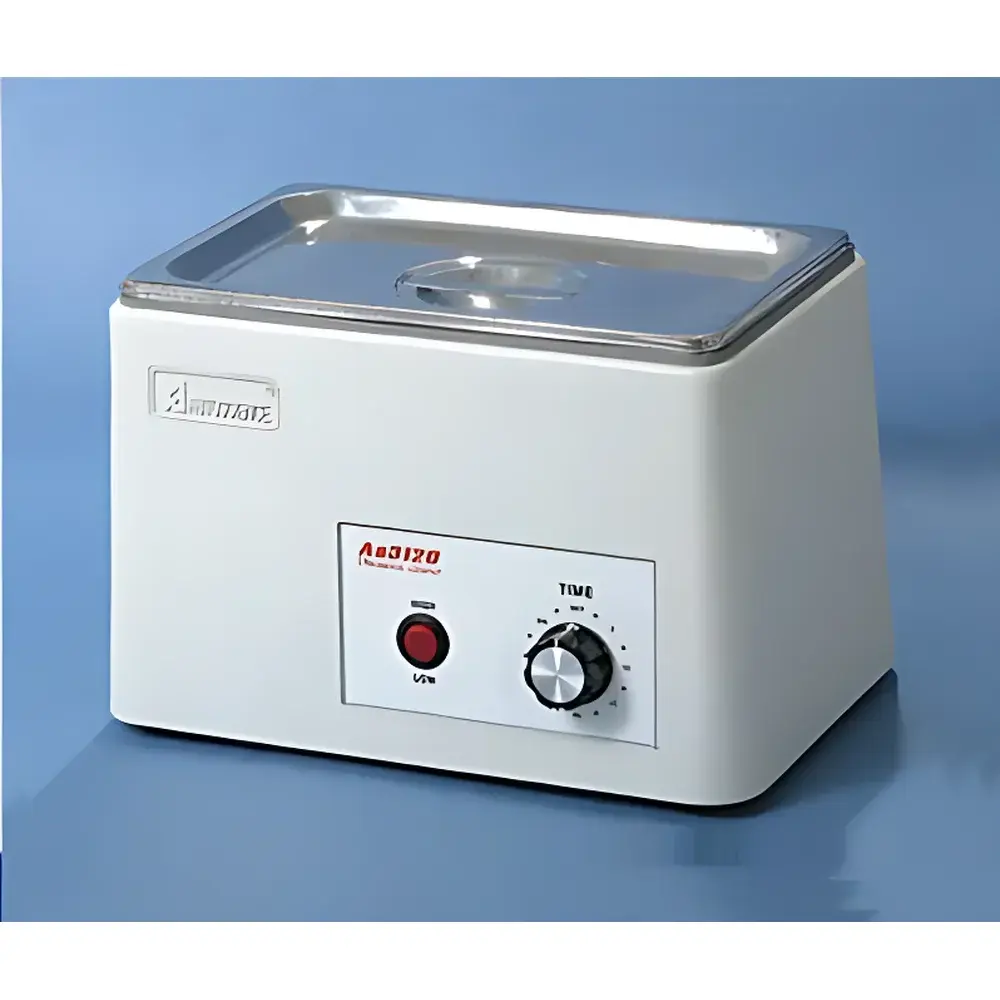
Otisience AS3120 Plastic-Housed Ultrasonic Cleaner
| Brand | Otisience |
|---|---|
| Origin | Tianjin, China |
| Model | AS3120 |
| Capacity | 3 L |
| Ultrasonic Frequency | 40 kHz |
| Ultrasonic Power | 60 W (adjustable: 50–100%) |
| Timer Range | 5–30 min |
| Lid | Sound-Dampening Cover Included |
| Drain | Manual Control |
| Housing Material | Reinforced Polymer Shell |
| External Dimensions (W×L×H) | 290 × 185 × 200 mm |
| Tank Dimensions (W×L×D) | 235 × 135 × 100 mm |
| Power Supply | Standard AC Input (specify voltage per regional configuration) |
Overview
The Otisience AS3120 Plastic-Housed Ultrasonic Cleaner is a compact, benchtop ultrasonic cleaning system engineered for routine laboratory decontamination, solvent-based particle removal, and pre-analytical sample preparation. It operates on the principle of piezoelectric transduction at a fixed frequency of 40 kHz, generating high-frequency acoustic pressure waves in liquid media to induce controlled cavitation—microbubble formation, growth, and implosive collapse—which delivers mechanical energy to dislodge particulates, organic residues, and loosely adhered contaminants from surfaces of immersed objects. Designed for general-purpose use across academic, quality control, and industrial R&D laboratories, the AS3120 delivers consistent cleaning performance within its 3-liter tank volume while maintaining thermal stability under continuous operation. Its polymer housing provides corrosion resistance and electrical insulation, making it suitable for environments where chemical exposure or moisture ingress may compromise metal-enclosed alternatives.
Key Features
- Stable 40 kHz ultrasonic output with adjustable power delivery (50% or 100% of nominal 60 W), enabling optimization for delicate versus robust substrates.
- Dual-timing functionality: electronic timer (5–30 minute range) and mechanical override for extended or continuous operation modes.
- Sound-dampening hinged lid reduces ambient noise levels during operation and minimizes solvent evaporation.
- Stainless steel tank interior ensures long-term chemical compatibility with common solvents including aqueous detergents, isopropanol, acetone, and ethanol.
- Reinforced polymer housing resists corrosion, impact, and incidental chemical splashes—ideal for shared lab environments with variable usage protocols.
- Manual drain valve allows controlled emptying without tilting or lifting the unit; compatible with standard lab sink connections.
- Benchtop footprint (290 × 185 × 200 mm) supports integration into constrained workspaces without compromising accessibility or safety clearance.
Sample Compatibility & Compliance
The AS3120 accommodates a broad range of sample carriers and instrumentation components—including glassware (vials, cuvettes, pipette tips), metal tools (tweezers, forceps, probes), ceramic substrates, and polymer-based microplates—provided they are non-porous and acoustically stable. It is not intended for sterilization or microbiological deactivation; users requiring validated bioburden reduction must implement complementary thermal or chemical disinfection steps post-ultrasonication. While the device itself does not carry CE, UL, or FDA 510(k) certification, its design aligns with general laboratory safety expectations per IEC 61010-1 for electrical equipment used in measurement, control, and laboratory applications. No temperature regulation is integrated; users should monitor bath temperature manually if exothermic cleaning cycles or heat-sensitive samples are involved.
Software & Data Management
The AS3120 is a standalone analog-controlled instrument with no embedded firmware, network interface, or data logging capability. All operational parameters—including timer setting and power selection—are configured via front-panel mechanical switches. This architecture eliminates software validation requirements and supports straightforward GLP/GMP-aligned documentation when paired with lab-specific SOPs. For traceability, users may record run parameters (duration, power level, solvent type, load composition) in paper-based or LIMS-integrated logbooks. The absence of digital controls also ensures immunity to electromagnetic interference and avoids cybersecurity considerations associated with connected instrumentation.
Applications
- Pre-chromatographic cleaning of HPLC vials, autosampler needles, and injection syringes to prevent carryover and column fouling.
- Removal of polishing compounds and machining oils from precision optical components and metrology standards.
- Deagglomeration support prior to particle size analysis (e.g., laser diffraction or dynamic light scattering) of powdered pharmaceutical excipients.
- Routine maintenance of electrophoresis combs, gel trays, and electrode assemblies in molecular biology workflows.
- Surface preparation of SEM/TEM sample stubs and mounting substrates to minimize artifact introduction during imaging.
- Cleaning of reusable filtration housings, SPE cartridges, and solvent-resistant tubing prior to reuse under documented cleaning validation protocols.
FAQ
Is the AS3120 suitable for cleaning delicate optics or MEMS devices?
Yes—when operated at 50% power and with low-surface-tension solvents (e.g., isopropanol), the AS3120 can effectively remove submicron particulates without damaging most coated or etched surfaces. However, direct validation using representative test samples is recommended before deployment in critical applications.
Does the unit include a heater or temperature control?
No. The AS3120 lacks integrated heating elements or thermostatic regulation. Bath temperature rise is solely dependent on ultrasonic energy dissipation and ambient conditions.
Can the timer be bypassed for uninterrupted operation?
Yes—the mechanical timer allows continuous mode activation, which is useful for extended degassing or multi-stage cleaning protocols requiring operator-defined endpoints.
What maintenance is required for long-term reliability?
Routine inspection of the transducer coupling integrity, periodic descaling of the stainless steel tank (especially when using hard water), and verification of lid seal condition constitute essential preventive maintenance. No scheduled calibration is required.
Is the unit compliant with ISO 13485 or FDA 21 CFR Part 11?
No—these regulatory frameworks apply to software-driven, data-generating medical device manufacturing systems. As a non-networked, non-data-logging instrument, the AS3120 falls outside their scope but remains appropriate for supporting compliant workflows when used per validated SOPs.



