
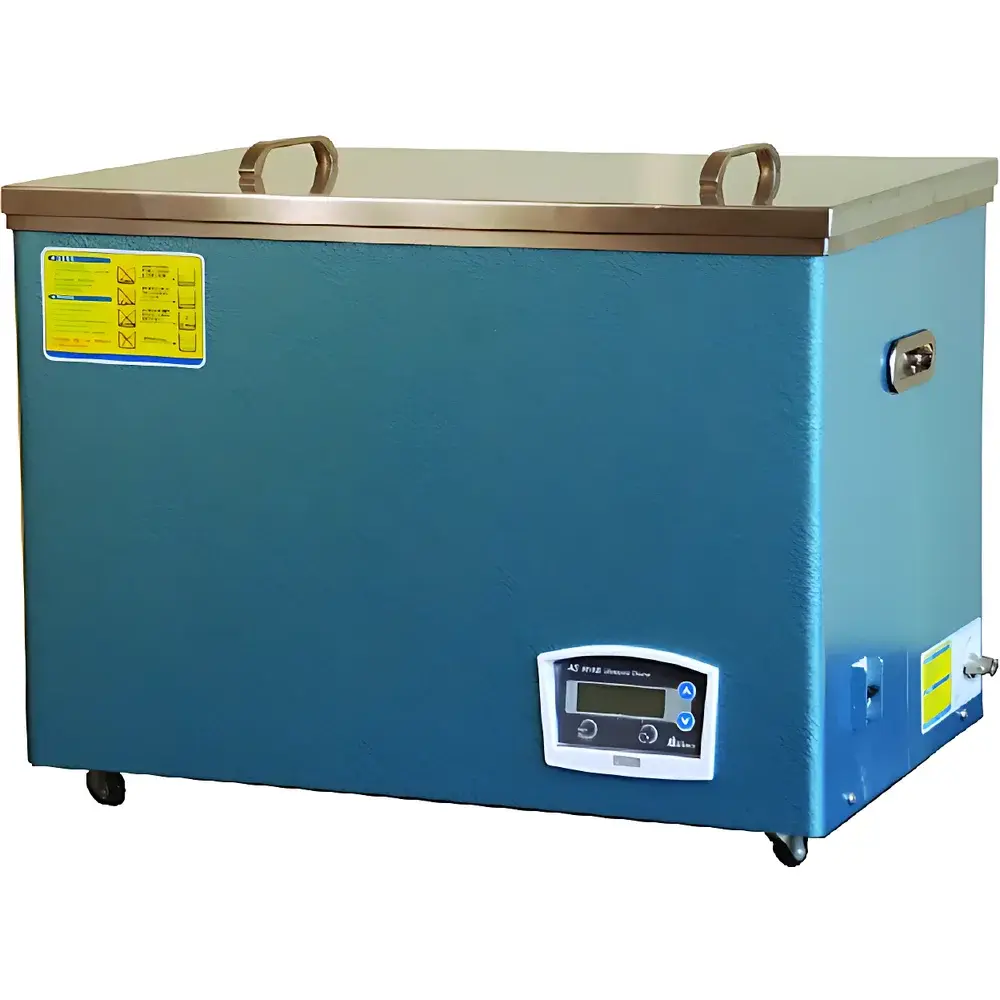
Otisience AS701KDT Ultrasonic Cleaner
| Brand | Otisience |
|---|---|
| Origin | Tianjin, China |
| Model | AS701KDT |
| Capacity | 70 L |
| Ultrasonic Frequency | 20 / 40 / 60 kHz |
| Ultrasonic Power Output | 700 W / 1000 W |
| Power Adjustment Range | 10–100% (pulse width & amplitude modulation) |
| Heating Temperature Range | RT + 5 °C to 80 °C |
| Heating Power | 2400 W |
| Timer Range | 1–99 min |
| Lid with Acoustic Damping | Yes |
| Manual Fill/Drain | Yes |
| External Dimensions (W×L×H) | 750 × 450 × 800 mm |
| Tank Dimensions (W×L×D) | 550 × 400 × 320 mm |
| Housing Material | Anodized Aluminum |
Overview
The Otisience AS701KDT Ultrasonic Cleaner is a high-capacity, multi-frequency benchtop ultrasonic cleaning system engineered for reproducible, non-destructive removal of particulate contaminants, organic residues, and loosely adhered biofilms from laboratory glassware, metal components, surgical instruments, chromatographic hardware, and botanical extraction vessels. It operates on the principle of cavitation—generated by high-frequency acoustic energy transmitted through liquid media—where transient microbubbles collapse near surfaces, producing localized shockwaves and microstreaming that dislodge contaminants without mechanical abrasion. Designed for continuous operation in QC labs, R&D facilities, and GMP-compliant pharmaceutical preparation environments, the AS701KDT integrates dual-mode ultrasonic excitation (continuous and pulse-modulated), precision PID-controlled heating, and full digital parameter monitoring to support validated cleaning protocols across diverse sample matrices.
Key Features
- Triple-frequency ultrasonic generation (20 kHz, 40 kHz, and 60 kHz) enables optimization for different cleaning challenges: low-frequency modes enhance macro-particle removal from robust substrates; higher frequencies improve resolution for fine particulates and delicate components.
- Dual-mode ultrasonic output: selectable “Continuous” mode for standard cleaning cycles and “Pulse Modulation” mode to reduce thermal loading and prevent sample degradation during extended exposure.
- Independent control of ultrasonic power via both pulse width modulation (PWM) and amplitude adjustment—enabling precise energy delivery calibrated to load density and solvent viscosity.
- Microprocessor-based PID temperature controller ensures stable thermal regulation within ±0.5 °C accuracy across the full 5–80 °C operating range; dual 3-digit LED displays simultaneously show setpoint and real-time bath temperature.
- Programmable digital timer (1–99 minutes) with auto-shutdown and audible alert; optional extension to 100 minutes via firmware configuration for validation-driven workflows.
- Robust anodized aluminum housing with integrated acoustic-damping lid minimizes airborne noise emission (<65 dB(A) at 1 m) and reduces evaporation during heated operation.
- Standard accessories include stainless-steel mesh basket, drain valve, fill port, and side-mount accessory interface for optional integration of degassing modules or external cooling loops.
Sample Compatibility & Compliance
The AS701KDT accommodates a broad spectrum of sample types—including volumetric flasks, HPLC vials, syringe filters, stainless-steel chromatography columns, titanium sonication probes, and whole-plant herbal matrices—without compromising structural integrity. Its sealed tank design and corrosion-resistant interior meet ASTM D2603-20 requirements for ultrasonic cleaning equipment used in analytical laboratories. While not certified to ISO 13485 or FDA 21 CFR Part 11 out-of-the-box, the system supports audit-ready documentation when paired with external logging software and calibrated thermistors. All heating and timing functions are traceable to NIST-traceable references upon user calibration. The unit complies with IEC 61010-1:2010 safety standards for electrical equipment used in laboratory environments.
Software & Data Management
The AS701KDT operates via embedded firmware with no proprietary PC software dependency. Parameter settings—including frequency selection, power level, temperature setpoint, and timer duration—are retained in non-volatile memory after power cycling. For regulated environments requiring electronic recordkeeping, the device supports optional RS-232 or USB-to-serial interface (available as add-on module) to relay operational logs—including start/stop timestamps, actual temperature profiles, and fault codes—to LIMS or ELN platforms. When configured with external data acquisition hardware, it satisfies GLP/GMP requirements for cleaning process validation, including IQ/OQ documentation templates and deviation reporting frameworks aligned with Annex 15 and USP .
Applications
- Routine decontamination of HPLC autosampler vials, injection ports, and flow cells prior to trace-level analysis.
- Extraction enhancement for botanicals and traditional Chinese medicine (TCM) samples using controlled cavitation-assisted leaching at sub-boiling temperatures.
- Pre-cleaning of optical components, MEMS devices, and semiconductor wafers where particle counts must remain below ISO Class 5 thresholds.
- Removal of proteinaceous residue from electrophoresis tanks, centrifuge rotors, and cell culture bioreactor parts.
- Support of ASTM E1921-22 and ISO 15529-2 validation procedures for ultrasonic cleaning efficacy in medical device reprocessing.
FAQ
Is the AS701KDT suitable for use with flammable solvents?
No. The unit is designed exclusively for aqueous or water-miscible cleaning solutions. Operation with flammable solvents (e.g., acetone, ethanol >20% v/v, chlorinated hydrocarbons) is prohibited due to lack of explosion-proof certification.
Can the ultrasonic frequency be customized beyond 20/40/60 kHz?
Yes. Factory-configurable firmware options support discrete frequencies between 15–120 kHz; custom calibration and verification reports are available upon request.
Does the system include validation documentation for GMP environments?
The base unit ships with a Factory Acceptance Test (FAT) report. Full IQ/OQ/PQ documentation packages—including temperature mapping, cavitation intensity profiling, and timing accuracy verification—are offered as professional services.
What maintenance is required for long-term reliability?
Biannual inspection of transducer bonding integrity, quarterly descaling of heater elements using 5% citric acid solution, and annual verification of timer accuracy against a calibrated stopwatch are recommended.
Is remote monitoring or Ethernet connectivity supported?
Not natively. However, third-party IoT gateways compatible with Modbus RTU can interface with the RS-232 port for cloud-based status monitoring and predictive maintenance alerts.



