
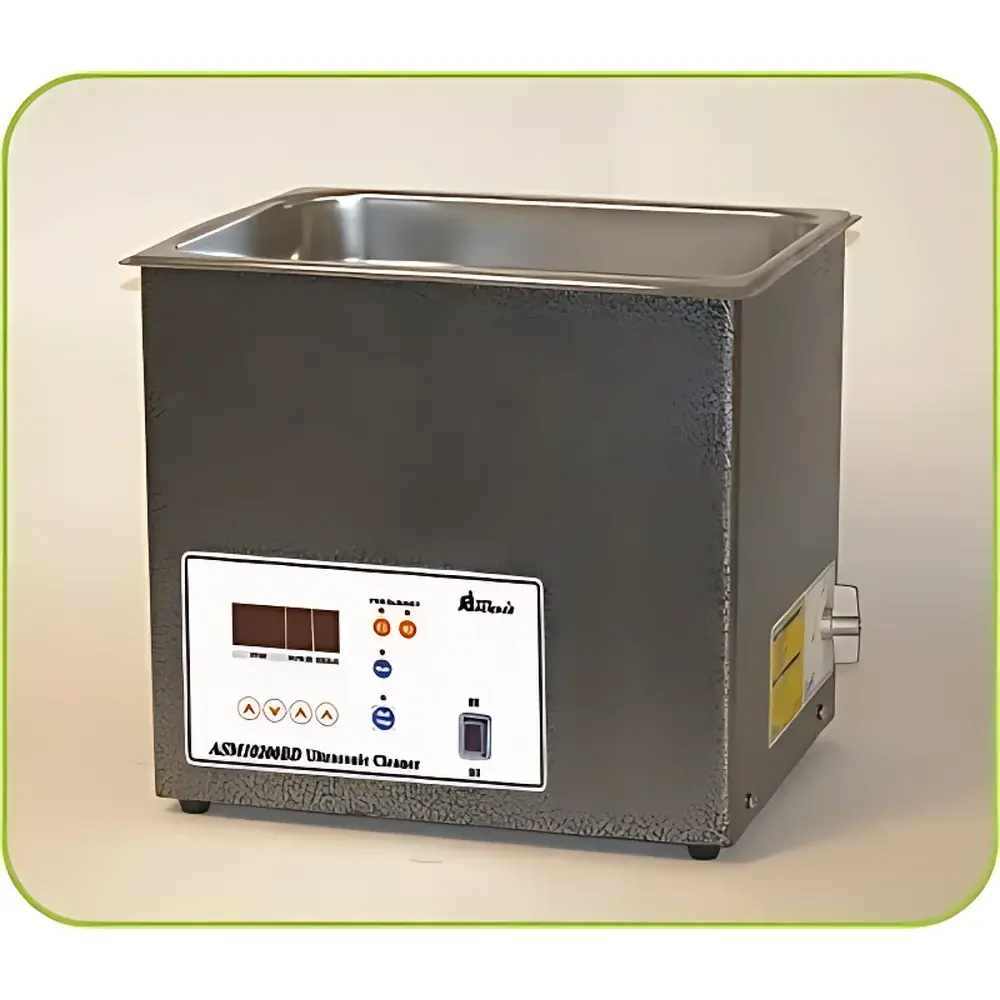
Otisience ASM Series USP/ChP-Compliant Ultrasonic Extractor & Cleaner
| Brand | Otisience |
|---|---|
| Model | ASM |
| Type | Benchtop Ultrasonic Processor for Pharmacopoeial Applications |
| Capacity | 4 L |
| Ultrasonic Frequency | 40 kHz |
| Nominal Ultrasonic Power | 100 W |
| Power Adjustment | Yes (Continuously Variable) |
| Temperature Control Range | Ambient to 80 °C |
| Timer Range | 1–99 min |
| Lid with Acoustic Damping | Yes |
| Manual Fill/Drain | Yes |
| Compliance | Designed to meet extraction parameter requirements specified in Chinese Pharmacopoeia (ChP) 2020 Edition and United States Pharmacopeia (USP) <561> and <701> |
Overview
The Otisience ASM Series USP/ChP-Compliant Ultrasonic Extractor & Cleaner is a purpose-engineered benchtop ultrasonic system designed specifically for pharmacopoeial sample preparation, including herbal matrix extraction and precision cleaning of glassware and instrumentation components. It operates on the principle of cavitation-induced mechanical disruption—where high-frequency acoustic energy (40 kHz) generates transient microbubbles in liquid media that collapse violently, producing localized shear forces, microstreaming, and thermal transients. This physical mechanism enables efficient cell wall disruption, solute release, and particulate detachment without chemical additives or elevated temperatures beyond defined pharmacopoeial limits. Unlike general-purpose cleaners, the ASM Series incorporates parameter traceability, reproducible energy delivery, and thermal stability features required for method validation under Good Laboratory Practice (GLP) and pharmaceutical quality systems.
Key Features
- Benchtop 4-liter stainless steel tank with corrosion-resistant 316L chamber and integrated heater for precise temperature control (ambient to 80 °C, ±1 °C accuracy)
- Digitally adjustable ultrasonic power output (0–100 W continuous range), enabling optimization of energy density (W/L) per pharmacopoeial monograph requirements
- Fixed-frequency transducer at 40 kHz—selected to balance penetration depth and cavitation intensity for botanical matrices per ChP General Chapter 2202 and USP
- Programmable digital timer (1–99 minutes) with auto-shutoff and audible end-of-cycle alert
- Acoustically damped hinged lid with safety interlock to reduce ambient noise (<65 dB(A)) and prevent operator exposure to airborne cavitation byproducts
- Manual fill/drain port with quick-connect fitting; no integrated pump or recirculation—ensuring compatibility with organic solvents and aqueous buffers used in pharmacopoeial extraction protocols
- Front-panel LED display showing real-time temperature, elapsed time, and active power level—supporting audit-ready operation logs when paired with external data recording
Sample Compatibility & Compliance
The ASM Series is validated for use with common pharmacopoeial extraction solvents—including water, ethanol (20–95%), methanol, and ethyl acetate—and accommodates heterogeneous solid samples such as dried herb powders, sliced rhizomes, and granulated botanicals up to 50 g per cycle. Its design supports compliance with multiple regulatory frameworks: ChP 2020 General Chapters 2202 (Ultrasonic Extraction), 0211 (Glassware Cleaning Validation), and 9101 (Analytical Method Validation); USP (Ultrasonic Cleaning), (Extractables and Leachables), and (Analytical Instrument Qualification); and ISO/IEC 17025:2017 clause 6.4.3 (Equipment Verification). While not certified to FDA 21 CFR Part 11 out-of-the-box, the unit’s deterministic parameter settings and manual log capability align with ALCOA+ data integrity principles for non-automated instruments.
Software & Data Management
The ASM Series operates as a standalone hardware platform with no embedded software or network interface—minimizing cybersecurity risk and qualification burden in regulated environments. All operational parameters (time, temperature, power) are set via tactile rotary controls and confirmed on the LED display. Users maintain manual batch records per SOP, referencing instrument ID, date/time, solvent type, sample mass, and observed cavitation behavior. For laboratories requiring electronic data capture, the unit integrates seamlessly with external USB data loggers or LIMS via analog voltage outputs (0–5 V DC proportional to power and temperature), supporting 21 CFR Part 11-compliant workflows when deployed with validated third-party acquisition software and audit-trail-enabled storage.
Applications
- Standardized extraction of active constituents (e.g., flavonoids, alkaloids, saponins) from traditional Chinese medicinal herbs per ChP monographs
- Cleaning of HPLC vials, pipette tips, sieve shakers, and dissolution apparatus parts prior to USP extractables testing
- Dispersion of nanosuspensions and liposomal formulations during pre-formulation development
- Deagglomeration of reference standards and CRM powders prior to gravimetric assay or ICP-MS analysis
- Routine decontamination of stainless steel forceps, spatulas, and mortar-pestle sets in QC microbiology labs
FAQ
Does the ASM Series support multiple frequencies?
No—the ASM model described here operates exclusively at 40 kHz, optimized for pharmacopoeial consistency and regulatory alignment. Multi-frequency variants (e.g., ASM-45, ASM-50) are available under separate model numbers but require distinct validation documentation.
Is temperature calibration traceable to NIST standards?
The built-in PT100 sensor is factory-calibrated; users may perform field verification using an accredited external thermometer per USP IQ/OQ protocols.
Can this unit be used for sonication of biological samples?
It is not recommended for heat-sensitive proteins or nucleic acids due to lack of active cooling; applications involving thermolabile analytes require chilled bath integration or alternative probe-based systems.
What maintenance is required for long-term reliability?
Quarterly inspection of transducer bond integrity, annual descaling of heater elements with 5% citric acid solution, and biannual verification of timer accuracy against a calibrated stopwatch.
Is the tank geometry compatible with standard USP dissolution baskets?
Yes—the 4 L chamber accommodates USP Apparatus 1 (basket) and Apparatus 2 (paddle) accessories when used for cleaning validation studies.



