
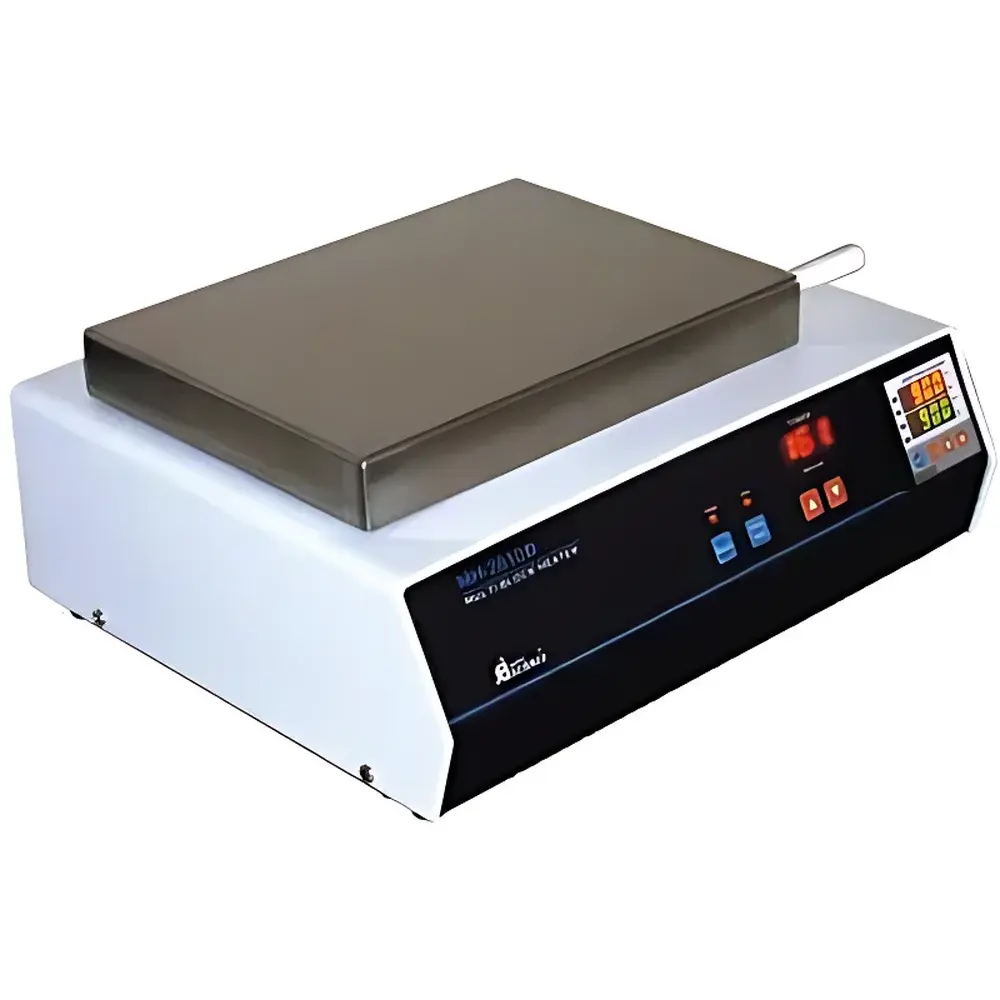
Otisience MH-2810D Programmable Dry-Block Thermostat
| Brand | Otisience |
|---|---|
| Model | MH-2810D |
| Temperature Range | Ambient +5 °C to 200 °C |
| Temperature Stability | ±0.1 °C |
| Temperature Accuracy | ±0.15 °C |
| Over-Temperature Protection | 200 °C |
| Deviation Alarm Threshold | Setpoint +5 °C |
| Timer Range | 1–999 min |
| Display | Dual 4-digit LED (PV/SV) |
| Heating Power | 750 W / 220 V / 50 Hz |
| External Dimensions | 320 × 92 × 270 mm (W×H×D) |
| Chamber Dimensions | 215 × 51 × 135 mm (W×H×D) |
| Block Capacity | 2 standard blocks or 1 double-size block |
| Compliance | CE-marked, RoHS-compliant, designed per IEC 61010-1 for laboratory use |
Overview
The Otisience MH-2810D Programmable Dry-Block Thermostat is an engineered solution for precise, reproducible thermal control of small-volume samples in vials, test tubes, and microcentrifuge tubes. Unlike water baths or circulating ovens, this dry-block system employs solid-state conductive heating via interchangeable aluminum or stainless-steel heating blocks—minimizing evaporation, cross-contamination, and maintenance overhead while delivering rapid thermal response and exceptional spatial uniformity across the block surface. Its core architecture follows the principle of resistive Joule heating coupled with closed-loop PID temperature regulation, enabling stable setpoint maintenance within ±0.1 °C under steady-state conditions. Designed specifically for routine analytical workflows—including enzyme incubation, DNA denaturation/annealing, reagent pre-warming, and sample equilibration—the MH-2810D meets the operational requirements of QC laboratories, clinical diagnostics units, and academic research facilities where traceability, repeatability, and GLP-aligned documentation are essential.
Key Features
- Programmable digital timer with adjustable duration from 1 to 999 minutes—enabling unattended operation and standardized protocol execution.
- Dual 4-digit LED display showing real-time process value (PV, red) and setpoint value (SV, green), supporting immediate visual verification of thermal status.
- Intelligent PID temperature controller with auto-tuning capability, ensuring fast ramp rates and minimal overshoot during setpoint changes.
- Over-temperature cutoff at 200 °C and independent deviation alarm (triggered when actual temperature exceeds setpoint by >5 °C), compliant with IEC 61010-1 safety requirements.
- Modular block design accommodating up to two standard heating blocks (e.g., for 0.5 mL, 1.5 mL, or 2.0 mL tubes) or one extended-format block—supporting user-defined configurations without hardware modification.
- Robust aluminum chassis with insulated housing, front-panel membrane keypad, and non-slip rubber feet for stable benchtop integration in multi-instrument environments.
Sample Compatibility & Compliance
The MH-2810D supports a wide range of common laboratory consumables through optional, precision-machined heating blocks—including but not limited to 0.2 mL PCR strips, 0.5 mL microtubes, 1.5 mL Eppendorf-style tubes, 2.0 mL screw-cap vials, and 12 × 75 mm culture tubes. All blocks are manufactured to ISO 2768-mK general tolerances and undergo thermal mapping validation prior to shipment. The instrument is CE-marked and conforms to IEC 61010-1:2010 (Safety Requirements for Electrical Equipment for Measurement, Control, and Laboratory Use) and RoHS Directive 2011/65/EU. While not inherently 21 CFR Part 11–compliant, its deterministic timer logic and non-volatile SV/PV logging (via external data acquisition) support audit-ready workflow documentation when integrated into validated laboratory systems adhering to ISO/IEC 17025 or GMP Annex 11 frameworks.
Software & Data Management
The MH-2810D operates as a standalone, embedded-control instrument with no proprietary software dependency. Temperature setpoints, timer values, and operational mode (timed vs. continuous) are configured exclusively via the front-panel interface. For laboratories requiring electronic record retention, analog voltage output (0–5 V DC proportional to PV) and digital relay contacts (for external event triggering) are available upon request—enabling connection to SCADA systems, LIMS interfaces, or programmable logic controllers (PLCs). Optional RS-485 Modbus RTU communication modules can be retrofitted to support remote monitoring and centralized parameter logging in networked lab environments—facilitating alignment with FDA 21 CFR Part 11 requirements when paired with appropriate access controls and audit-trail-enabled host software.
Applications
- Controlled-temperature incubation of enzymatic reactions (e.g., restriction digests, ligations, phosphatase treatments) requiring tight thermal consistency across replicates.
- Pre-warming of reagents, standards, and mobile phase solvents prior to HPLC or GC analysis to reduce baseline drift and improve retention time reproducibility.
- Standardized sample conditioning for dissolution testing (USP ) and extractables/leachables studies where ambient-equilibrated vials are insufficient.
- Thermal activation or deactivation steps in immunoassay protocols, including ELISA plate pre-heating and antibody conjugation stabilization.
- Routine quality control checks on thermolabile reference standards, calibration materials, and biological reference samples stored in secondary containers.
FAQ
What is the maximum operating temperature of the MH-2810D?
The unit is rated for continuous operation up to 200 °C, with hardware-limited over-temperature protection preventing exceedance of this threshold.
Can the MH-2810D maintain temperature stability during extended incubation periods?
Yes—under controlled ambient conditions (20–25 °C, low air draft), the device achieves ±0.1 °C stability over 8-hour intervals, verified per ASTM E220–21 calibration practices.
Is it possible to replace or customize heating blocks?
All blocks are field-replaceable and available as accessories; custom bore patterns (e.g., for specialty vial formats or OEM integration) can be quoted separately.
Does the timer function interrupt heating if the set duration expires?
Yes—the unit automatically terminates heating and enters standby mode (with audible alert option enabled), preserving sample integrity without manual intervention.
How is traceability ensured for calibration and maintenance records?
Each unit ships with a factory calibration certificate (NIST-traceable reference sensor), and users may log maintenance events using the built-in service counter reset function accessible via diagnostic mode.



