
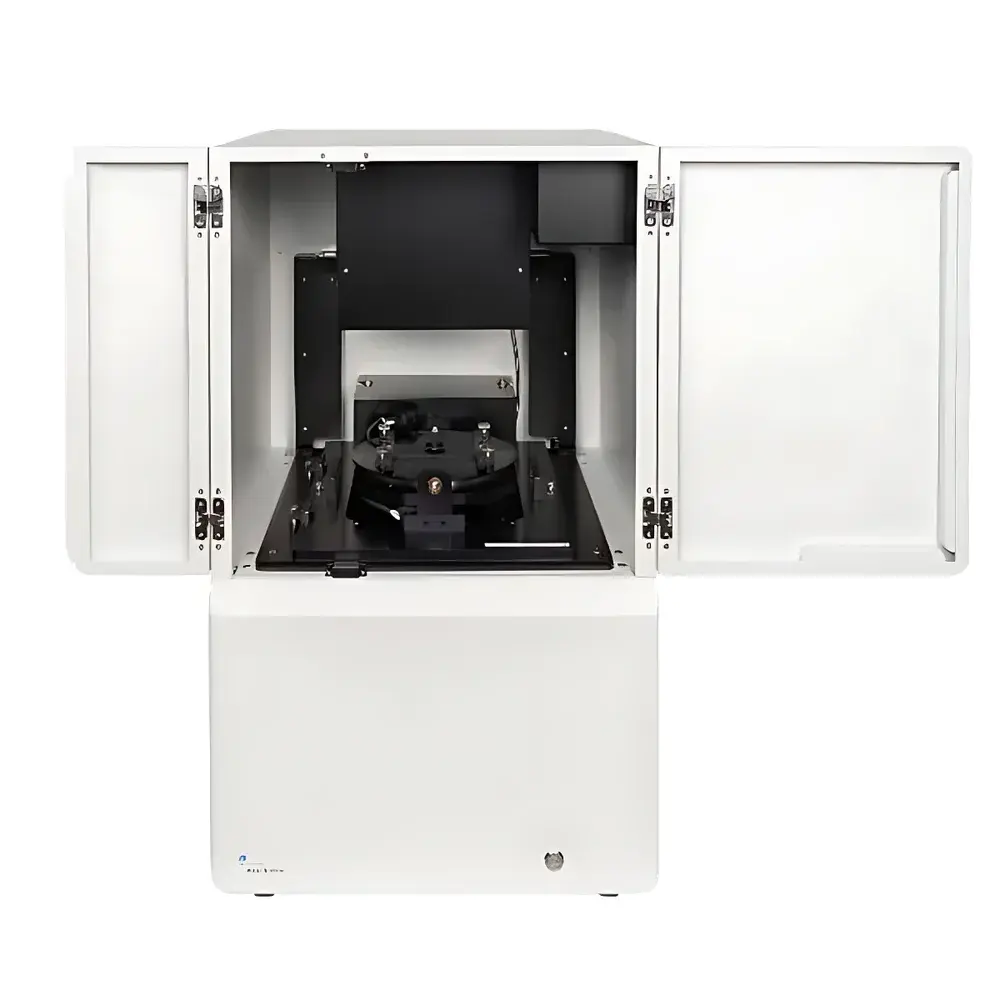
Otsuka Electronics RETS-100nx Advanced Phase Difference Analyzer
| Brand | Otsuka Electronics |
|---|---|
| Origin | Japan |
| Model | RETS-100nx |
| Measurement Range (Retardation) | 0–60,000 nm |
| Wavelength Range | 400–800 nm (optional extensions available) |
| Retardation Repeatability (n=30) | ≤0.08 nm (quartz waveplate, ~600 nm) |
| Cell Gap Range | 0–600 µm (An=0.1) |
| Cell Gap Repeatability (n=30) | ≤0.005 µm (at ~3 µm gap, An=0.1) |
| Axis Detection Repeatability (n=30) | ≤0.08° |
| Spot Diameter | φ2 mm (standard) |
| Light Source | 100 W halogen lamp |
| Detector | Proprietary high-speed multichannel spectrometer (≈500 wavelength channels) |
| Standard Stage | 100×100 mm fixed platform |
| Optional Accessories | Motorized XY stage, tilt-rotary stage for Rth and 3D birefringence analysis, axis-angle compensation module |
Overview
The Otsuka Electronics RETS-100nx is a high-precision, non-contact phase difference analyzer engineered for comprehensive optical characterization of birefringent thin films and layered optical components. Based on spectroscopic ellipsometry principles combined with instantaneous multichannel spectral acquisition, the system measures retardation (optical path difference), fast/slow axis orientation, and wavelength-dependent dispersion across the visible spectrum (400–800 nm). Its core architecture leverages Otsuka’s proprietary high-throughput multichannel spectrometer—capable of acquiring ≈500 discrete wavelength points per measurement—enabling statistically robust retardation profiles with exceptional signal-to-noise ratio. Unlike single-wavelength or scanning monochromator-based systems, the RETS-100nx delivers full-spectrum data in a single exposure, eliminating mechanical drift and enabling true high-speed, high-reproducibility metrology for production environments and advanced R&D labs.
Key Features
- Non-destructive, contactless measurement of laminated multilayer films—including OLED polarizers, IPS liquid crystal compensation films, and hybrid retardation stacks—without delamination or surface damage.
- Ultra-wide retardation range: 0–60,000 nm, supporting characterization of both standard quarter-wave plates and ultra-high-retardation industrial films used in next-generation displays.
- High-resolution spectral acquisition: ≈500 wavelength channels per measurement—approximately 50× the spectral sampling density of conventional competing instruments—ensuring accurate dispersion modeling and reliable Rth (thickness-normalized out-of-plane retardation) calculation.
- Integrated axis-angle compensation algorithm corrects for sample misalignment during repositioning, maintaining sub-0.1° angular repeatability (≤0.08°, n=30, verified on calibrated quartz waveplates).
- Optional motorized tilt-rotary stage enables full three-dimensional birefringence analysis (nx, ny, nz) and precise Rth determination per ISO 10110-5 and JIS K 7134 standards.
- Standard φ2 mm spot size optimized for micro-area mapping; compatible with optional automated XY translation for spatially resolved retardation profiling.
Sample Compatibility & Compliance
The RETS-100nx is validated for direct measurement of industrially relevant optical materials including stretched polymer films (e.g., PC, COP, TAC), liquid crystal cells, photo-aligned layers, and laminated polarizer assemblies. It complies with key international standards governing optical film metrology, including ISO 5–1 (retardation measurement terminology), ISO 10110-5 (specification of optical components—birefringence), and JIS K 7134 (test methods for retardation of plastic films). Its non-invasive methodology supports GLP-compliant quality control workflows where sample integrity must be preserved for downstream testing or qualification. The system’s traceable calibration protocol—using NIST-traceable quartz reference waveplates—is documented per ISO/IEC 17025 requirements for accredited laboratories.
Software & Data Management
The instrument operates under Otsuka’s dedicated RETS Control Suite, a Windows-based application designed for metrology-grade data acquisition and analysis. Software modules support real-time spectral visualization, multi-parameter fitting (e.g., simultaneous extraction of retardation, axis angle, and absorption anisotropy), and automated report generation compliant with 21 CFR Part 11 audit trail requirements. All raw spectral interferograms and processed parameters are stored in vendor-neutral HDF5 format, enabling third-party integration with MATLAB, Python (NumPy/H5Py), or LIMS platforms. Calibration history, user access logs, and measurement metadata are retained with time-stamped digital signatures to satisfy GMP documentation requirements.
Applications
- Development and process validation of wide-viewing-angle LCD compensation films (A-plate, C-plate, O-plate)
- Characterization of OLED circular polarizer stacks and encapsulation-induced birefringence
- In-line QC of roll-to-roll coated retardation films for display manufacturing
- R&D of photoaligned liquid crystal polymer (LCP) films and patterned alignment layers
- Quantitative evaluation of cell gap uniformity and pretilt angle distribution in TFT-LCD test cells
- Material screening of novel birefringent polymers and nanocomposite films
FAQ
What is the maximum measurable retardation, and how is accuracy maintained at high values?
The RETS-100nx supports retardation up to 60,000 nm using harmonic-order ambiguity resolution based on multi-wavelength spectral interference analysis. Accuracy is preserved through continuous spectral calibration and phase-unwrapping algorithms validated against NIST-traceable standards.
Can the system measure Rth without destructive cross-sectioning?
Yes—when equipped with the optional tilt-rotary stage, the RETS-100nx performs non-contact, angle-resolved measurements enabling full 3D refractive index tensor reconstruction (nx, ny, nz) and direct Rth calculation per ISO 10110-5 Annex B.
Is the software compliant with FDA 21 CFR Part 11 for regulated environments?
Yes—the RETS Control Suite implements electronic signatures, role-based access control, immutable audit trails, and data integrity safeguards aligned with 21 CFR Part 11 and EU Annex 11 requirements.
What sample handling options are available for automated throughput?
Motorized XY stages (±50 mm travel, 0.1 µm resolution) and programmable sample loaders integrate seamlessly with the control software for unattended batch measurement of standardized substrates or wafer-mounted films.
How does the multichannel spectrometer improve measurement fidelity compared to scanning systems?
By capturing all 500 wavelengths simultaneously, the system eliminates temporal artifacts from source fluctuation or mechanical vibration, yielding superior repeatability (≤0.08 nm) and enabling dynamic measurement of time-varying birefringence in stimuli-responsive films.






