
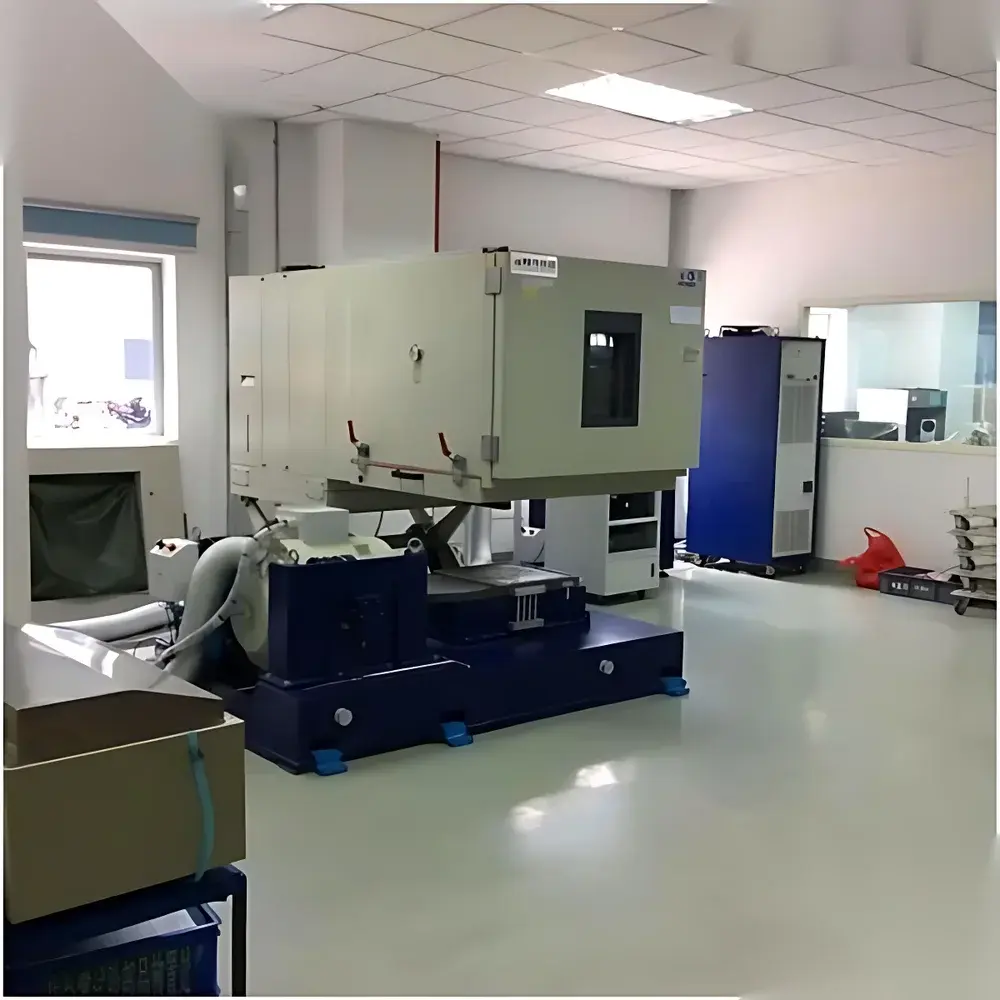
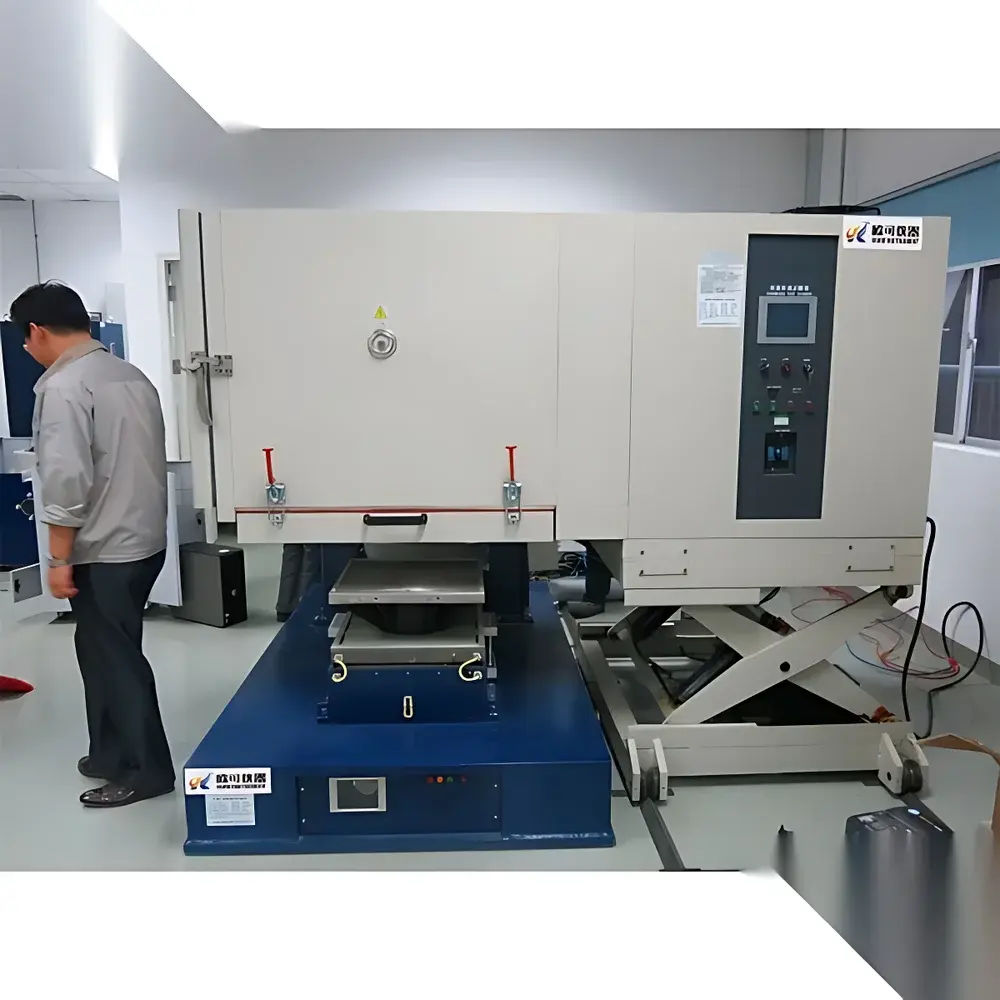
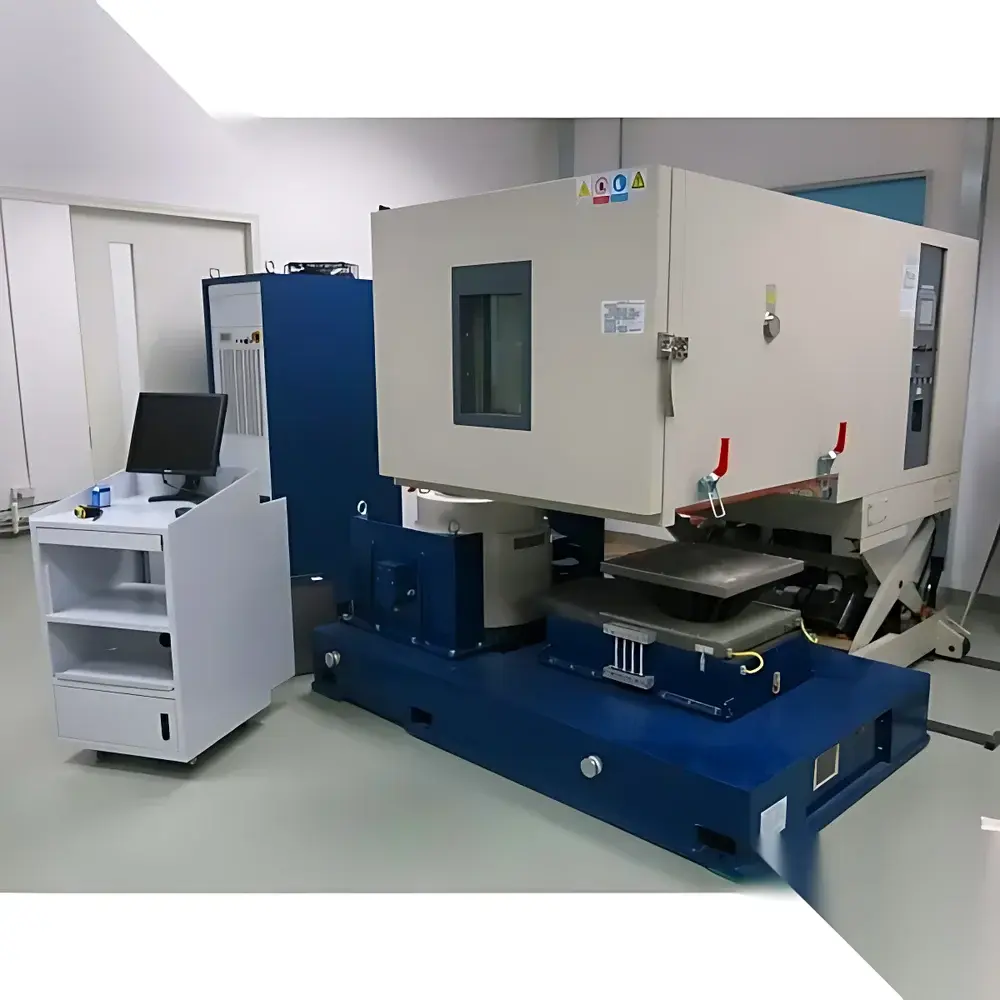
Ouke Combined Temperature-Humidity-Vibration Environmental Test Chamber
| Brand | Other Brands |
|---|---|
| Origin | Imported |
| Manufacturer Type | General Distributor |
| Price | USD 21,500 (approx.) |
| Compliance | GB/T 2423.1–2023, GB/T 2423.2–2023, GB/T 5170.2–2017, GB/T 11158–2012, GB/T 10592–2023 |
| Control System | 7" or 10" Touchscreen PID Controller with Ethernet/RS-232/RS-485 Interface |
| Refrigeration | Dual-stage cascade refrigeration system with hermetic Tecumseh (France) compressors |
| Interior Material | Electropolished 304 stainless steel, full TIG-welded seams |
| Exterior Material | Powder-coated or polyurethane-coated structural steel |
| Vibration Integration | Standard mounting interface for electrodynamic or servo-hydraulic shakers |
| Data Logging | Onboard SD/USB storage, email/SMS alarm notifications, audit-trail-capable event logging |
Overview
The Ouke Combined Temperature-Humidity-Vibration Environmental Test Chamber is an integrated reliability validation platform engineered for concurrent simulation of thermal, hygroscopic, and dynamic mechanical stress conditions. It operates on the principle of synergistic environmental exposure—simultaneously controlling chamber temperature (−70 °C to +180 °C), relative humidity (10 %RH to 98 %RH), and broadband vibration input (typically 5–2000 Hz, up to 100 g peak acceleration when coupled with compatible shakers). This triaxial stress combination replicates real-world service environments encountered by aerospace avionics, automotive ECUs, medical device enclosures, and high-reliability PCB assemblies. The chamber’s thermodynamic architecture employs a dual-stage cascade refrigeration circuit with hermetically sealed Tecumseh compressors—ensuring stable sub-zero operation and rapid thermal transition rates (≥3 °C/min average ramp rate under load). Its aerodynamic design features multi-blade centrifugal blowers and optimized air ducting to achieve ≤±0.5 °C temperature uniformity and ≤±2 %RH humidity uniformity across the working volume per IEC 60068-3-5 and GB/T 5170.2.
Key Features
- Full-welded 304 stainless steel interior with electropolished finish—resistant to corrosion, condensation ingress, and microbial retention; compliant with ISO 14644-1 Class 8 cleanroom maintenance protocols.
- 7-inch or 10-inch industrial-grade touchscreen controller with embedded PID auto-tuning algorithm—enabling real-time compensation for thermal inertia and load-dependent humidity lag.
- Dual independent control loops: one for temperature/humidity regulation via steam humidification and direct-expansion cooling; another for synchronized vibration profile triggering via RS-485 or Ethernet-based command forwarding.
- Integrated safety architecture: dual independent overtemperature cutoffs (mechanical and electronic), dew-point monitoring to prevent condensation on test specimens, and automatic door-interlock shutdown.
- Structural outer shell fabricated from cold-rolled steel with durable polyurethane or custom powder coating—designed for long-term laboratory or production-floor deployment without dimensional drift.
- Optical-grade double-glazed observation window with anti-fog heating element and LED interior lighting—enabling non-intrusive visual inspection during active test cycles.
Sample Compatibility & Compliance
The chamber accommodates standard test specimens up to 600 mm × 600 mm × 600 mm (W×D×H), with optional internal fixtures supporting DIN 45020, MIL-STD-810H, and IEC 60068-2-64 compliant mounting configurations. All operational parameters are traceably calibrated per GB/T 5170.2–2017 and ISO/IEC 17025 requirements. The system satisfies mandatory clauses of China’s national standards GB/T 2423.1 (cold), GB/T 2423.2 (dry heat), GB/T 2423.3 (damp heat, cyclic), and GB/T 2423.10 (vibration). Optional third-party calibration certificates—including uncertainty budgets referenced to NIM (National Institute of Metrology, China)—are available upon request. For regulated industries, the controller firmware supports configurable audit trails, user-level access control (admin/operator/guest), and electronic signature capability aligned with FDA 21 CFR Part 11 Annex 11 expectations.
Software & Data Management
The embedded controller runs proprietary firmware with EZ-View™ remote supervision software (optional license), enabling centralized monitoring and control of up to 32 chambers across geographically dispersed facilities via secure HTTPS or VPN tunnels. All test logs—including setpoints, actual values, alarm events, and vibration trigger timestamps—are stored in CSV-compliant format with ISO 8601 timestamping. Data export supports USB mass storage devices, network file shares (SMB/NFS), and automated email delivery with TLS encryption. Event-driven notifications include SMS alerts via GSM gateway and SMTP-based email with customizable templates. Raw data files retain metadata such as operator ID, calibration status, and environmental sensor serial numbers—facilitating full traceability in GLP/GMP audits.
Applications
This chamber is routinely deployed in product qualification labs for accelerated life testing of electronic assemblies subjected to combined thermal cycling and mechanical shock (e.g., solder joint fatigue analysis per IPC-9701); validation of sealing integrity in IP67-rated enclosures under humid thermal soak; evaluation of polymer creep behavior under sustained vibration and elevated humidity; and verification of battery thermal management system performance under dynamic thermal-hygric loads. It serves as a primary tool for compliance testing against GB/T 2423 series, IEC 60068-2, MIL-STD-810H Method 514.7 (vibration), and ISO 16750-4 (road vehicles—electrical disturbances). Automotive Tier-1 suppliers use it for PPAP submission evidence generation, while R&D teams apply it to failure mode identification during HALT/HASS protocols.
FAQ
Does the chamber support synchronized vibration profiling with temperature/humidity ramps?
Yes—the controller accepts external trigger signals from compatible shaker amplifiers and can initiate predefined vibration spectra at specified temperature/humidity setpoints or time intervals.
Can the system be integrated into a factory MES or LIMS environment?
Yes—via Modbus TCP, OPC UA, or RESTful API interfaces (available as optional software modules), enabling bidirectional data exchange with enterprise systems.
What is the maximum allowable specimen weight when interfaced with a vibration table?
The standard mounting interface supports payloads up to 50 kg; heavier loads require reinforced base plates and dynamic load analysis per ISO 10816-3.
Is humidity control possible below 0 °C?
Humidity is not actively controlled below freezing due to condensation risk; however, the chamber maintains dry nitrogen purge capability to suppress ice formation in sub-zero damp heat profiles.
How frequently must the system undergo metrological recalibration?
Per GB/T 5170.2, temperature and humidity sensors require annual calibration; vibration transducers (when integrated) follow ISO 16063-21 guidelines with biannual verification recommended for production-critical use.



