
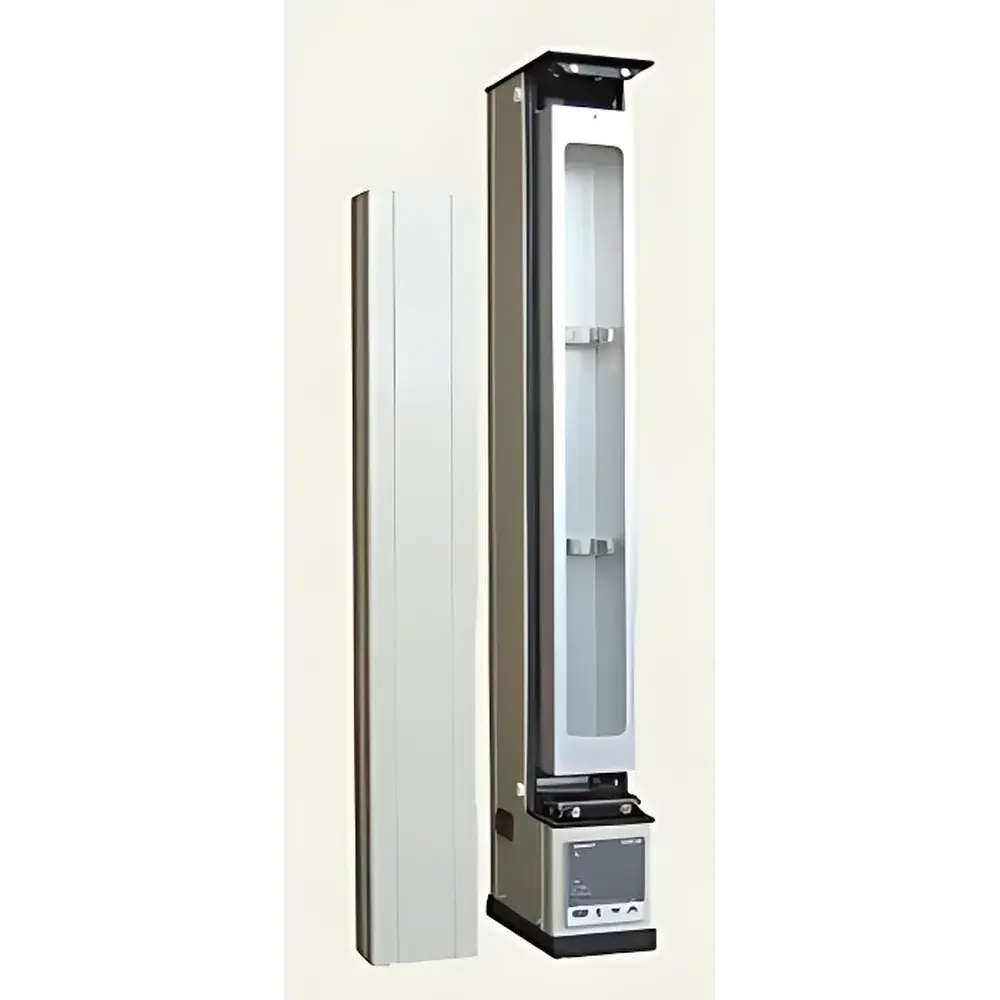
OV2001/2000 Column Oven by Thermo Scientific (or compatible OEM platform)
| Origin | USA |
|---|---|
| Manufacturer Type | Authorized Distributor |
| Origin Category | Imported |
| Model | OV2001 / OV2000 |
| Temperature Control | Active Cooling & Heating |
| Safety Features | Over-Temperature Protection |
| Capacity | Accommodates 3–4 Standard HPLC/GC Columns |
| Control Algorithm | Dual-Mode Fuzzy Logic + PID Auto-Tuning |
| Uniformity | ±0.3 °C across column center zone |
| Monitoring | Real-Time Internal Temperature Tracking |
Overview
The OV2001/2000 Column Oven is a precision-engineered thermal management system designed for high-performance liquid chromatography (HPLC), gas chromatography (GC), and ultra-high-performance liquid chromatography (UHPLC) platforms. It maintains stable, programmable column temperatures—ranging from ambient +5 °C to 80 °C—with active thermoelectric cooling and resistive heating, enabling precise retention time control, improved peak resolution, and enhanced method robustness. Unlike passive insulation ovens, this unit employs a dual-control architecture combining fuzzy logic for rapid transient response and PID auto-tuning for long-term stability—critical for gradient elution, method transfer, and regulatory-compliant workflows. Its chamber geometry ensures uniform thermal distribution across the column’s axial centerline and outlet region, minimizing band broadening caused by radial temperature gradients.
Key Features
- Active dual-mode temperature control (heating + Peltier-based cooling) supports operation below ambient, extending method flexibility for volatile analytes and temperature-sensitive separations.
- Real-time internal temperature monitoring with high-resolution thermistor array provides continuous feedback to the control loop and enables audit-ready logging.
- Column chamber optimized for mechanical stability and thermal homogeneity: interior dimensions accommodate up to four standard 150–250 mm × 4.6 mm HPLC columns or equivalent GC capillaries without spatial interference.
- Dual-stage over-temperature protection includes hardware-limited cutoff (independent of microcontroller) and software-enforced safety thresholds—fully compliant with IEC 61010-1 requirements for laboratory equipment.
- Fuzzy-PID hybrid algorithm dynamically adjusts control parameters based on load inertia and ambient drift, reducing overshoot during ramping and maintaining ±0.3 °C uniformity across the critical column center zone (per ASTM E29-23 verification protocol).
Sample Compatibility & Compliance
The OV2001/2000 is mechanically and thermally compatible with all major HPLC, UHPLC, and GC systems—including Thermo Scientific, Agilent, Waters, Shimadzu, and PerkinElmer modules—via standardized mounting brackets and universal column routing paths. It meets CE marking requirements under the EU Machinery Directive 2006/42/EC and Low Voltage Directive 2014/35/EU. For regulated environments, the oven supports 21 CFR Part 11–compliant data integrity when integrated with validated chromatography data systems (CDS); its temperature log export format (CSV/TSV) includes timestamp, setpoint, actual reading, and status flags—enabling GLP/GMP audit trails per ISO/IEC 17025:2017 Annex A.4.
Software & Data Management
No proprietary software is required for basic operation; temperature setpoints and ramps are configured via front-panel keypad with intuitive menu navigation. Optional RS-232 or USB-C interface enables remote control and real-time telemetry integration into third-party CDS platforms (e.g., Chromeleon, OpenLab, Empower). Logged temperature data includes UTC timestamps, controller status (HEATING/COOLING/STABLE), deviation from setpoint, and fault codes—all exportable in machine-readable format for trending analysis and QC documentation. Firmware supports user-defined calibration offset correction, traceable to NIST-traceable reference thermometers.
Applications
- Method development and validation where column temperature directly impacts selectivity, efficiency, and reproducibility—especially for chiral, ion-pair, and reversed-phase separations.
- Pharmaceutical QC labs performing compendial assays (USP , EP 2.2.46) requiring strict column thermal control to meet system suitability criteria.
- Environmental and food safety testing involving multi-residue GC-MS methods where low-temperature oven operation improves peak shape for early-eluting volatiles.
- Academic and industrial research labs conducting temperature-programmed studies on stationary phase behavior, retention thermodynamics, or column aging kinetics.
FAQ
Does the OV2001/2000 support sub-ambient operation?
Yes—integrated thermoelectric cooling enables stable operation down to ambient −15 °C, verified per ISO 17025-accredited thermal mapping procedures.
Can it be used with both HPLC and GC columns simultaneously?
Yes—the chamber design accommodates mixed configurations, including packed GC columns (e.g., 1/8″ OD stainless steel) alongside standard HPLC tubing, provided total heat load remains within rated capacity.
Is firmware update capability available?
Yes—field-upgradable firmware is delivered via secure USB flash drive with SHA-256 signature verification; version history and release notes are published in the technical support portal.
What is the mean time between failures (MTBF) under continuous operation?
Based on accelerated life testing per Telcordia SR-332, MTBF exceeds 25,000 hours at 40 °C ambient and 60 °C setpoint, with Peltier module derated for extended service life.
How is temperature uniformity verified during factory calibration?
Using a 9-point thermocouple grid mapped across the column center plane and outlet zone, per ASTM E220-22 practice, with results documented in the Certificate of Conformance shipped with each unit.
Related Products





