
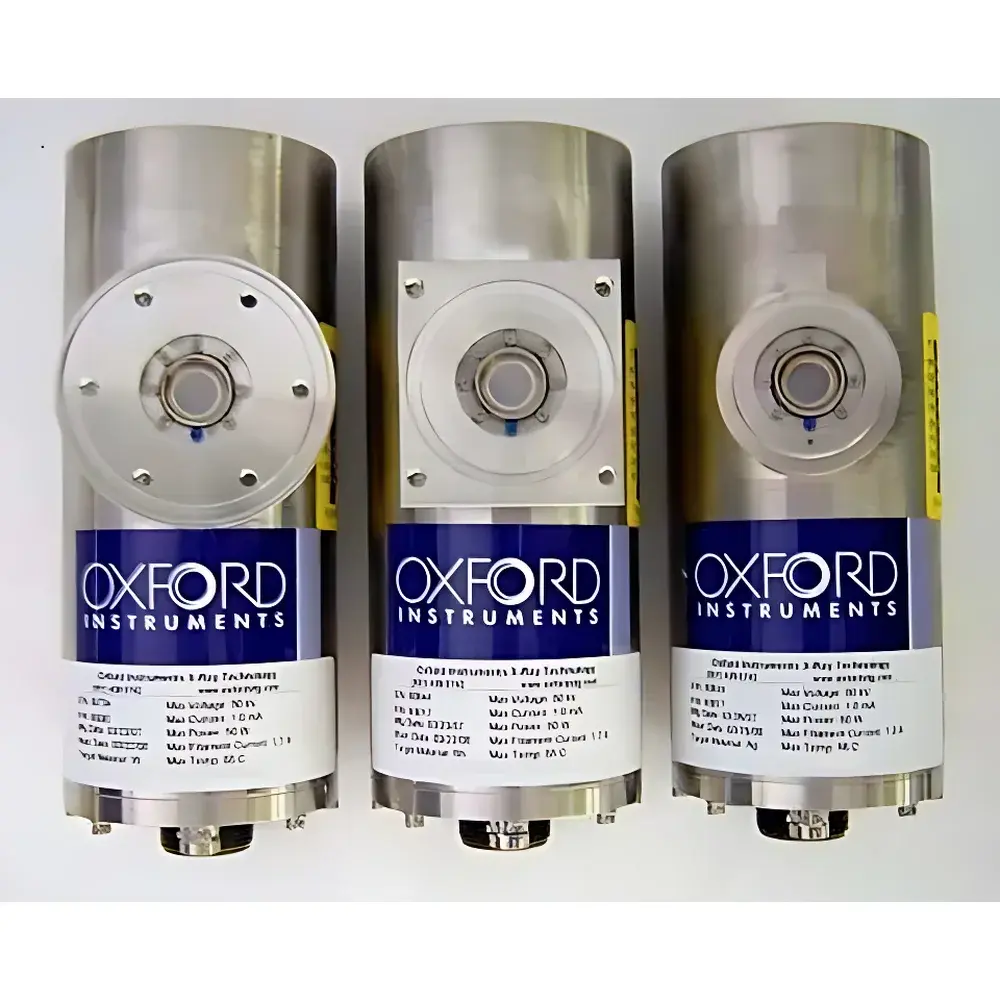
Oxford Instruments 5000 Series Sealed X-ray Tube
| Brand | Oxford Instruments |
|---|---|
| Origin | USA |
| Model | 5000 Series |
| Max Anode Current | 1.0 mA |
| Max Anode Voltage | 50 kV |
| Max Power | 50 W |
| Filament Nominal Voltage | 2.0 V @ 50 kV, 1 mA |
| Filament Max Current | 1.7 A |
| Stability (4 hr) | ±0.2% |
| Nominal Focal Spot Size | 110 µm |
| Anode Material Options | W, Mo, Rh (custom anodes available) |
| Beryllium Window Thickness Options | 75 µm, 125 µm, 250 µm |
| Approx. Weight | 1.816 kg (4 lbs) |
| Cooling Method | Compressed Air @ 150 CFM |
| Beam Divergence Angle | 25° |
Overview
The Oxford Instruments 5000 Series Sealed X-ray Tube is a high-reliability, side-window-configured X-ray source engineered for integration into benchtop and industrial X-ray fluorescence (XRF), energy-dispersive X-ray spectroscopy (EDS), and X-ray diffraction (XRD) systems. Designed around a robust sealed-tube architecture, it eliminates the need for vacuum pumping infrastructure while maintaining stable, reproducible output over extended operational cycles. The tube operates on the principle of electron bombardment of a solid anode target—where thermionically emitted electrons from a tungsten filament are accelerated across a high-voltage potential (up to 50 kV) and focused onto a precisely defined focal spot. Characteristic X-rays generated at the anode are extracted through a beryllium exit window, with spectral output determined by anode material (W, Mo, or Rh standard; custom targets available per application requirements). Its hermetically sealed stainless-steel housing incorporates integrated lead shielding to meet international radiation safety standards (IEC 61010-1, IEC 62495), ensuring compliance in both laboratory and production-floor environments.
Key Features
- Hermetically sealed construction with internal lead-lined stainless-steel enclosure for inherent radiation containment and mechanical durability.
- Optimized thermal management via proprietary dielectric cooling oil fill, coupled with forced-air cooling (150 CFM compressed air) to sustain continuous 50 W operation without thermal drift.
- High-stability electron optics: filament current regulation supports <±0.2% intensity variation after 4 hours of continuous operation—critical for quantitative XRF calibration and long-duration EDS mapping.
- Modular flange interface (CF, ISO-KF, or custom OEM flanges) enables drop-in replacement or system-specific integration across OEM analytical platforms.
- Multiple beryllium window thickness options (75 µm, 125 µm, 250 µm) allow spectral transmission tuning—balancing low-energy sensitivity (e.g., Na, Mg, Al Kα) against window longevity and vacuum integrity.
- Nominal focal spot size of 110 µm ensures sufficient spatial resolution for micro-XRF and small-spot excitation applications without compromising photon flux density.
Sample Compatibility & Compliance
The 5000 Series is compatible with solid, powdered, and thin-film samples routinely analyzed in regulated QA/QC workflows—including metal alloys, geological specimens, polymer additives, and electronic solder joints. It meets electromagnetic compatibility (EMC) requirements per EN 61326-1 and conforms to radiation safety directives under EU Directive 2013/59/Euratom. When installed in certified XRF or XRD systems, the tube supports GLP-compliant data acquisition when paired with software enabling audit-trail logging (e.g., ASTM E135–22 compliant reporting frameworks). Its sealed design eliminates gas contamination risks associated with open-tube sources—ensuring consistent performance across ISO/IEC 17025-accredited laboratories.
Software & Data Management
While the 5000 Series tube itself is hardware-only, its electrical and thermal interfaces are designed for seamless interoperability with industry-standard high-voltage power supplies (e.g., Spellman, UltraVolt) and OEM control firmware. Digital communication protocols (RS-232, CAN bus, or analog 0–10 V feedback loops) support real-time monitoring of filament current, anode voltage, and thermal sensor outputs. Integration with spectral acquisition software (e.g., Thermo Fisher’s SuperQ, Bruker’s ESPRIT, or open-source PyMca) enables automated tube parameter synchronization during multi-element quantification routines. Firmware-level interlocks prevent operation outside safe voltage/current envelopes, supporting FDA 21 CFR Part 11–aligned system validation where traceable parameter logging is required.
Applications
- Wavelength- and energy-dispersive XRF for RoHS-compliant elemental screening in electronics manufacturing.
- In-line alloy verification in metal recycling and foundry QA using Mo-anode tubes for enhanced Fe/Ni/Cr differentiation.
- Micro-XRF mapping of catalyst layer heterogeneity in fuel cell R&D, leveraging Rh-anode spectral purity for Pt/La detection.
- Portable XRD phase identification in field geology, where compact size and air-cooling eliminate reliance on external chillers.
- Academic teaching labs requiring maintenance-free, turnkey X-ray sources for Bragg’s law demonstrations and crystallography instruction.
FAQ
What anode materials are standard, and how do they affect spectral output?
Tungsten (W), molybdenum (Mo), and rhodium (Rh) are standard anode options. W provides broad Bremsstrahlung continuum with strong Kα at 59.3 keV; Mo yields higher Kα/Kβ ratio at 17.5/19.6 keV—ideal for mid-Z elements; Rh enhances sensitivity for light elements (Na–Ca) due to lower absorption edge and efficient L-line excitation.
Is the tube compatible with existing OEM spectrometers?
Yes—the 5000 Series supports common flange geometries (CF-35, ISO-KF40) and electrical interfaces. Mechanical and electrical integration kits—including HV cable assemblies and cooling duct adapters—are available upon request for major platform families (e.g., PANalytical, Rigaku, Horiba).
How is radiation safety ensured during installation and operation?
The integrated lead shielding meets Type B packaging equivalency per IAEA SSR-6. Full-system shielding validation must be performed per local regulatory authority requirements (e.g., NRC 10 CFR 35, UK IR(ME)R), but the tube itself contributes ≤0.5 µSv/h at 5 cm under nominal operating conditions.
Can the tube be operated in vacuum environments?
No—the internal oil fill and sealed envelope are optimized for atmospheric or inert-gas purged enclosures only. Operation under vacuum will compromise seal integrity and thermal performance.
What is the expected service life under continuous use?
Based on accelerated lifetime testing at rated 50 W, mean time to failure exceeds 15,000 hours. Filament replacement is not user-serviceable; end-of-life units are returned for factory refurbishment or exchange under Oxford Instruments’ extended warranty program.




