
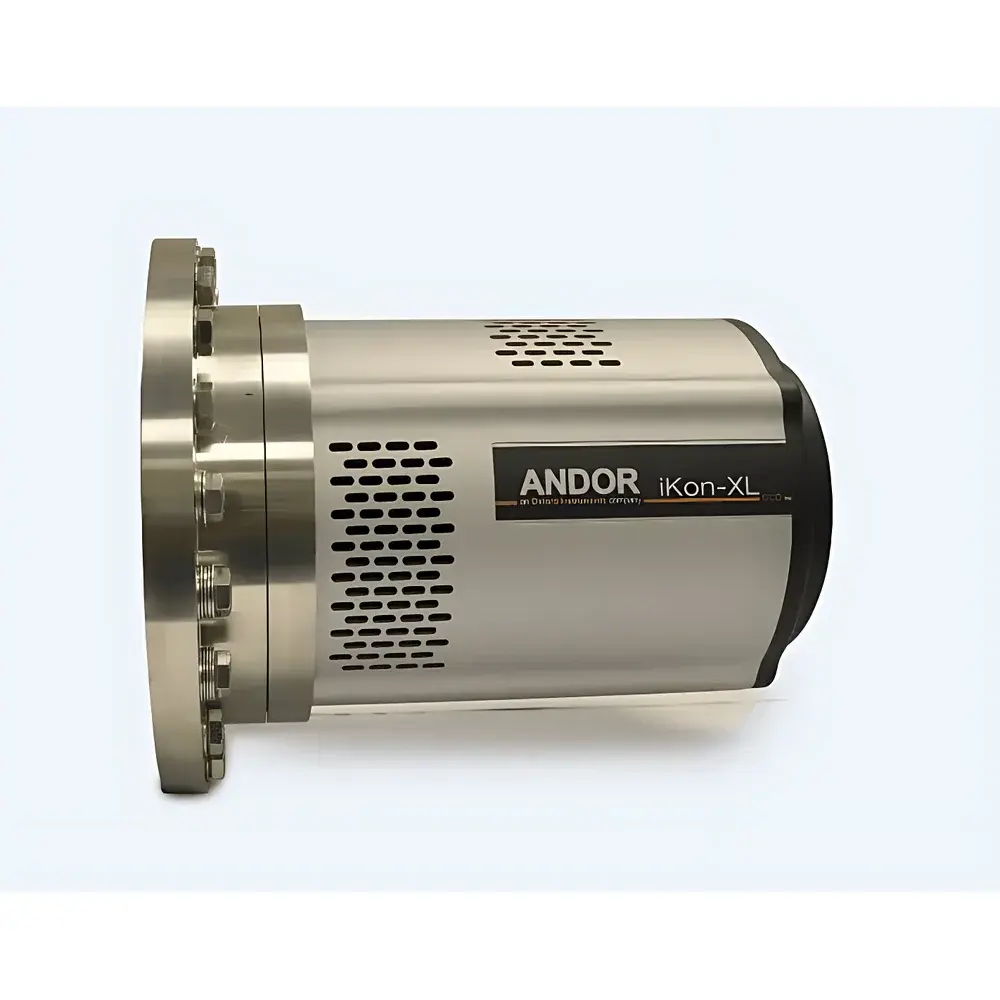
Oxford Instruments Andor iKon-XL CCD Camera
| Brand | Oxford Instruments |
|---|---|
| Origin | United Kingdom |
| Manufacturer Type | Authorized Distributor |
| Origin Category | Imported |
| Model | iKon-XL CCD |
| Price Range | USD 13,500 – 68,000 (est.) |
| Effective Pixels | 16.8 Megapixel |
| Pixel Size | 15 × 15 µm |
| Sensor Type | Back-Illuminated CCD (e2v CCD231-84 or CCD230-84) |
| Cooling Method | Thermoelectric (TE) with ColdSpace™ |
| Operating Temperature | −100 °C |
| Quantum Efficiency | Up to 95% (deep-depletion NIR-enhanced) |
| Read Noise | ≤ 2.1 e⁻ |
| Full Well Capacity | 350,000 e⁻ |
| Digitization | 18-bit ADC |
| Interface | USB 3.0 or Fiber Optic |
| Readout Modes | Single-channel or Quad-channel (quadrant-balanced) |
Overview
The Oxford Instruments Andor iKon-XL CCD Camera is a high-performance, thermoelectrically cooled scientific imaging platform engineered for demanding low-light, long-exposure applications in astronomy, astrophysics, and synchrotron-based imaging. Built around large-format, back-illuminated CCD sensors from e2v—specifically the CCD231-84 and CCD230-84—the iKon-XL delivers exceptional quantum efficiency (up to 95% in deep-depletion configuration), ultra-low read noise (≤2.1 e⁻), and high full-well capacity (350 ke⁻), enabling reliable detection of faint photonic signals over integration times spanning minutes to hours. Its proprietary ColdSpace™ technology achieves stable −100 °C sensor cooling using solid-state thermoelectric elements—eliminating dependency on liquid nitrogen dewars or mechanically complex cryo-coolers. This architecture ensures operational robustness, minimal maintenance, and compatibility with remote observatory environments where reliability and uptime are mission-critical.
Key Features
- Patent-pending ColdSpace™ thermoelectric cooling system maintaining sensor temperature at −100 °C with <0.1 °C stability over multi-hour exposures
- Back-illuminated e2v CCD231-84 (NIR-optimized deep-depletion) and CCD230-84 (61.4 × 61.4 mm active area, 4096 × 4096 format) sensors
- 18-bit analog-to-digital conversion enabling extended dynamic range without gain switching or frame averaging
- Quad-channel readout architecture with quadrant-balanced electronics for improved spatial uniformity and reduced fixed-pattern noise
- Dual interface options: high-bandwidth USB 3.0 for lab integration or fiber-optic link (up to 100 m) for EMI-immune operation in radio-quiet telescope enclosures
- Hermetically sealed vacuum chamber with anti-reflection coated, fused-silica window optimized for UV–NIR transmission (200–1100 nm)
Sample Compatibility & Compliance
The iKon-XL is designed for photon-starved imaging modalities requiring high spatial fidelity and radiometric accuracy. It supports direct coupling to Ritchey-Chrétien, Cassegrain, and wide-field corrector optics via standard C-mount or custom flange interfaces. The deep-depletion sensor variant complies with ISO 14644-1 Class 5 cleanroom handling protocols during assembly and is qualified for use in environments meeting IEC 61000-6-2 (immunity) and IEC 61000-6-3 (emissions) standards. Firmware and acquisition software support audit trails, user access control, and metadata stamping aligned with GLP and ISO/IEC 17025 documentation requirements. While not FDA-regulated, its data integrity features—including non-volatile configuration storage and CRC-verified image headers—facilitate compliance with 21 CFR Part 11 when deployed in regulated research settings.
Software & Data Management
Andor’s SOLIS® software suite (v6.10+) provides native support for iKon-XL, offering real-time bias/dark/flat calibration, non-uniformity correction, and pixel defect mapping. All acquired frames embed FITS-compliant headers containing exposure time, sensor temperature, ADC gain, and environmental telemetry. Raw 18-bit data can be exported losslessly in FITS, HDF5, or Andor Binary formats. The SDK (C/C++, Python, MATLAB) enables integration into custom observatory control systems (e.g., INDI, ASCOM Alpaca) and pipeline frameworks such as Astropy and IRAF. Remote operation is supported via TLS-secured HTTP API, allowing command-and-control from Linux, macOS, or Windows clients across campus or WAN networks—critical for robotic telescope networks and distributed sky surveys.
Applications
- Wide-field astronomical surveys (e.g., transient detection, galactic structure mapping)
- Exoplanet transit photometry requiring sub-mmag precision over multi-night baselines
- Spatially resolved spectroscopy using slit or integral field units (IFUs)
- Orbital debris tracking and characterization in LEO/MEO regimes
- X-ray and neutron radiography in materials science beamlines (with scintillator coupling)
- Low-background luminescence imaging in cryogenic physics experiments
FAQ
Does the iKon-XL require liquid nitrogen or mechanical cryocoolers?
No. ColdSpace™ thermoelectric cooling achieves and maintains −100 °C sensor temperature without consumables or moving parts.
What is the difference between the iKon-XL 231 and iKon-XL 230 models?
The iKon-XL 231 uses the e2v CCD231-84 sensor optimized for NIR quantum efficiency and lowest read noise; the iKon-XL 230 employs the larger-area CCD230-84 (61.4 × 61.4 mm) for maximum field-of-view applications.
Is the 18-bit digitization implemented via hardware oversampling or software binning?
It is native hardware digitization—each pixel value is resolved across 262,144 discrete levels by a single 18-bit ADC per readout channel, preserving shot-noise-limited performance.
Can the camera operate unattended for extended periods in remote observatories?
Yes. It features watchdog timers, automatic thermal recalibration, and power-fail recovery logic. Field deployments exceeding 12 months continuous operation have been validated under ESO and NOIRLab specifications.
Are calibration frames (bias, dark, flat) supported within SOLIS?
Yes. SOLIS includes automated master calibration generation, pixel-response normalization, and temperature-stabilized dark library management with linear interpolation between stored darks.



