
Oxford Instruments Asylum Research blueDrive Photothermal Excitation System
| Brand | Oxford Instruments |
|---|---|
| Origin | Germany |
| Manufacturer Type | Authorized Distributor |
| Origin Category | Imported |
| Model | blueDrive |
| Price Range | USD 13,500 – 68,000 |
| Instrument Type | AFM Accessory |
Overview
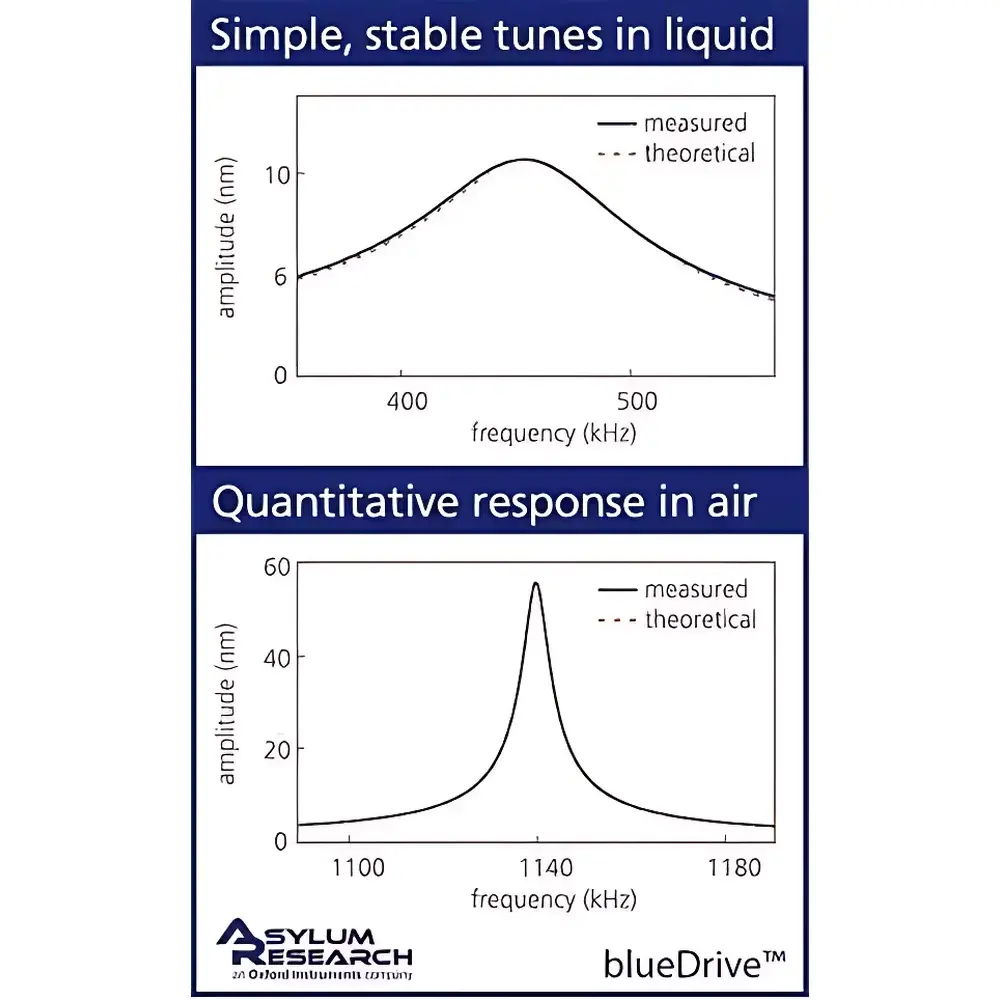
The Oxford Instruments Asylum Research blueDrive Photothermal Excitation System is a precision-engineered optical actuation module designed exclusively for integration with Cypher S and Cypher ES atomic force microscopes (AFMs). Unlike conventional piezoelectric acoustic excitation—where mechanical vibrations are transmitted through the scanner body and induce non-uniform cantilever drive—the blueDrive employs a focused 405 nm blue laser to induce localized thermal expansion at the base of the AFM cantilever. This photothermal mechanism generates a highly linear, low-noise, and resonance-independent driving force that directly couples to the cantilever’s fundamental flexural mode. As a result, blueDrive delivers exceptional phase stability, reduced spurious resonances, and immunity to scanner-induced crosstalk—critical advantages for quantitative dynamic AFM in both ambient air and liquid environments. Its design adheres to the physical principles of photothermal actuation first demonstrated in the 1990s for frequency-modulation (FM) AFM, now refined for robust commercial deployment across amplitude-modulation (AM), phase imaging, and advanced nanomechanical modalities.
Key Features
- 405 nm diode laser source with adjustable power output (0–5 mW), enabling precise thermal actuation without sample heating artifacts
- Optically isolated excitation path—decoupled from mechanical scanner vibrations—ensuring high signal-to-noise ratio and reproducible resonance tracking
- Full compatibility with all Cypher S and Cypher ES AFM platforms, including vacuum-compatible configurations
- Seamless integration with CypherSpotOn™ laser alignment system for real-time optimization of photothermal coupling efficiency
- Enables stable, artifact-free tapping-mode operation in liquids—eliminating hydrodynamic damping inconsistencies associated with piezo-driven systems
- Supports simultaneous multimodal acquisition: topography, phase, EFM, KPFM, MFM, AM-FM, and contact-resonance viscoelastic mapping
Sample Compatibility & Compliance
The blueDrive system is validated for use across a broad spectrum of soft and hard materials—including polymers, biological membranes, hydrogels, battery electrode composites, and 2D materials—under ambient, controlled humidity, and aqueous physiological conditions. It complies with ISO/IEC 17025 calibration traceability requirements when used with Asylum’s certified calibration standards. The absence of mechanical drive components ensures minimal electromagnetic interference, making it suitable for electrostatic and magnetic measurements under GLP-compliant laboratory practices. All firmware and hardware interfaces meet IEC 61326-1 (EMC) and IEC 61010-1 (safety) standards. While not FDA-cleared as a medical device, its operational parameters align with ASTM E2530-22 guidelines for nanomechanical property quantification in research-grade AFM systems.
Software & Data Management
blueDrive operates natively within Asylum Research’s Interactive Mode™ software suite (v15.0+), which provides real-time feedback on photothermal coupling efficiency, laser alignment status, and cantilever thermal response dynamics. The software includes automated resonance search algorithms optimized for photothermally driven modes, with built-in compensation for thermal drift during long-term liquid experiments. All raw excitation signals, cantilever deflection traces, and derived mechanical parameters (e.g., loss tangent, storage modulus) are stored in vendor-neutral HDF5 format, supporting metadata tagging per MIAME/MINSEQ standards. Audit trails, user authentication, and electronic signature functionality comply with 21 CFR Part 11 requirements when deployed in regulated QC/QA environments. Export modules support direct integration with MATLAB, Python (via PySPM), and OriginLab for advanced statistical analysis and publication-ready figure generation.
Applications
- Quantitative nanomechanical mapping of viscoelastic heterogeneity in lithium-ion battery cathodes and solid electrolytes
- In situ monitoring of protein adsorption kinetics and conformational changes on functionalized surfaces in buffer solutions
- High-resolution phase contrast imaging of lipid bilayer domains and membrane raft formation
- Sub-nanometer topographic and surface potential correlation in ferroelectric thin films using synchronized KPFM and tapping-mode acquisition
- Multi-frequency contact resonance spectroscopy for depth-resolved elastic modulus profiling in polymer blends
- Low-dissipation imaging of radiation-sensitive biological specimens (e.g., cryo-prepared viruses) without piezo-induced acoustic noise
FAQ
Is blueDrive compatible with third-party AFM platforms?
No—blueDrive is engineered specifically for Asylum Research Cypher S and Cypher ES instruments. Its optical path, firmware interface, and mechanical mounting are proprietary and not adaptable to other AFM architectures.
Does blueDrive require recalibration when switching between air and liquid environments?
No. The photothermal excitation mechanism is inherently insensitive to medium-dependent damping; only minor laser power adjustment is needed to maintain optimal drive amplitude.
Can blueDrive be used for force spectroscopy?
While primarily optimized for dynamic modes, blueDrive supports approach-retract cycles in intermittent-contact configuration with calibrated spring constant tracking via thermal noise analysis.
How does blueDrive improve reproducibility in AM-FM measurements?
By eliminating piezo-induced background noise and providing deterministic cantilever drive, blueDrive reduces phase lag uncertainty and enhances the fidelity of higher-harmonic detection in dual-frequency AM-FM schemes.
Is laser exposure safe for live cells?
Yes—laser power is maintained below 1 mW at the cantilever base, resulting in negligible temperature rise (<0.1 °C) at the tip-sample interface, as verified by finite-element thermal modeling and live-cell viability assays.



