
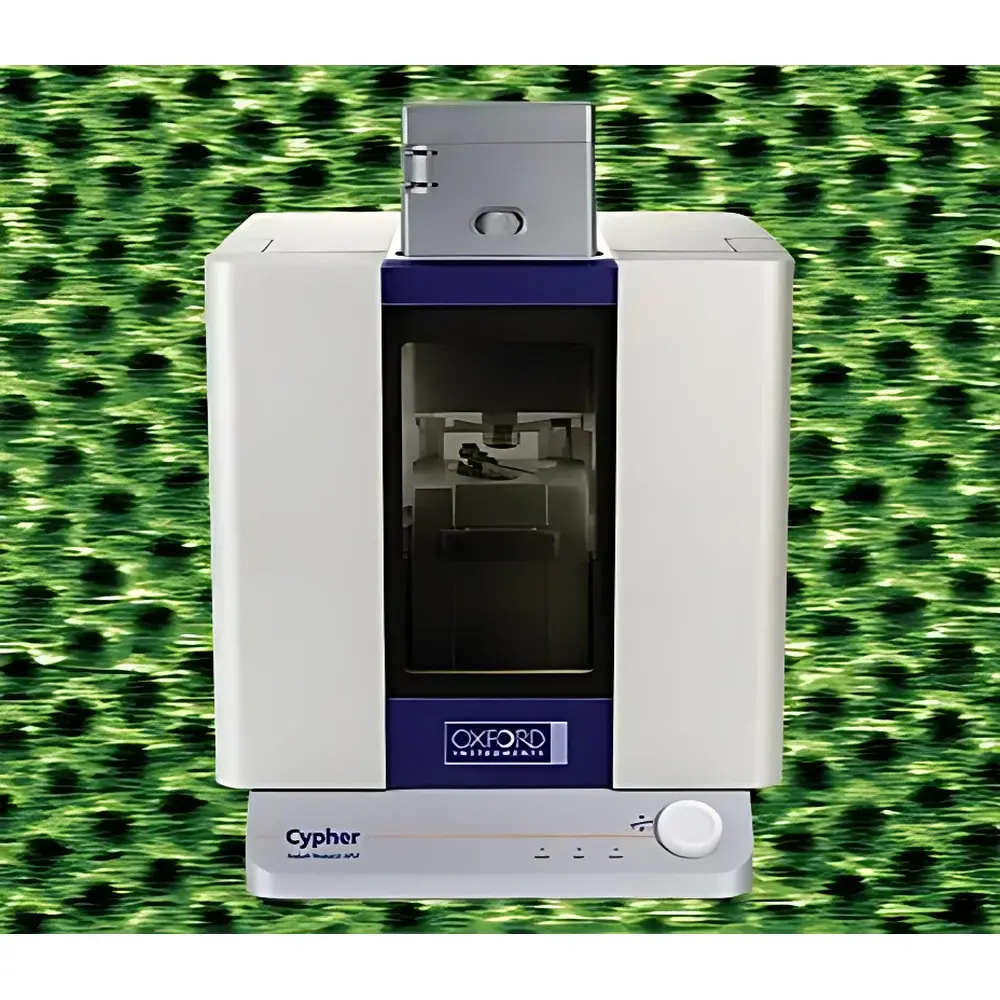
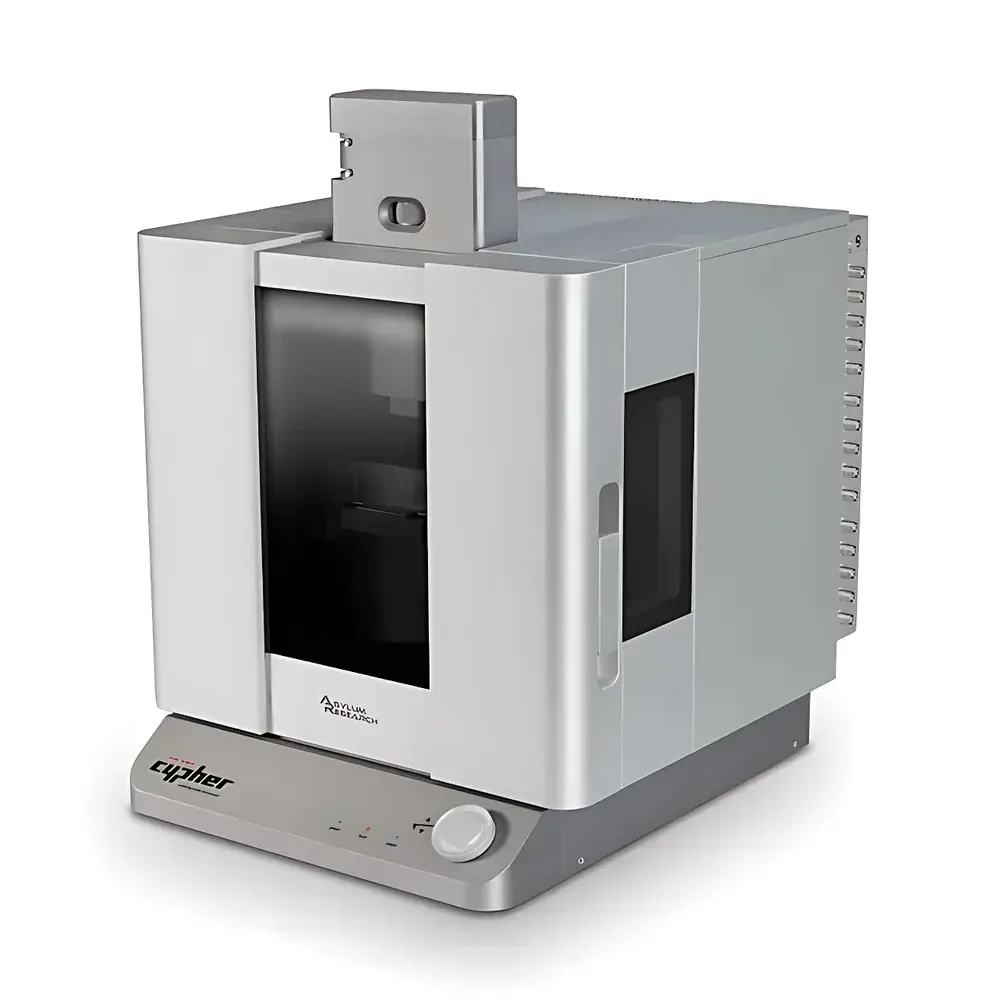
Oxford Instruments Asylum Research Cypher S Atomic Force Microscope
| Brand | Oxford Instruments |
|---|---|
| Origin | USA |
| Manufacturer Type | Authorized Distributor |
| Origin Category | Imported |
| Model | Cypher S |
| Instrument Type | Materials-Focused AFM |
| Closed-Loop Noise (X,Y) | <0.06 nm |
| Closed-Loop Noise (Z) | <0.05 nm |
| Height Noise | <0.015 nm |
| Sample Diameter | <15 mm (standard), <7 mm (high-stability configuration) |
| XY Stage Travel Range | 180 mm × 180 mm |
| Imaging Speed | Up to 10–100× faster than conventional AFMs |
| Probe Compatibility | Supports ultra-small probes (e.g., 3 × 9 µm optical spot size, optional) |
| Environmental Flexibility | Upgradeable to Cypher ES (environmental control) and Cypher VRS (video-rate scanning) |
Overview
The Oxford Instruments Asylum Research Cypher S is a high-performance, commercially available atomic force microscope engineered for rapid, quantitative nanoscale characterization of materials in ambient air and liquid environments. Built upon Asylum Research’s proprietary closed-loop piezoelectric positioning architecture, the Cypher S delivers sub-angstrom mechanical stability and exceptional thermal and acoustic isolation—enabling true atomic-resolution imaging on a routine basis. Its design integrates a low-drift, low-noise Z-sensor with a rigid, monolithic scanner body, minimizing thermal drift (<0.1 nm/min) and mechanical hysteresis. Unlike open-loop systems, the Cypher S employs real-time position feedback across all three axes, ensuring traceable, reproducible topographic and property mapping without post-scan correction artifacts. This makes it particularly suitable for applications demanding metrological rigor—such as thin-film metrology, 2D material characterization, polymer phase analysis, and soft biological sample imaging under physiological conditions.
Key Features
- Mechanical Stability: Industry-leading closed-loop noise floor—X/Y < 0.06 nm, Z < 0.05 nm, height noise < 0.015 nm—achieved via monolithic scanner design and active vibration damping.
- High-Speed Imaging: Scans 10–100× faster than conventional AFMs; supports video-rate imaging when upgraded to Cypher VRS configuration.
- Intelligent Automation Suite: ModeMaster™ auto-configures software parameters per selected mode; SpotOn™ enables one-click motorized laser/detector alignment; GetReal™ performs in situ cantilever spring constant and sensitivity calibration; blueDrive™ enhances tapping-mode stability and quantitation.
- Modular Expandability: Native compatibility with Asylum’s full suite of functional modes—including contact resonance AFM (CR-AFM), conductive AFM (CAFM), piezoresponse force microscopy (PFM), and bimodal AM-FM viscoelastic mapping.
- Large Sample Handling: 180 mm × 180 mm XY motorized stage accommodates wafers, substrates, and multi-sample holders without repositioning.
Sample Compatibility & Compliance
The Cypher S supports samples up to 15 mm in diameter (standard configuration) or 7 mm (optimized for highest stability). It operates reliably in ambient air, controlled humidity chambers, and fully submerged liquid cells—including buffered saline, organic solvents, and electrochemical electrolytes. All hardware and firmware comply with ISO/IEC 17025-relevant instrumentation traceability requirements. Data acquisition meets GLP/GMP-aligned audit trail standards when used with Asylum’s compliant software modules, supporting FDA 21 CFR Part 11–ready metadata logging (user authentication, parameter versioning, timestamped raw data archives). Optional environmental enclosures (Cypher ES) enable temperature-controlled (±0.1 °C), gas-purged, or vacuum-compatible operation per ASTM E2541 and ISO 18758 protocols.
Software & Data Management
Acquisition and analysis are managed through Asylum’s Interactive Microscopy Platform (IMP) software—a modular, scriptable environment built on Python 3.9+ and Qt5. IMP supports batch processing, automated ROI selection, spectral deconvolution, and export to HDF5, TIFF, and MDA formats. Raw force-distance curves, time-series property maps, and multi-channel overlays are stored with embedded calibration metadata (scanner gain, photodiode sensitivity, probe geometry). The platform integrates with third-party tools including MATLAB, Igor Pro, and Python-based analysis pipelines (e.g., scikit-image, AFMpy). Audit logs record every user action, parameter change, and file export—fully compatible with laboratory information management systems (LIMS) via RESTful API.
Applications
- Quantitative nanomechanical mapping of polymer blends, hydrogels, and biomaterials using dual-frequency AM-FM and contact resonance techniques.
- In situ electrochemical AFM (EC-AFM) of battery electrode interfaces during charge/discharge cycling.
- Piezoelectric domain imaging and switching spectroscopy in ferroelectric thin films (Pb(Zr,Ti)O₃, BiFeO₃).
- High-resolution topography and electrical conductivity mapping of graphene, MoS₂, and other 2D heterostructures.
- Dynamic structural monitoring of protein fibrils, lipid bilayers, and extracellular matrix components in buffer at physiological pH and temperature.
FAQ
What distinguishes the Cypher S from conventional AFMs in terms of resolution and repeatability?
Its closed-loop scanner architecture, ultra-low electronic noise floor, and sub-0.1 nm/min thermal drift enable consistent atomic lattice resolution without manual drift compensation or post-processing.
Can the Cypher S be upgraded to support environmental control or video-rate imaging?
Yes—hardware upgrades to Cypher ES (environmental enclosure) and Cypher VRS (high-speed scanner + FPGA controller) are field-installable and preserve full software compatibility.
Is the system compliant with regulatory documentation requirements for quality-controlled labs?
Standard IMP software includes configurable audit trails, electronic signatures, and data integrity features aligned with FDA 21 CFR Part 11 and ISO/IEC 17025 Annex A.2.
What probe types are supported, and how does blueDrive improve tapping-mode performance?
The system accepts standard and ultra-small cantilevers (down to 3 × 9 µm optical spot); blueDrive uses direct photothermal excitation to eliminate acoustic coupling, enabling stable, amplitude-independent frequency tracking and improved modulus quantitation.
What warranty and long-term support options are included?
All systems ship with a two-year comprehensive hardware and software warranty; lifetime no-charge technical and applications support is provided; extended service plans offer industry-low repair cost guarantees.



