
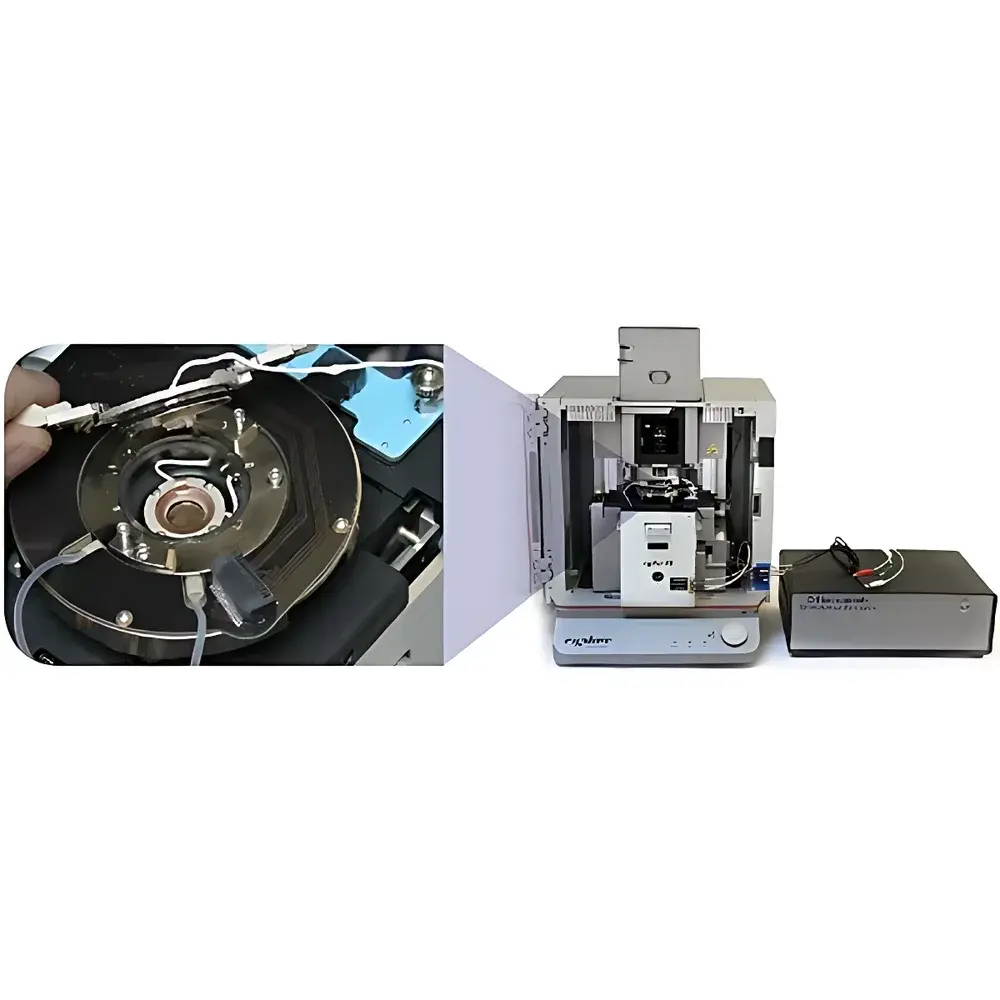
Oxford Instruments Asylum Research Cypher ES Electrochemical Atomic Force Microscope
| Brand | Oxford Instruments |
|---|---|
| Origin | USA |
| Manufacturer Type | Authorized Distributor |
| Origin Category | Imported |
| Model | Cypher ES EC-AFM |
| Price Range | USD 340,000 – 410,000 (FOB) |
| Instrument Type | Atomic Force Microscope (AFM), Materials-Focused |
| Position Detection Noise | 625 Hz (RMS, bandwidth-corrected) |
| Sample Dimensions | Ø < 15 mm, Thickness < 5 mm |
| XY Stage Scan Range | 180 µm × 180 µm (optical field of view), with full 180 mm × 180 mm motorized sample positioning area |
Overview
The Oxford Instruments Asylum Research Cypher ES Electrochemical Atomic Force Microscope (EC-AFM) is a high-performance, modular platform engineered for in situ and operando nanoscale characterization of electrochemical interfaces under controlled liquid or inert-gas environments. Built upon the Cypher ES AFM architecture—renowned for its sub-angstrom height resolution, low thermal drift (<0.1 nm/min), and closed-loop piezoelectric scanning—the system integrates a purpose-designed electrochemical cell module to enable simultaneous topographic, mechanical, and electrical property mapping during potentiostatic or galvanostatic stimulation. The core measurement principle relies on dynamic force detection via optical beam deflection (OBD) with laser interferometric position sensing, enabling quantitative nanomechanical analysis (e.g., modulus, adhesion, dissipation) synchronized with electrochemical current/voltage transients. This architecture meets the stringent demands of fundamental electrochemistry research, battery interface science, corrosion mechanism studies, and bioelectrochemical surface dynamics—where spatial resolution, temporal stability, and environmental fidelity are non-negotiable.
Key Features
- Modular EC-cell integration: Fully sealed, chemically resistant electrochemical cell kit compatible with standard three-electrode configurations (working, counter, reference)
- Fluid-compatible probe holder and liquid cell design optimized for low-noise imaging in aqueous and organic electrolytes (e.g., LiPF6/EC:DMC, H2SO4, PBS, acetonitrile)
- Dual-stage environmental control: Optional Peltier-based sample stage (–20 °C to +80 °C) for thermodynamic profiling of electrode processes; optional glovebox integration (O2/H2O < 0.1 ppm) without compromising scan stability or signal-to-noise ratio
- High-speed closed-loop scanning: Up to 10 Hz frame rate at 512 × 512 pixels with active drift compensation, enabling real-time monitoring of nucleation, dissolution, SEI growth, or biofilm evolution
- Multi-modal correlative capability: Simultaneous acquisition of topography, current mapping (conductive AFM), surface potential (KPFM), and nanomechanical properties (force spectroscopy, QNM)
Sample Compatibility & Compliance
The Cypher ES EC-AFM accommodates a broad range of conductive and semiconductive samples, including Li-ion battery cathodes (NMC, LFP), anode materials (Si, graphite), corrosion-prone alloys (Al 2024, stainless steel), enzymatic electrodes, and microbial biofilms. Sample mounting uses standardized electrochemical fixtures compatible with rotating disk electrodes (RDEs), microband arrays, and thin-film substrates. All wet-cell components comply with ISO 8502-9 (surface cleanliness), ASTM D7235 (electrochemical testing in corrosive media), and USP guidelines for analytical instrument qualification. The system supports GLP/GMP-aligned audit trails when paired with Asylum’s Interactive Mode software and optional 21 CFR Part 11-compliant electronic signature modules.
Software & Data Management
Acquisition and analysis are performed using Asylum Research’s Interactive Mode software—a MATLAB-based platform supporting real-time parameter synchronization between potentiostat (e.g., BioLogic SP-300, CHI 760E) and AFM controller. Software features include automated time-lapse scripting, multi-channel data fusion (topography + current + phase + dissipation), batch processing for statistical morphology analysis (grain size distribution, roughness evolution), and export to HDF5/CSV for third-party modeling (COMSOL, Python-based FEM). Raw data files retain full metadata (timestamp, environmental conditions, electrochemical protocol parameters), ensuring traceability per ISO/IEC 17025 requirements.
Applications
- In situ solid-electrolyte interphase (SEI) formation and degradation kinetics on battery electrodes
- Nanoscale mapping of localized corrosion initiation and pit propagation on passive films
- Real-time observation of metal electrodeposition/dissolution (e.g., Cu, Zn, Li) under controlled overpotential
- Mechano-electrochemical coupling in redox-active polymers and conductive hydrogels
- Topographic and viscoelastic evolution of electroactive biofilms under varying electron acceptor conditions
- Nucleation density and growth orientation of catalytic nanoparticles (e.g., Pt, IrOx) during electrochemical synthesis
FAQ
Can the Cypher ES EC-AFM operate inside a nitrogen-filled glovebox?
Yes—the system’s compact footprint, low-vibration design, and fiber-optic signal transmission allow seamless integration into Class IV gloveboxes while maintaining sub-nanometer resolution and thermal stability.
Is the electrochemical cell compatible with aggressive solvents such as HF-containing electrolytes?
Standard cells use chemically inert PEEK and Viton components; for HF or molten salt systems, custom quartz or sapphire cell variants are available under OEM engineering support.
Does the system support fast-scan cyclic voltammetry coupled with AFM imaging?
Yes—synchronized acquisition at up to 100 mV/s scan rates is achievable with hardware-triggered frame capture and post-hoc alignment of electrochemical transients with topographic sequences.
What level of environmental control is required for stable imaging during long-term (>24 h) experiments?
For extended operando studies, active temperature stabilization (±0.1 °C) and acoustic isolation (Class A vibration table) are recommended; humidity control is optional unless studying hygroscopic systems.
How is probe contamination mitigated during prolonged immersion in electrolyte?
The system includes automated cantilever rinsing protocols, UV-ozone cleaning integration, and real-time resonance frequency tracking to detect coating-induced damping before image artifacts occur.




