
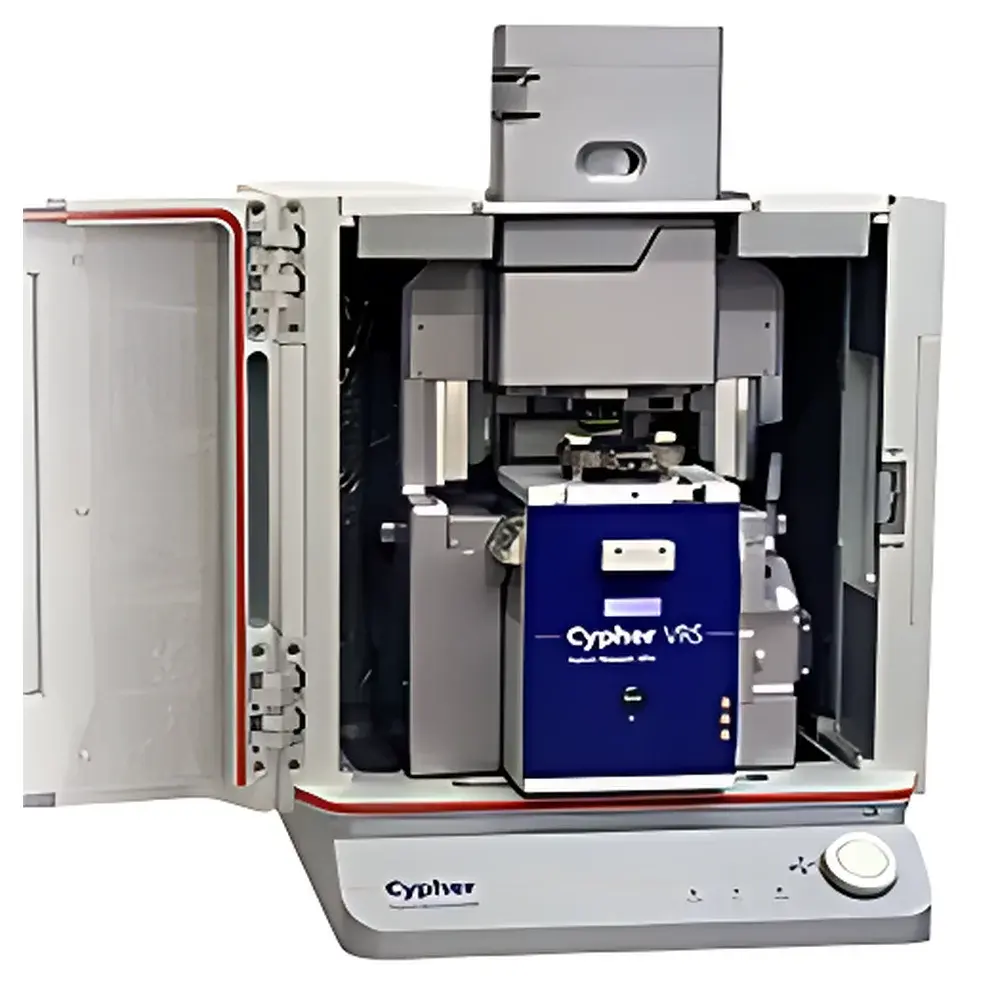
Oxford Instruments Asylum Research Cypher VRS Video-Rate Scanning Probe Microscope
| Brand | Oxford Instruments |
|---|---|
| Origin | USA |
| Model | Cypher VRS |
| Instrument Type | Material-Focused Atomic Force Microscope |
| XY Positional Noise | <60 pm |
| Z Positional Noise | <50 pm |
| Maximum Sample Diameter | ≤15 mm |
| Maximum Sample Thickness | ≤7 mm |
| Sample Stage Travel Range | 180 mm × 180 mm |
| Scan Speed | Up to 625 lines/sec |
| Frame Rate | >10 fps at 512×512 pixel resolution |
| Excitation Method | blueDrive™ Photothermal Actuation |
| Compliance | ASTM E2539, ISO/IEC 17025-compatible operation, GLP/GMP-ready data integrity architecture |
Overview
The Oxford Instruments Asylum Research Cypher VRS is a high-performance, video-rate scanning probe microscope engineered for real-time nanoscale dynamic imaging and quantitative surface metrology. Built upon the proven Cypher platform architecture, the VRS variant integrates advanced photothermal excitation (blueDrive™), low-noise closed-loop positioning, and optimized mechanical damping to achieve unprecedented temporal resolution without compromising spatial fidelity. Unlike conventional AFMs limited to quasi-static or slow-scan regimes, the Cypher VRS operates on a fundamentally different scanning paradigm—capturing continuous, time-resolved topographic and property maps directly in native video format, not as sequential static frames. This enables direct observation of kinetic processes such as molecular adsorption/desorption, polymer chain relaxation, electrochemical interface evolution, and nanomechanical response under stimuli (e.g., thermal, electrical, or fluidic). Its design adheres to core principles of scanning probe metrology: traceable tip–sample interaction control, minimized environmental coupling, and deterministic signal acquisition synchronized to hardware clocking.
Key Features
- Video-rate imaging capability: Sustained frame rates exceeding 10 fps at full 512×512 pixel resolution, with line scan speeds up to 625 Hz—more than one order of magnitude faster than legacy fast-scanning AFMs.
- Sub-angstrom positional stability: Closed-loop XY stage noise <60 pm RMS; Z noise <50 pm RMS—enabling atomic-scale resolution even during rapid scanning.
- blueDrive photothermal excitation: Eliminates piezoelectric actuator hysteresis and drift; provides stable, linear, and broadband cantilever drive independent of ambient humidity or temperature fluctuations.
- Fully sealed scanner assembly: IP54-rated enclosure protects against accidental liquid spills and particulate ingress, supporting extended operation in wet-cell or electrochemical environments.
- Motorized optical alignment system: Automated laser positioning and photodetector optimization reduce setup time from minutes to seconds—critical for multi-user lab environments.
- Integrated dual-channel lock-in amplification: Enables simultaneous acquisition of topography and quantitative nanomechanical properties (e.g., modulus, adhesion, dissipation) at video rates.
Sample Compatibility & Compliance
The Cypher VRS accommodates standard substrate geometries common in materials science and life sciences laboratories: circular samples up to 15 mm in diameter and 7 mm thick—including Si wafers, mica flakes, ITO/glass slides, and electrospun membranes. The 180 mm × 180 mm motorized sample stage supports large-area mapping and automated tile-based stitching across heterogeneous specimens. All operational modes comply with ASTM E2539 (Standard Guide for Measurement of Surface Topography Using Scanning Probe Microscopy) and support audit-ready metadata logging aligned with ISO/IEC 17025 laboratory accreditation requirements. Data provenance—including timestamped instrument configuration, calibration history, and environmental sensor readings—is embedded in every acquired dataset, satisfying GLP and GMP documentation expectations for regulated R&D workflows.
Software & Data Management
Acquired video-rate data are stored natively in HDF5 format with embedded metadata per frame, enabling direct ingestion into Python-based analysis pipelines (e.g., SciPy, scikit-image, PySPM). Asylum’s Interactive Mode software provides real-time parameter tuning, multi-modal overlay visualization (topography + phase + dissipation), and scriptable automation via Python API. For regulatory compliance, optional FDA 21 CFR Part 11 modules enforce electronic signature authentication, role-based access control, and immutable audit trails covering all user actions—from scan initiation to post-processing export. Raw video streams can be exported losslessly to industry-standard codecs (e.g., FFV1, ProRes) for integration into publication-grade figures or collaborative review platforms.
Applications
- In situ electrochemical AFM: Tracking solid-electrolyte interphase (SEI) formation on battery electrodes with sub-second temporal resolution.
- Dynamic polymer physics: Quantifying viscoelastic relaxation timescales during nanoindentation or thermal cycling.
- Biological membrane dynamics: Imaging lipid raft reorganization or protein clustering under controlled buffer flow conditions.
- Nanomaterial synthesis monitoring: Observing nucleation and growth kinetics of 2D crystals or MOF thin films in liquid cell configurations.
- Failure analysis in microelectronics: Correlating local topographic changes with current-induced electromigration in interconnect structures.
FAQ
What distinguishes Cypher VRS from Cypher ES?
The VRS adds hardware-accelerated video-rate scanning electronics, enhanced blueDrive photothermal driver firmware, and real-time video streaming architecture—while retaining full backward compatibility with Cypher ES probes, accessories, and software modules.
Is liquid-phase imaging supported at video rates?
Yes—when configured with appropriate fluid cells and cantilevers, the VRS maintains >5 fps imaging in aqueous environments without sacrificing Z-noise performance.
Does the system support third-party probe interchangeability?
It accepts standard 125 µm-wide rectangular cantilevers compliant with ISO 18757; however, optimal video-rate performance requires Asylum-certified probes with matched resonance tuning and Q-factor specifications.
How is calibration traceability maintained?
Each instrument ships with NIST-traceable grating standards and integrated interferometric position verification; calibration logs are automatically appended to all datasets.
Can the Cypher VRS be integrated into automated lab infrastructure?
Yes—it features Ethernet/IP and RS-232 interfaces, supports LabVIEW and MATLAB drivers, and includes RESTful API endpoints for scheduling, status polling, and remote diagnostics.




