
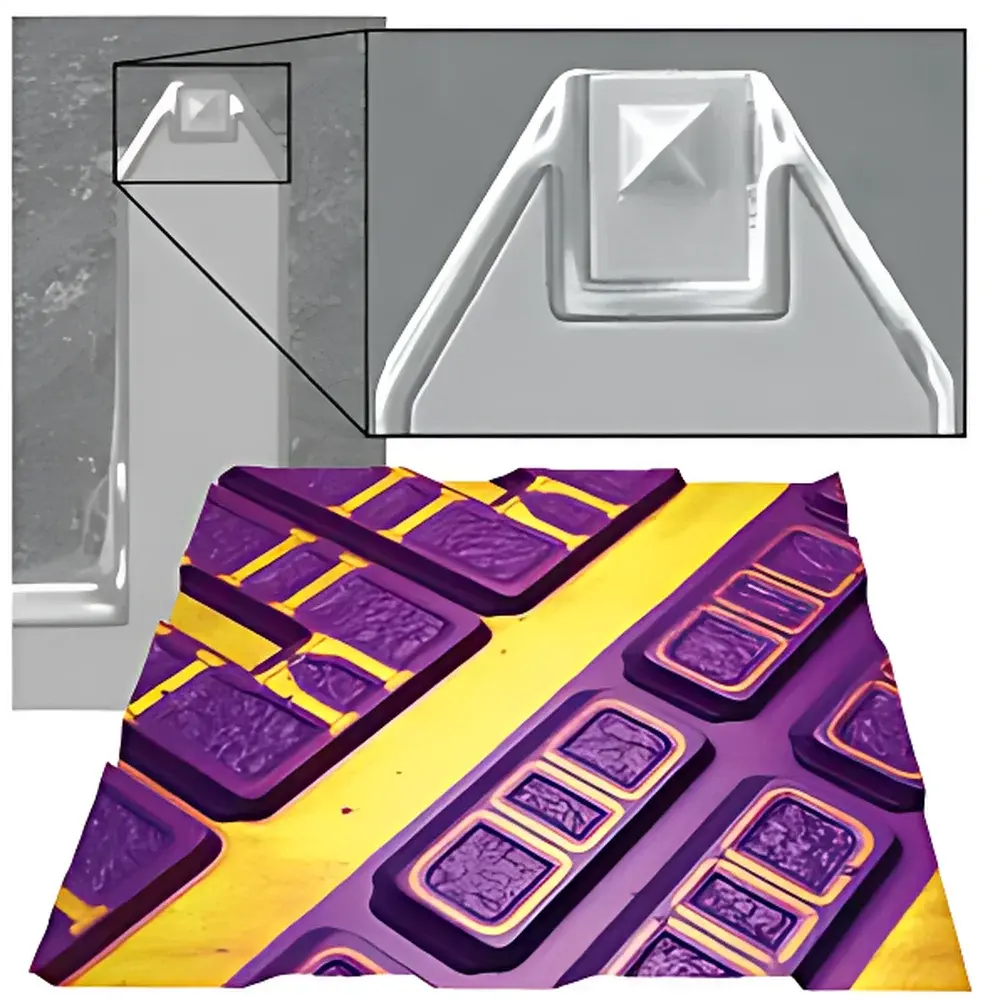
Oxford Instruments Asylum Research Scanning Microwave Impedance Microscope (sMIM) for MFP-3D and Cypher AFM Platforms
| Brand | Oxford Instruments |
|---|---|
| Origin | United Kingdom |
| Manufacturer Type | Authorized Distributor |
| Origin Category | Imported |
| Model | Scanning Microwave Impedance Microscopy (sMIM) |
| Instrument Type | Scanning Probe Microscope |
| Application Domain | Nanoscale Electrical Characterization |
Overview
Oxford Instruments Asylum Research Scanning Microwave Impedance Microscopy (sMIM) is a proprietary nanoelectrical characterization module integrated exclusively with the MFP-3D™ and Cypher™ series atomic force microscopes (AFMs). Unlike conventional conductive or electrostatic AFM modes, sMIM operates at microwave frequencies (typically 1–20 GHz), enabling quantitative, non-contact, high-spatial-resolution mapping of local complex impedance—specifically capacitance (C) and resistance (R)—with sub-50 nm lateral resolution. The technique leverages resonant microwave scattering from a custom-designed, impedance-matched probe tip, where changes in sample dielectric permittivity and conductivity modulate the reflected microwave signal phase and amplitude. This physical basis allows sMIM to decouple capacitive and resistive contributions simultaneously—even in heterogeneous, multi-phase, or buried-layer systems—without requiring DC bias or current injection. As a result, sMIM is uniquely suited for correlative nanoscale electrical metrology in semiconductor device analysis, 2D material heterostructures, ferroelectric domain imaging, and failure analysis of advanced interconnects and gate oxides.
Key Features
- Sub-50 nm lateral resolution: Achieved through optimized microwave probe design and high-stability AFM feedback architecture—enabling discrimination of individual dopant clusters, grain boundaries in polycrystalline films, and edge states in topological insulators.
- Simultaneous dual-parameter acquisition: Real-time, co-registered mapping of DC capacitance (C), DC resistance (R), differential capacitance (dC/dV), and differential resistance (dR/dV) under variable bias—supporting quantitative carrier profiling and trap-state analysis.
- High signal-to-noise ratio (SNR): >10× higher SNR than competing scanning impedance techniques (e.g., SCM, SSRM) at equivalent pixel dwell times, due to low-noise microwave electronics and patented impedance-matching circuitry developed by PrimeNano.
- High-speed imaging capability: Up to 80× faster frame acquisition than conventional nanoelectrical AFM methods—enabling dynamic studies such as bias-dependent domain switching kinetics or time-resolved charge trapping in perovskite solar cell layers.
- Ultra-low power operation: Microwave excitation power < −20 dBm at the probe tip—minimizing Joule heating, dielectric breakdown risk, and tip-sample perturbation—critical for soft materials (e.g., organic semiconductors, biological membranes) and ultrathin dielectrics (<2 nm).
Sample Compatibility & Compliance
sMIM supports broad material compatibility across conductors (metals, graphene), semiconductors (Si, GaN, MoS₂), wide-bandgap insulators (Al₂O₃, HfO₂), ferroelectrics (PZT, BFO), and emerging quantum materials (WTe₂, Bi₂Se₃). No conductive coating or vacuum requirement is needed; measurements are routinely performed in ambient air, controlled N₂ environments, or liquid cells. The system complies with ISO/IEC 17025 calibration traceability requirements for nanoscale electrical metrology. Data acquisition protocols support GLP/GMP-aligned audit trails when used with Asylum’s Cypher ES or MFP-3D Infinity controllers, including timestamped parameter logging, user authentication, and electronic signature support per FDA 21 CFR Part 11 guidelines.
Software & Data Management
sMIM functionality is fully embedded within Asylum Research’s Interactive Measurement Software (IGS) v9.5+, providing intuitive workflow-driven acquisition, real-time FFT-based microwave signal demodulation, and automated calibration routines for tip-sample impedance matching. All raw RF data (I/Q components) and derived parameters (C, R, dC/dV, dR/dV) are stored in vendor-neutral HDF5 format with embedded metadata (scan parameters, calibration coefficients, environmental conditions). Batch processing scripts (Python API) enable statistical analysis of spatial variance, cross-correlation with topography or phase signals, and machine-learning-assisted feature classification. Export modules support direct integration with MATLAB, Python (SciPy, scikit-image), and commercial TCAD platforms for device simulation validation.
Applications
- Quantitative dopant profiling in FinFET and GAA transistor channels without destructive cross-sectioning
- Nanoscale mapping of polarization reversal dynamics in ferroelectric memory cells
- Interface trap density estimation at Si/SiO₂ and III-V/high-k interfaces
- Defect localization in perovskite thin-film photovoltaics and OLED emissive layers
- Conductivity heterogeneity analysis in CVD-grown 2D heterostructures (e.g., h-BN/MoS₂/graphene stacks)
- Non-destructive evaluation of gate oxide integrity and leakage pathways in advanced logic nodes
FAQ
Is sMIM compatible with existing MFP-3D or Cypher AFM systems?
Yes—sMIM is available as a field-upgradeable module for all MFP-3D Bio, MFP-3D Infinity, Cypher ES, and Cypher VRS platforms equipped with RF-capable controller electronics.
Does sMIM require specialized probes?
Yes—sMIM uses proprietary microwave-optimized probes manufactured by PrimeNano under license, featuring integrated impedance-matching structures and calibrated RF response characteristics.
Can sMIM operate in liquid or controlled atmosphere?
Yes—ambient, inert gas (N₂, Ar), and liquid-cell configurations are supported; optional environmental chambers enable temperature-controlled (−30 °C to +200 °C) and humidity-regulated operation.
How is sMIM calibrated for quantitative impedance values?
Calibration employs a two-step process: (1) open-short-load (OSL) on a reference substrate, followed by (2) tip-sample coupling correction using a known dielectric standard (e.g., fused silica or SiO₂/Si); full traceability documentation is provided.
What software licenses are required to run sMIM?
sMIM requires the Asylum IGS Advanced Electrical Module license, included with new systems or available as an upgrade—no third-party software dependencies are required.





