
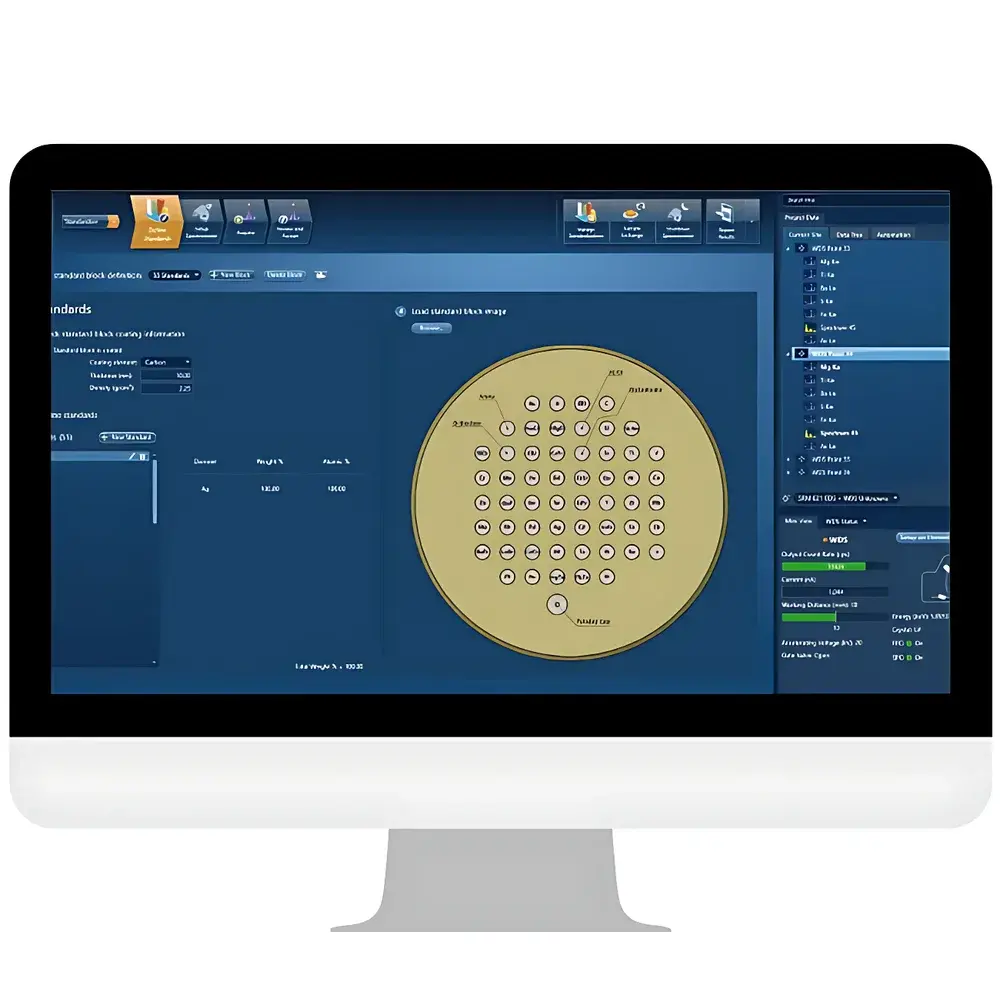
Oxford Instruments AZtecTEM Energy-Dispersive Spectroscopy Software for JEOL TEM Systems
| Brand | Oxford Instruments |
|---|---|
| Origin | United Kingdom |
| Model | AZtecTEM |
| Instrument Type | EDS Software Platform |
| Compatibility | JEOL 200 kV & 300 kV Transmission Electron Microscopes equipped with JED EDS detectors |
| Key Features | Point-and-ID analysis, LineScan, Elemental Mapping (TruMap, QuantMap), Drift Correction (AutoLock), Real-time Dynamic Imaging (AZtecLive) |
Overview
The Oxford Instruments AZtecTEM is a high-performance energy-dispersive spectroscopy (EDS) software platform engineered specifically for integration with JEOL transmission electron microscopes (TEMs) operating at 200 kV and 300 kV acceleration voltages and equipped with JEOL’s JED-series EDS detectors. Unlike generic spectral processing tools, AZtecTEM leverages Oxford Instruments’ proprietary algorithms to deliver quantitative elemental analysis at sub-nanometer spatial resolution—critical for characterizing advanced materials, catalysts, battery electrodes, and biological ultrastructures. Its architecture is built upon the physics of X-ray generation in thin specimens under electron beam irradiation, incorporating accurate absorption, fluorescence, and detector response corrections. The software operates within the constraints of TEM-specific geometry—including take-off angle, specimen tilt, and detector solid angle—and supports both standardless and standard-based quantification using Cliff–Lorimer or ZAF methodologies where appropriate. Designed for routine use in academic core facilities and industrial R&D labs, AZtecTEM ensures traceable, reproducible results compliant with ISO 14785 (microanalysis by EDS in electron microscopy) and ASTM E1508 (quantitative elemental analysis by EDS).
Key Features
- Point-and-ID Analysis (Analyzer/Point ID): Rapid identification of elemental composition at user-defined locations with automated peak deconvolution, background subtraction, and interference correction.
- LineScan & Elemental Mapping: High-fidelity line profiles and 2D spatial distribution maps generated directly from spectrum imaging (SI) datasets, supporting dwell times down to 10 µs per pixel.
- AutoLock Drift Compensation: Dual-mode drift correction—passive (based on image cross-correlation) and active (beam-following via stage feedback)—enabling stable acquisition over extended periods essential for atomic-resolution mapping.
- TruMap: Real-time spectral deconvolution engine that resolves overlapping peaks (e.g., S Kα / Pb Mα, Ti Kβ / V Kα) and suppresses artifacts arising from Bremsstrahlung tailing or secondary fluorescence, delivering physically accurate elemental distributions.
- QuantMap: Pixel-by-pixel quantitative mapping of elemental mass fractions, calibrated against certified reference standards or using internal matrix-matched references.
- AZtecLive: Streaming visualization of evolving elemental distributions during in-situ experiments, synchronized with TEM stage control and external stimuli (e.g., heating, biasing, gas flow).
Sample Compatibility & Compliance
AZtecTEM is validated for use with JEOL JEM-ARM200F, JEM-3200FS, JEM-3000F, and other 200–300 kV TEM platforms fitted with JED-2300/2400 series silicon drift detectors (SDDs). It supports standard TEM specimen geometries—including 3 mm diameter grids, cryo-EM grids (Quantifoil, UltrAuFoil), and focused ion beam (FIB)-lifted lamellae—without requiring hardware modification. Data integrity meets GLP/GMP documentation requirements through full audit trail logging (user actions, parameter changes, calibration events), electronic signatures, and export formats compatible with LIMS integration (CSV, HDF5, EMDB-compliant metadata). Software validation packages are available to support FDA 21 CFR Part 11 compliance for regulated environments.
Software & Data Management
AZtecTEM runs natively on Windows 10/11 (64-bit) with support for multi-core CPU parallelization and GPU-accelerated spectral processing. All raw SI data are stored in vendor-neutral .emd (Electron Microscopy Data) format, preserving full spectral metadata including acquisition time, beam current, convergence angle, and detector parameters. Batch processing workflows enable automated quantification across hundreds of regions-of-interest (ROIs); scripting via Python API allows custom analysis pipelines (e.g., phase segmentation, clustering, correlation with diffraction data). Backups and version-controlled project files ensure full traceability; data exports comply with FAIR principles (Findable, Accessible, Interoperable, Reusable).
Applications
- Atomic-scale compositional mapping of heterostructures in 2D materials (e.g., MoS₂/WSe₂ interfaces)
- Quantitative analysis of dopant segregation in semiconductor nanowires
- In-situ oxidation/reduction dynamics in Li-ion cathode particles
- Trace metal localization in cryo-TEM tomograms of cellular organelles
- Phase identification and stoichiometry refinement in intermetallic compounds
- Correlative EDS–EELS analysis for valence state and elemental co-localization
FAQ
Is AZtecTEM compatible with non-JEOL TEM systems?
No—AZtecTEM is exclusively licensed and validated for JEOL TEM platforms equipped with JED EDS hardware. Integration with other manufacturers’ instruments requires separate Oxford Instruments software variants (e.g., AZtecSEM for SEM, AZtecTEM for FEI/Thermo Fisher systems).
Does AZtecTEM require an internet connection for operation?
No—local installation enables fully offline operation. Internet access is optional and only required for license activation, software updates, and technical support portal access.
Can AZtecTEM process data acquired with older JED detector firmware?
Yes—backward compatibility extends to JED firmware versions released since 2015. Legacy spectrum files (.jed, .raw) are automatically converted to the unified .emd format during import.
What validation documentation is provided for regulated laboratories?
Oxford Instruments supplies IQ/OQ documentation templates, a risk-based validation guide, and a 21 CFR Part 11 readiness checklist. Full GxP validation support is available through certified field application specialists.




