
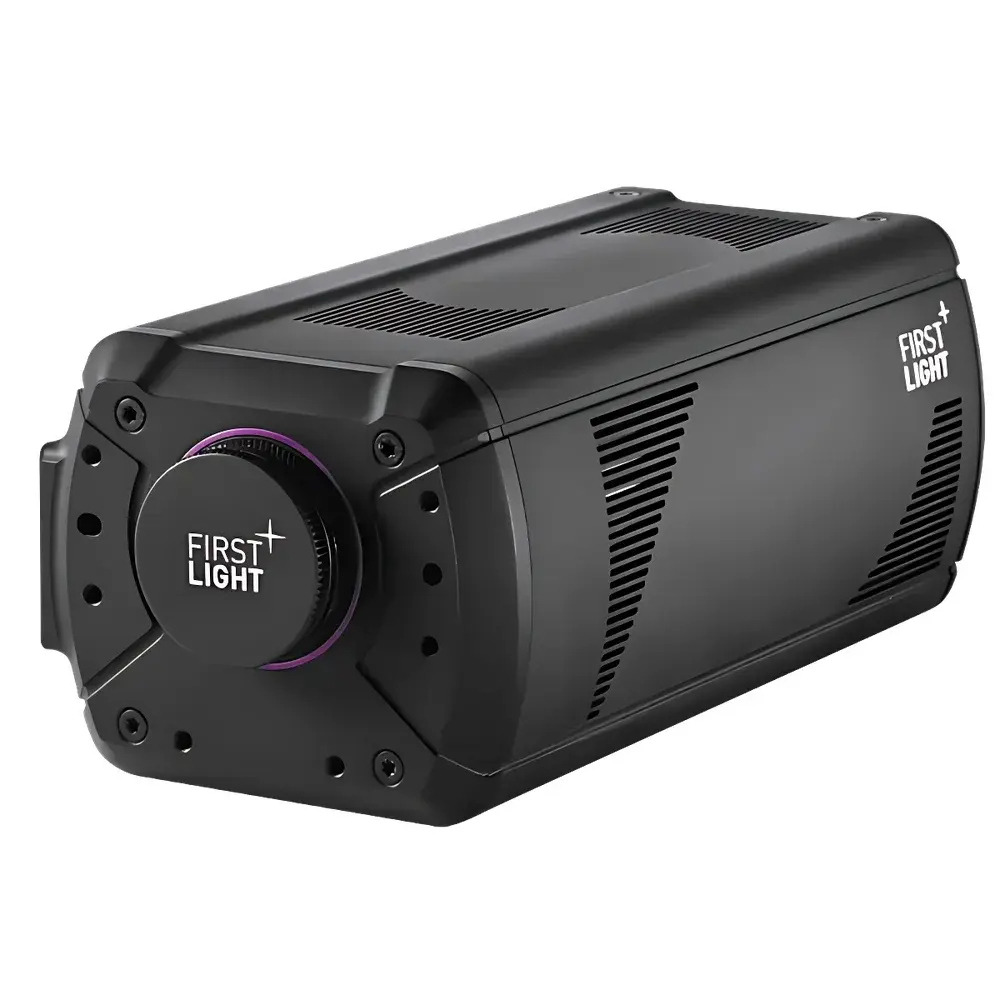
Oxford Instruments C-Blue One Scientific CMOS Camera
| Brand | Oxford Instruments |
|---|---|
| Origin | France |
| Model | C-Blue One |
| Image Resolution | 0.5 MP (812 × 612), 1.7 MP (1608 × 1104), or 7.1 MP (3208 × 2200) |
| Pixel Size | 9 µm (0.5 MP & 1.7 MP variants), 4.5 µm (7.1 MP variant) |
| Sensor Diagonal | 9.6 mm (0.5 MP), 17.6 mm (1.7 MP & 7.1 MP) |
| Interface | CoaXPress 2.0 or SFP+ 10 GigE |
| Bit Depth | 14-bit |
| Quantum Efficiency | >70% @ peak (550–650 nm) |
| Read Noise | <1.5 e⁻ (typical, correlated double sampling) |
| Shutter Type | Global shutter |
| Compliance | GigE Vision v2.0, GenICam3 |
Overview
The Oxford Instruments C-Blue One is a high-performance scientific CMOS camera engineered for demanding low-light, high-speed visible and near-infrared imaging applications. Built upon Sony’s latest Pregius™ global-shutter CMOS sensor architecture, the C-Blue One delivers exceptional sensitivity, temporal fidelity, and spatial resolution across three distinct sensor configurations—enabling researchers to select the optimal balance of frame rate, field-of-view, and pixel-level sampling for their specific optical setup. Its spectral response spans 400–1000 nm, with peak quantum efficiency exceeding 70% in the green-to-red band (550–650 nm), making it especially suited for fluorescence microscopy, adaptive optics wavefront sensing, laser beam profiling, time-resolved spectroscopy, and astronomical lucky imaging. The camera employs a true global shutter—eliminating motion-induced distortion—and achieves sub-electron read noise through optimized correlated double sampling (CDS), ensuring high signal-to-noise ratio (SNR) even at single-photon flux levels. Designed for integration into rigorous scientific environments, the C-Blue One supports deterministic data acquisition with minimal latency and full hardware synchronization via trigger-in/out TTL lines.
Key Features
- Three interchangeable sensor configurations: 0.5 MP (812 × 612, 9 µm), 1.7 MP (1608 × 1104, 9 µm), and 7.1 MP (3208 × 2200, 4.5 µm), all sharing identical mechanical, thermal, and electronic interfaces
- Global shutter operation with <1.5 e⁻ typical read noise (CDS mode), enabling quantitative intensity measurements under ultra-low illumination
- 14-bit digitization with linear response and <0.5% integral nonlinearity across full dynamic range
- High-speed data transmission via CoaXPress 2.0 (up to 12.5 Gbps per cable) or SFP+ 10 GigE, fully compliant with GigE Vision v2.0 and GenICam3 standards
- Zero-latency direct-readout architecture—no on-board frame buffer—ensuring deterministic timing and eliminating frame queuing artifacts
- Passively cooled aluminum housing with thermal stabilization (±0.1 °C regulation), minimizing dark current drift during extended acquisitions
- Hardware-triggered exposure control with microsecond-level precision and support for external sync, strobe, and gate signals
Sample Compatibility & Compliance
The C-Blue One is compatible with standard C-mount and F-mount optical systems, and integrates seamlessly with motorized filter wheels, shutters, and stage controllers via TTL and LVDS I/O. It meets key industry interoperability requirements: GigE Vision v2.0 certification ensures plug-and-play compatibility with major machine vision software suites (e.g., HALCON, Common Vision Blox, MATLAB Image Acquisition Toolbox). Its GenICam3-compliant XML feature description enables automated parameter discovery and configuration in LabVIEW, Python (harvesters, pypylon), and C++ SDKs. For regulated environments, the camera supports audit-ready metadata embedding—including timestamp (PTPv2 IEEE 1588), exposure settings, sensor temperature, and firmware version—facilitating GLP/GMP-aligned documentation workflows. While not FDA 21 CFR Part 11-certified out-of-the-box, its deterministic acquisition log and immutable image headers provide foundational traceability required for validation protocols.
Software & Data Management
Oxford Instruments provides a native C++/Python SDK with comprehensive API documentation, including real-time acquisition examples, ROI streaming, multi-camera synchronization, and hardware-triggered burst capture. The SDK supports both Windows and Linux (Ubuntu LTS, CentOS/RHEL 8+) platforms. All images are output in standard 14-bit TIFF or raw binary formats with embedded EXIF-like metadata (via custom GenICam feature tags). Time-stamping leverages IEEE 1588 Precision Time Protocol (PTPv2) when used with compatible network switches—critical for multi-sensor correlation in pump-probe experiments or distributed telescope arrays. No proprietary compression is applied; lossless data integrity is preserved end-to-end from sensor to host memory. Integration with HDF5-based analysis pipelines (e.g., h5py, PyTables) is natively supported via memory-mapped buffers.
Applications
- Astronomy: High-cadence lucky imaging, speckle interferometry, and solar granulation studies requiring sub-millisecond exposure control and photon-starved SNR optimization
- Life Sciences: Confocal and light-sheet fluorescence microscopy where global shutter eliminates scan-line artifacts; calcium imaging with fast kinetics
- Industrial Metrology: Real-time laser spot analysis, weld seam monitoring, and particle tracking velocimetry (PTV) in turbulent flows
- Defense & Aerospace: Beam quality assessment of high-power lasers, missile plume characterization, and hypersonic boundary layer imaging
- Quantum Optics: Single-photon avalanche diode (SPAD) array calibration reference, entangled photon pair detection synchronization
FAQ
Does the C-Blue One support region-of-interest (ROI) readout to increase frame rates?
Yes—hardware-configurable ROIs reduce data volume and enable higher effective frame rates without compromising timing determinism.
Is cooling active or passive?
The camera uses a thermally optimized passive heatsink design with calibrated thermal mass; no fans or TECs are employed to avoid vibration or EMI interference.
Can multiple C-Blue One cameras be synchronized precisely?
Yes—via hardware trigger distribution and PTPv2 network time synchronization, achieving sub-microsecond inter-camera skew in multi-node configurations.
What is the maximum sustained data throughput over 10 GigE?
Up to 9.6 Gbps (line rate) with jumbo frames enabled; actual payload depends on pixel format, ROI size, and host system PCIe bandwidth.
Is there an SDK available for MATLAB or Python?
Yes—the official Oxford Instruments SDK includes native MATLAB bindings and full Python support (pip-installable, documented, and tested on Python 3.8–3.11).



