
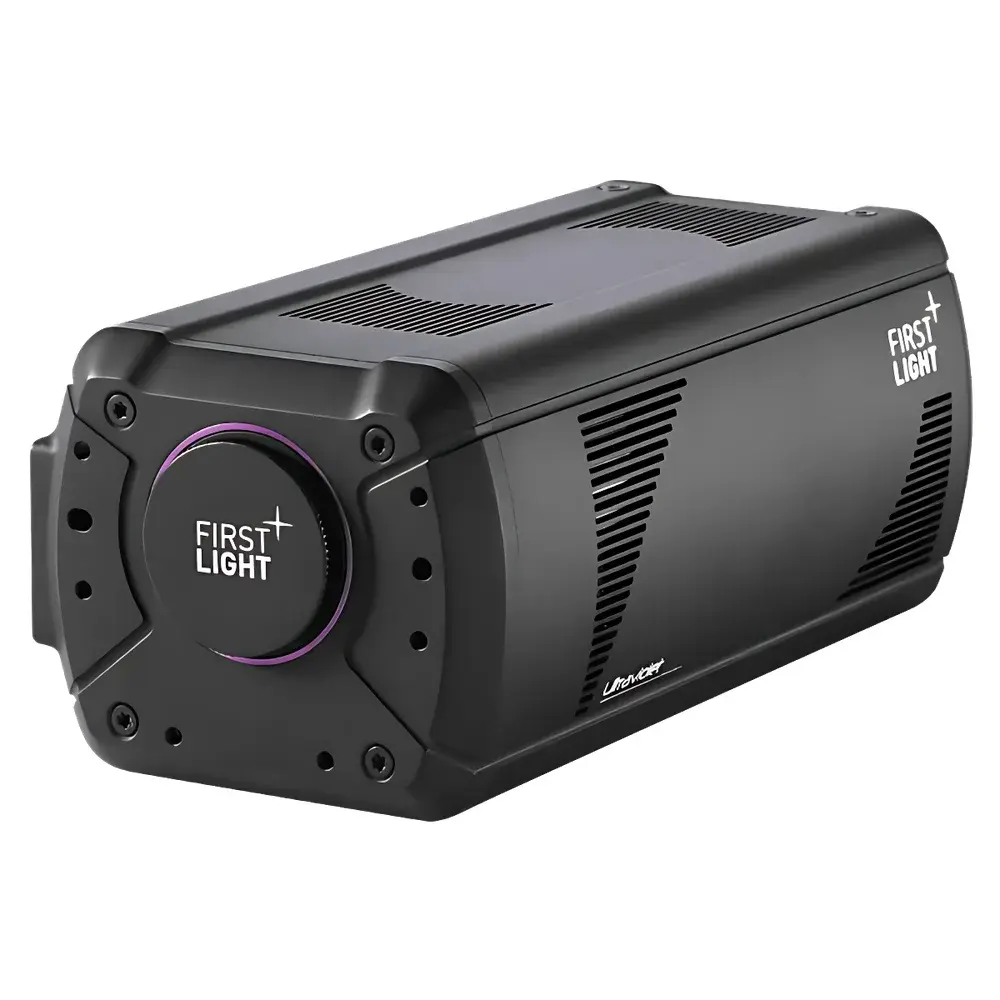
Oxford Instruments C-Blue One UV CMOS Camera
| Brand | Oxford Instruments |
|---|---|
| Origin | France |
| Model | C-Blue One UV |
| Image Resolution | 2848 × 2848 |
| Pixel Size | 2.74 µm |
| Sensor Diagonal | 11.2 mm |
| Interface | CoaXPress 2.0 or SFP+ 10GigE |
| Bit Depth | 14-bit |
| Quantum Efficiency | >70% (peak in UV) |
| Shutter Type | Global Shutter |
| Spectral Range | 200–1000 nm |
| Cooling | Active thermoelectric stabilization down to 0 °C |
| Lens Mount | CS-mount (with C-mount adapter) |
| ADC Modes | 8-bit / 12-bit selectable |
| Analog Gain | up to 24 dB |
| Digital Gain | up to 48 dB |
| ROI & Multi-Window Support | Yes |
| Compliance | GigE Vision v2.0, GenICam v3.x |
Overview
The Oxford Instruments C-Blue One UV CMOS Camera is a high-performance, industrial-grade scientific imaging system engineered for demanding ultraviolet and broadband visible applications. Built around a state-of-the-art monochrome global shutter CMOS sensor from Sony’s Pregius™ family, the camera delivers exceptional quantum efficiency (>70% peak) across the deep UV (200–400 nm), with measured QE of >50% at 300 nm and ~30% at 220 nm — enabling robust photon-limited detection in spectroscopy, plasma diagnostics, UV lithography monitoring, and fluorescence lifetime imaging. Its 2848 × 2848 pixel array (8.1 MP) features a compact 2.74 µm pixel pitch and an 11.2 mm diagonal active area, optimized for high spatial resolution without compromising fill factor or charge handling capacity. Unlike rolling shutter architectures, the global shutter ensures temporal fidelity and eliminates motion-induced distortion — critical for time-resolved measurements and synchronization with pulsed light sources such as excimer lasers or UV LEDs.
Key Features
- UV-Optimized Monochrome Sensor: High QE silicon CMOS architecture with back-thinned or UV-enhanced coating (application-specific variant), delivering superior sensitivity below 350 nm compared to standard visible-optimized sensors.
- Dual High-Bandwidth Interfaces: Simultaneous support for 10GigE (via SFP+ module, compliant with GigE Vision 2.0) and CoaXPress 2.0 — enabling flexible integration into real-time machine vision systems or low-latency scientific data acquisition environments.
- Active Thermal Stabilization: Integrated Peltier cooler and precision temperature control maintain sensor operation at stable sub-ambient temperatures (down to 0 °C), reducing dark current by up to two orders of magnitude versus uncooled operation and ensuring long-exposure stability required for low-light quantitative imaging.
- Configurable Readout Architecture: Selectable ADC bit depth (8-bit for speed, 12-bit for dynamic range optimization), programmable analog/digital gain (up to 24 dB analog + 48 dB digital), and hardware-accelerated ROI/multi-window readout for frame-rate enhancement without host CPU overhead.
- Robust Mechanical Design: Compact aluminum housing (154.3 × 76.2 × 64.1 mm, 1.1 kg) with CS-mount lens interface (C-mount adapter included), IP50-rated enclosure, and dual synchronization I/O (TTL-compatible) for precise triggering and external device coordination.
Sample Compatibility & Compliance
The C-Blue One UV is designed for integration into vacuum-compatible optical tables, cleanroom-grade inspection platforms, and regulated laboratory environments. Its sealed sensor chamber and absence of internal volatile outgassing materials meet ISO 14644-1 Class 5 compatibility requirements when installed with appropriate feedthroughs. The camera complies with CE, FCC, and RoHS directives. Software-level interoperability adheres to industry standards including GenICam v3.x feature naming conventions, enabling seamless configuration via HALCON, MATLAB Image Acquisition Toolbox, or custom C++/Python SDKs. For regulated industries (e.g., semiconductor metrology, pharmaceutical UV assay validation), the camera supports audit-trail-capable metadata logging (timestamp, exposure, gain, temperature) compatible with FDA 21 CFR Part 11–aligned data management workflows when deployed with validated acquisition software.
Software & Data Management
Oxford Instruments provides the C-Blue SDK — a cross-platform (Windows/Linux) C/C++ and Python API supporting full GenICam-compliant parameter control, buffer management, and asynchronous image streaming. The SDK includes sample applications demonstrating synchronized multi-camera acquisition, ROI-based high-speed burst capture, and real-time histogram analysis. All image data carries embedded metadata (exposure time, sensor temperature, gain settings, timestamp with microsecond resolution) in standard TIFF or raw binary formats. Integration with third-party platforms such as LabVIEW (NI Vision), StreamPix, or EPICS IOC modules is supported through documented driver interfaces. Firmware updates are delivered via signed packages with SHA-256 verification to ensure integrity in GxP environments.
Applications
- UV laser beam profiling and M² measurement in excimer and frequency-tripled Nd:YAG systems
- In-line monitoring of photomask inspection and EUV resist development processes
- Time-resolved UV fluorescence imaging in biological and material science studies
- Plasma emission spectroscopy (200–400 nm spectral window) for fusion diagnostics and industrial plasma etching
- High-speed schlieren and shadowgraph imaging in aerodynamics and combustion research
- Quantitative UV reflectometry and thin-film thickness mapping in semiconductor process control
FAQ
Is the C-Blue One UV suitable for vacuum environments?
The camera is not vacuum-rated as supplied; however, its mechanical design allows for optional vacuum-feedthrough integration using CF or KF flanges (custom engineering support available upon request).
What is the maximum sustained frame rate at full resolution?
At 2848 × 2848 and 12-bit mode, sustained frame rates reach 30 fps over 10GigE and 60 fps over CoaXPress 2.0 — dependent on host system bandwidth and buffer allocation.
Does the camera support hardware triggering with sub-microsecond jitter?
Yes — the dual TTL sync inputs support edge-triggered acquisition with <500 ns timing jitter, fully synchronized to sensor exposure start.
Can I perform flat-field correction onboard?
Flat-field and dark-frame correction are implemented in firmware and applied in real time prior to data transmission; calibration frames can be loaded via the SDK.
Is GenICam compliance certified by AIA?
The camera is self-certified per GenICam v3.3 specification and listed in the AIA GenICam XML Registry (Device ID: OXI-CBLUE1UV-GV).




