
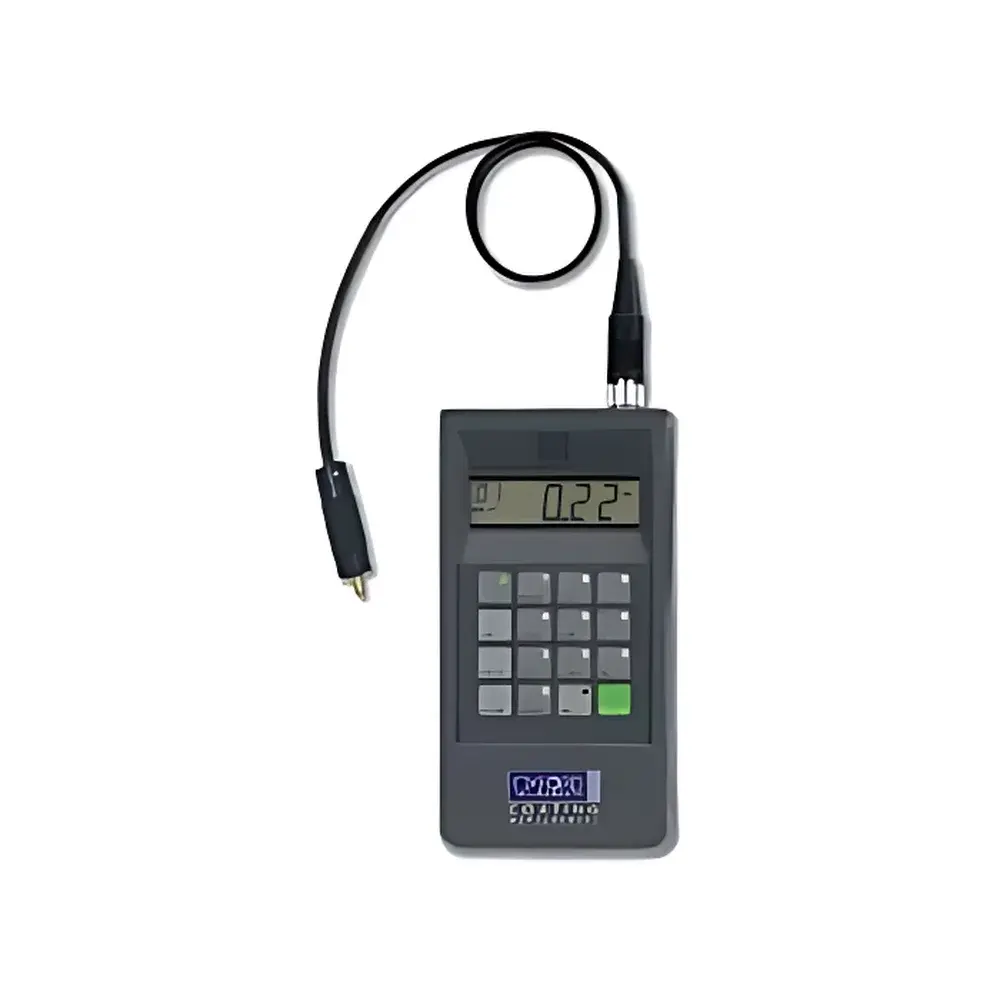
Oxford Instruments CMI233 Electromagnetic Eddy Current & Magnetic Induction Coating Thickness Gauge
| Brand | Oxford Instruments |
|---|---|
| Origin | USA |
| Model | CMI233 |
| Measurement Principle | Dual-mode (Magnetic Induction for ferrous substrates |
| Measurement Range | 0–3.05 mm (magnetic induction), 0–1.52 mm (eddy current) |
| Resolution | 0.1 µm |
| Accuracy | ±1% or ±0.1 µm (per certified reference standards) |
| Minimum Substrate Thickness | 0.35 mm |
| Minimum Curvature Radius | 5 mm (convex), 25 mm (concave) |
| Minimum Test Area | Ø20 mm |
| Compliance | ASTM B499, B530, B244, B259 |
| Data Storage | 12,400 readings |
| Display | 1/2-inch backlit LCD |
| Interface | RS-232 serial port |
| Power | 9 V alkaline or rechargeable battery |
| Weight | 260 g (incl. battery) |
| Dimensions | 149 × 79.4 × 30.2 mm |
| Units | Switchable metric/imperial |
| Statistical Functions | Mean, SD, min/max, histogram, CPK, count |
| Scan Mode | Time-based averaging with min/max capture |
| Keypad | Sealed membrane (9-key basic / 16-key enhanced) |
Overview
The Oxford Instruments CMI233 is a dual-principle, handheld coating thickness gauge engineered for high-reproducibility measurement of non-magnetic coatings on ferrous substrates and non-conductive coatings on non-ferrous conductive substrates. It operates simultaneously on two well-established physical principles: magnetic induction (per ASTM B499 and ISO 2178) for steel or iron substrates, and eddy current (per ASTM B244 and ISO 2360) for aluminum, copper, brass, or other non-ferrous metals. This dual-mode architecture eliminates the need for separate instruments in mixed-material production environments—such as automotive body shops, aerospace component finishing lines, or multi-substrate corrosion protection facilities—where both galvanized steel and anodized aluminum parts are processed.
Key Features
- Dual-sensor capability integrated into a single compact unit: automatic mode recognition based on substrate conductivity and magnetic permeability, with real-time sensor validation feedback.
- High-resolution 0.1 µm measurement resolution across full range, calibrated traceably to NIST-traceable certified foil standards (e.g., Fe/Ni/Cu reference stacks).
- Ruggedized industrial design: IP54-rated sealed membrane keypad, shock-absorbing elastomer housing, and thermal stability compensation for operation between 0–50 °C ambient.
- Onboard statistical engine supporting real-time calculation of mean, standard deviation, min/max, process capability index (CPK), and histogram generation—enabling immediate SPC evaluation without external software.
- Configurable scan mode: user-defined time window (1–10 s) for continuous surface profiling, with automatic averaging and optional min/max reporting per scan cycle.
- RS-232 serial interface compliant with industry-standard ASCII protocol, enabling seamless integration into MES, LIMS, or automated QA data collection systems with audit-trail-ready timestamping.
Sample Compatibility & Compliance
The CMI233 is validated for use across a broad spectrum of industrial coating systems. On ferrous substrates (≥0.35 mm thickness), it measures zinc, chromium, cadmium, tin, copper, epoxy, PTFE, powder coatings, and wet paint films. On non-ferrous conductive substrates—including aluminum, copper, and austenitic stainless steels—it quantifies anodized layers, enamel, porcelain, epoxies, and polymer films. Its measurement validity is constrained by minimum geometry requirements: convex surfaces ≥5 mm radius, concave surfaces ≥25 mm radius, and minimum test area Ø20 mm. All calibration and verification procedures align with GLP-compliant documentation practices, and instrument firmware supports configurable calibration certificate logging per ISO/IEC 17025 laboratory requirements.
Software & Data Management
Data export and configuration are managed via Oxford’s proprietary CMI DataLink software (Windows-compatible), which supports batch download, report generation (PDF/CSV), and customizable pass/fail threshold assignment per job ID or lot number. Raw measurement logs include timestamp, operator ID, probe type, substrate ID, and environmental temperature—meeting FDA 21 CFR Part 11 requirements for electronic records when deployed with user authentication and audit trail activation. Firmware updates preserve all stored calibration histories and user-defined profiles, ensuring continuity during periodic metrological recalibration cycles.
Applications
- Automotive OEM and Tier-1 suppliers: verifying e-coat thickness on chassis components and clear-coat uniformity on painted panels.
- Aerospace MRO facilities: monitoring anodize layer integrity on aluminum airframe structures per AMS-A-8625.
- Pipeline and marine infrastructure: assessing fusion-bonded epoxy (FBE) and polyethylene coating thickness on carbon steel pipe joints.
- Electronics manufacturing: measuring solder mask thickness over copper traces and conformal coating thickness on PCB assemblies.
- Quality assurance labs in electroplating facilities: validating Ni/Cr duplex plating thickness per ASTM B456 and ISO 1456.
FAQ
Does the CMI233 require substrate-specific calibration for each material?
No. The instrument automatically detects substrate type and selects the appropriate measurement algorithm. However, a two-point calibration using certified foils on representative substrate samples is recommended before critical measurements.
Can the CMI233 measure coatings on curved or irregular surfaces?
Yes—within defined geometric limits. Convex surfaces down to 5 mm radius and concave surfaces down to 25 mm radius are supported. For tighter radii, optional curvature-compensated probes (e.g., CMI-SP12) are available.
Is the device suitable for ISO 17025-accredited laboratories?
Yes. When used with documented calibration certificates, traceable standards, and configured audit trails, the CMI233 satisfies metrological traceability and record retention requirements specified in ISO/IEC 17025:2017 Clause 6.4 and 7.7.
What is the battery life under typical field use?
Approximately 100 hours of continuous operation with alkaline 9 V battery; rechargeable NiMH variants extend operational uptime and reduce long-term cost-of-ownership.
How does the instrument handle edge effects near part boundaries or holes?
The CMI233 employs dynamic field compensation algorithms that suppress edge-induced signal distortion. Users must maintain ≥10 mm distance from edges or apertures to ensure measurement validity per ASTM D7091 guidance.



