
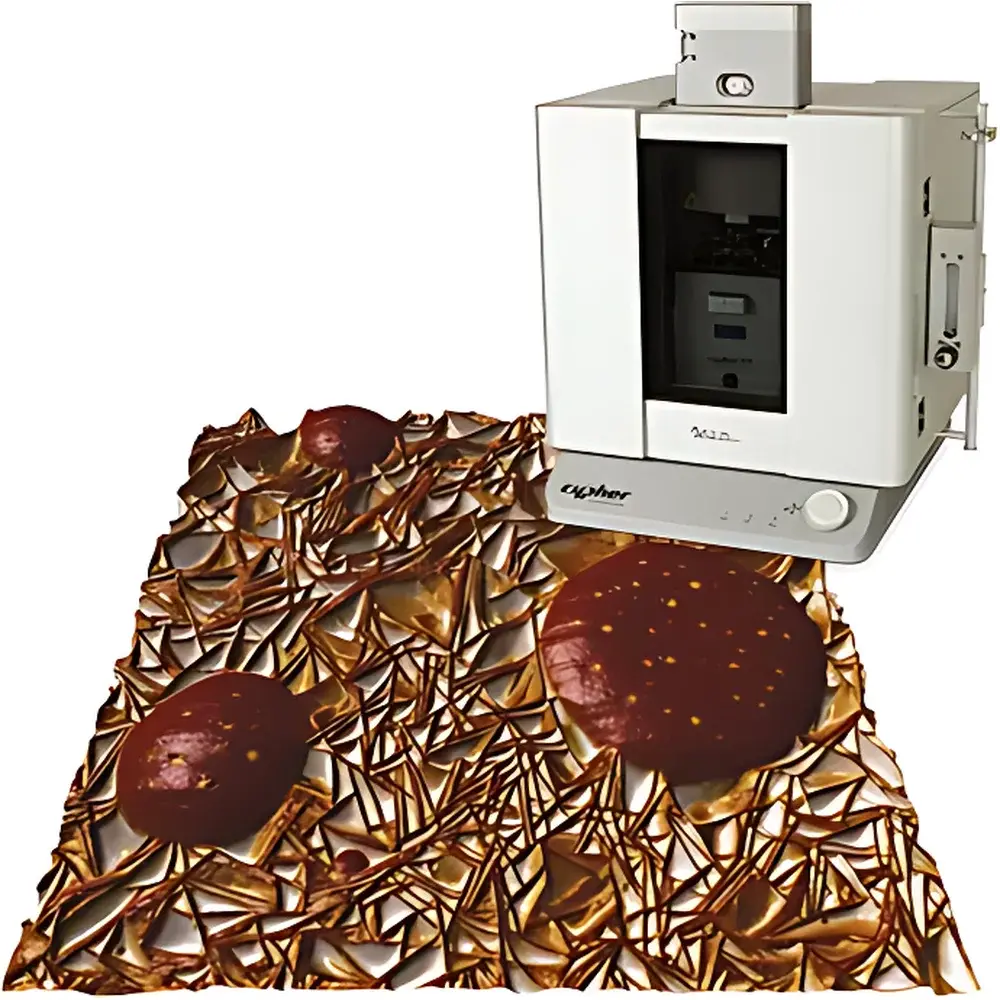
Oxford Instruments Cypher ES Polymer Edition Atomic Force Microscope
| Brand | Oxford Instruments |
|---|---|
| Origin | USA |
| Manufacturer Type | Authorized Distributor |
| Origin Category | Imported |
| Model | Cypher ES Polymer Edition |
| Price Range | USD 420,000 – 700,000 (est.) |
| Instrument Type | Atomic Force Microscope (AFM) |
| Application Class | Materials Science |
| Position Detection Noise | 625 Hz |
| Sample Dimensions | Ø < 15 mm, Thickness < 5 mm |
| Stage Travel Range | 180 mm × 180 mm |
| Environmental Control | Sealed fluid/gas chamber compatible |
| Temperature Control Range | 0–250 °C |
| Nanomechanical Capabilities | Integrated NanoMechPro toolkit (Force Modulation, Contact Resonance, and HarmoniX™) |
| Excitation Method | blueDrive photothermal excitation for tapping mode |
Overview
The Oxford Instruments Cypher ES Polymer Edition is a high-performance, research-grade atomic force microscope engineered specifically for the nanoscale characterization of polymeric materials. Built upon the robust Cypher ES platform, this edition integrates hardware and software enhancements optimized for soft, viscoelastic, and thermally responsive polymer systems. It operates on standard contact, tapping, and advanced dynamic modes—leveraging photothermal excitation via blueDrive technology to eliminate piezo acoustic noise and ensure stable, high-fidelity cantilever oscillation. The system’s closed-loop XY scanner with 180 mm × 180 mm travel enables large-area mapping without sample repositioning, while its low-noise position detection (625 Hz bandwidth) supports quantitative force spectroscopy and sub-nanometer topographic resolution under ambient, liquid, or controlled gas environments. Designed for integration into ISO 17025-compliant labs and GLP/GMP-aligned R&D workflows, the Cypher ES Polymer Edition meets the stringent reproducibility and traceability requirements of academic polymer physics, industrial formulation development, and regulatory-supported material qualification.
Key Features
- blueDrive photothermal excitation: Eliminates mechanical coupling artifacts and enables stable, amplitude-controlled tapping mode imaging—even on low-modulus polymers and hydrated films.
- NanoMechPro toolkit integration: Includes three complementary nanomechanical techniques—Force Modulation Microscopy (FMM), Contact Resonance AFM (CR-AFM), and HarmoniX™ multi-harmonic analysis—for simultaneous topography, modulus, adhesion, loss tangent, and viscoelastic mapping.
- Polymer-optimized thermal stage: Precision-controlled heating/cooling from 0 °C to 250 °C with ±0.1 °C stability; compatible with in situ annealing, crystallization studies, and glass transition (Tg) mapping.
- Sealed environmental chamber: Supports liquid-phase imaging (e.g., polymer swelling, hydrogel hydration), inert gas purging (N2, Ar), and corrosive vapor exposure (e.g., chlorinated solvents, organic acids) without compromising scanner integrity.
- Compact footprint (< 0.8 m²): Integrates seamlessly into shared microscopy suites or QC laboratories with space constraints—no external vibration isolation required beyond standard optical tables.
- Automated calibration suite: On-the-fly tip shape reconstruction, spring constant verification (Sader method), and deflection sensitivity calibration compliant with ISO/IEC 17025 documentation standards.
Sample Compatibility & Compliance
The Cypher ES Polymer Edition accommodates standard polymer substrates—including spin-coated thin films, electrospun mats, melt-pressed pellets, and crosslinked hydrogels—with maximum dimensions of Ø < 15 mm and thickness < 5 mm. Its non-contact, low-force imaging capability minimizes sample deformation during scanning, preserving native morphology of thermoplastics (e.g., PS, PMMA, PEEK), elastomers (e.g., PDMS, TPU), and biopolymers (e.g., cellulose derivatives, PLGA). The instrument complies with IEC 61000-6-3 (EMC emissions), IEC 61000-6-2 (immunity), and meets essential safety requirements per IEC 61010-1. Data acquisition and reporting support audit-ready workflows aligned with FDA 21 CFR Part 11 (electronic signatures, audit trails) when deployed with Oxford’s optional compliance package.
Software & Data Management
Acquired using Asylum Research’s Interactive Mode™ software (v18.0+), the system delivers intuitive, scriptable control via Python API and MATLAB interface. All raw force-distance curves, time-series datasets, and multi-parameter maps are stored in vendor-neutral HDF5 format with embedded metadata (timestamp, environmental conditions, calibration parameters). Batch processing pipelines support automated grain boundary detection, phase separation quantification (via FFT-based domain size analysis), and Tg gradient extraction from temperature-ramped nanomechanical maps. Export options include TIFF, CSV, and MTEX-compatible ODF files for crystallographic texture analysis of semi-crystalline polymers.
Applications
- Phase morphology mapping of block copolymers (e.g., PS-b-PMMA) and polymer blends under thermal cycling.
- In situ nanomechanical evolution during solvent annealing or UV crosslinking.
- Surface energy heterogeneity assessment via adhesion mapping across functionalized polymer interfaces.
- Dynamic viscoelastic profiling of hydrogels at physiological temperatures and pH.
- Crystallinity gradients in drawn polyethylene films correlated with local modulus distribution.
- Failure mechanism analysis of polymer coatings under nanoindentation and scratch protocols.
FAQ
Is the Cypher ES Polymer Edition compatible with conductive AFM (CAFM) or Kelvin probe force microscopy (KPFM)?
Yes—optional CAFM and KPFM modules are available and fully integrated into the same software environment, enabling concurrent electrical and mechanical property mapping.
Can the system perform correlative imaging with optical microscopy?
Yes—the stage is optically transparent and compatible with inverted optical microscopes; optional motorized alignment stages enable precise registration between AFM and fluorescence/Raman signals.
What level of training and application support is provided?
Oxford Instruments provides on-site installation, 3-day hands-on user training, and annual application workshops focused on polymer-specific workflows—including ISO 16770-compliant nanomechanical testing protocols.
Does the system support automated tip exchange or multi-tip libraries?
No—tip exchange remains manual to preserve calibration integrity; however, the software maintains per-tip calibration history and automatically applies corrections during data processing.
Are service contracts and extended warranty options available?
Yes—comprehensive CarePlus service plans include remote diagnostics, priority on-site response (< 48 h), and annual performance validation against NIST-traceable standards.





