
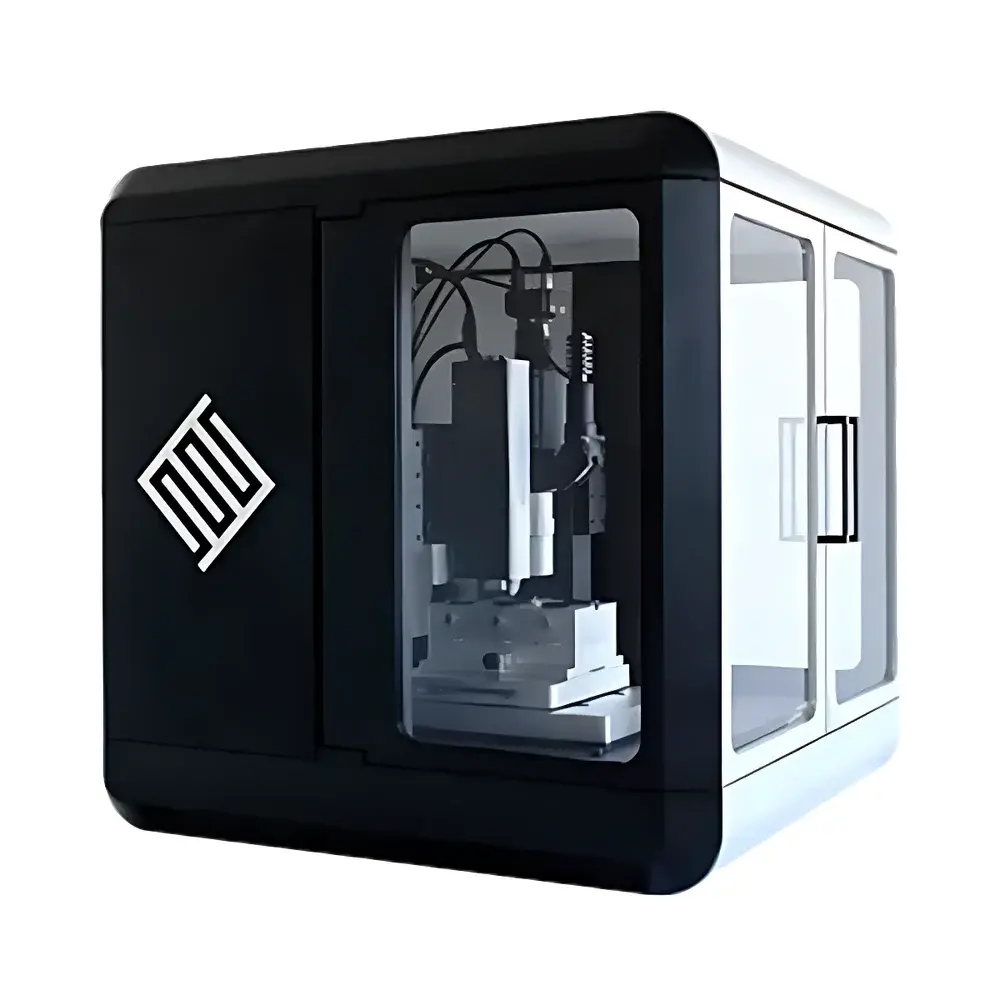
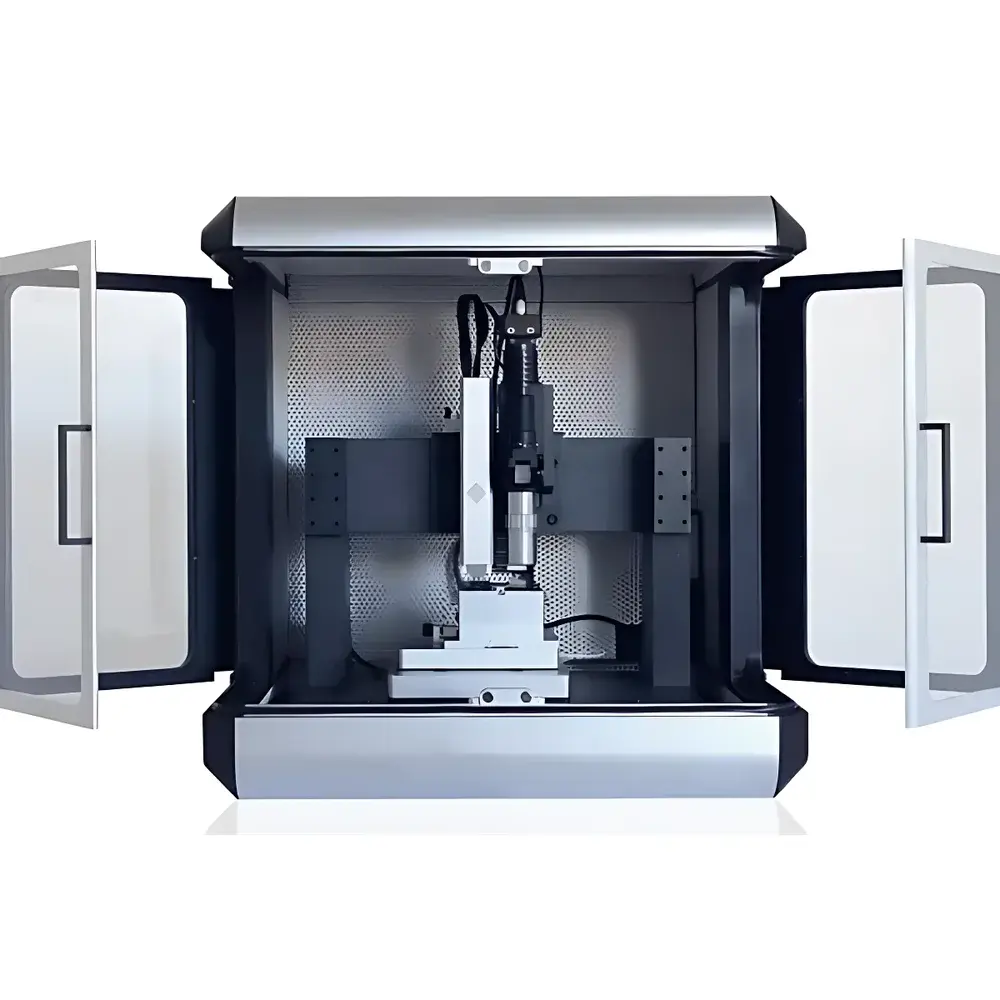
Oxford Instruments FT-I04 Nanoindenter
| Brand | Oxford Instruments |
|---|---|
| Origin | Switzerland |
| Model | FT-I04 |
| Instrument Type | Nanoindenter |
| Maximum Load Range | 2 N (across 5 selectable load channels) |
| Load Resolution | 0.5 nN (FT-S200 sensor) |
| Displacement Resolution | 0.05 pm |
| Indenter Tip Materials | Diamond, Tungsten Carbide, Sapphire |
| Indenter Geometries | Berkovich, Cube Corner, Flat Punch, Wedge, Conical, Spherical |
Overview
The Oxford Instruments FT-I04 Nanoindenter is a high-resolution, high-throughput mechanical characterization platform engineered for quantitative nanoscale mechanical and tribological property mapping. It leverages patented FemtoTools MEMS-based transduction technology—refined over two decades of microelectromechanical systems development—to deliver exceptional displacement and force fidelity under ambient and controlled environments. Unlike conventional piezoelectric or electromagnetic actuation systems, the FT-I04 employs an inherently displacement-controlled architecture with direct MEMS-based sensing, enabling real-time capture of rapid plastic events, pop-in phenomena, and fracture initiation with sub-nanometer spatial and sub-nanonewton force resolution. Its design targets rigorous materials science applications across metals, ceramics, polymers, thin films, and functional coatings, where multi-scale mechanical behavior—spanning elastic recovery, plastic flow, strain hardening, and interfacial delamination—must be resolved with metrological traceability.
Key Features
- MEMS-based dual-axis force-displacement sensing with intrinsic displacement control mode (optional force- or strain-rate control available)
- 10-decade force measurement range (0.5 nN to 2 N) via interchangeable, calibrated MEMS force sensors (e.g., FT-S200, FT-S2’000’000)
- 9-decade displacement measurement range: high-fidelity fine mode (20 µm range, ≤0.05 pm noise floor) and extended long-range mode (40 mm range, ≤1 nm noise)
- Dynamic bandwidth up to 100 kHz mechanical resonance frequency; data acquisition at up to 96 kHz for transient event capture
- Sub-second Continuous Stiffness Measurement (CSM) capability—single-point indentation completed in ≤1 s, enabling high-density mechanical property mapping (e.g., 120 mm × 60 mm area coverage)
- Modular architecture supporting optional add-ons: nanoscratch & wear module (with in situ friction coefficient and residual depth quantification), SPM-mode surface topography scanning, and high-temperature nano-mechanical testing (inert gas environment, independent tip heating)
Sample Compatibility & Compliance
The FT-I04 accommodates a broad spectrum of solid-state specimens—including bulk substrates, freestanding membranes, multilayer stacks, and vapor-deposited thin films—without requiring conductive coating. Its open-stage design allows integration with optical microscopy, Raman spectroscopy, or SEM-compatible sample holders. All force and displacement calibrations are traceable to SI units via NIST-traceable reference standards. The system supports compliance with ASTM E2546 (Standard Test Method for Instrumented Indentation Testing), ISO 14577 (Metallic materials — Instrumented indentation test), and USP (Mechanical Property Assessment of Pharmaceutical Films). Audit trails, electronic signatures, and parameter locking align with FDA 21 CFR Part 11 requirements when configured with validated software modules for regulated environments (GMP/GLP).
Software & Data Management
Control and analysis are performed via the dedicated FT-Analysis Suite—a modular, scriptable platform built on a deterministic real-time kernel. Preconfigured test templates cover CSM, creep, relaxation, dynamic fatigue, and high-throughput grid indentation. Raw force–displacement datasets are stored in HDF5 format with embedded metadata (timestamp, environmental conditions, calibration history, operator ID). Advanced post-processing includes Oliver–Pharr modulus/hardness extraction, pile-up/sink-in correction algorithms, clustering-based mechanical phase identification (e.g., k-means applied to hardness–modulus scatter plots), and automated cloud-map generation (hardness, elastic modulus, contact stiffness, plastic work ratio). Export options include CSV, MATLAB .mat, and standardized MDF (Materials Data Facility) schemas for FAIR data sharing.
Applications
- Depth-resolved hardness and reduced modulus profiling in graded coatings and ion-implanted surfaces
- Interface strength quantification via interfacial delamination mapping in adhesive joints and thermal barrier coatings
- Nanoscale creep kinetics in amorphous alloys and polymer glasses under constant-load or constant-depth conditions
- Mechanical heterogeneity assessment in multiphase composites (e.g., metal matrix composites, bioceramics)
- In situ nanoscratch testing to determine critical load for coating failure, friction coefficient evolution, and wear volume quantification
- High-temperature nanoindentation (up to 800 °C) for creep activation energy and thermal softening behavior in aerospace superalloys
FAQ
What is the guaranteed noise floor for force and displacement measurements in ambient lab conditions?
The system achieves ≤0.5 nN force noise and ≤0.05 pm displacement noise under standard laboratory vibration isolation (optical table + passive damping), verified per ISO 14577 Annex D.
Can the FT-I04 perform both nanoindentation and nanoscratch on the same sample without repositioning?
Yes—the modular head design allows seamless switching between indentation and scratch modes using motorized tip exchange and calibrated lateral force compensation, maintaining positional repeatability within ±50 nm.
Is the software compliant with 21 CFR Part 11 for use in pharmaceutical or medical device QA/QC labs?
When deployed with validated configuration (audit trail logging enabled, role-based access control, electronic signature workflow), the FT-Analysis Suite meets ALCOA+ data integrity principles and supports full 21 CFR Part 11 compliance documentation packages.
How is thermal drift compensated during long-duration nanoindentation tests?
The system integrates active thermal drift compensation via real-time thermal expansion modeling of the MEMS sensor stack and closed-loop thermal stabilization of the indenter shaft, achieving <0.02 nm/s drift rate over 60-minute hold periods.
Are calibration certificates provided with each force sensor?
Each MEMS force sensor ships with a NIST-traceable calibration certificate, including sensitivity, linearity error, hysteresis, and temperature coefficient data across its full operating range.



