
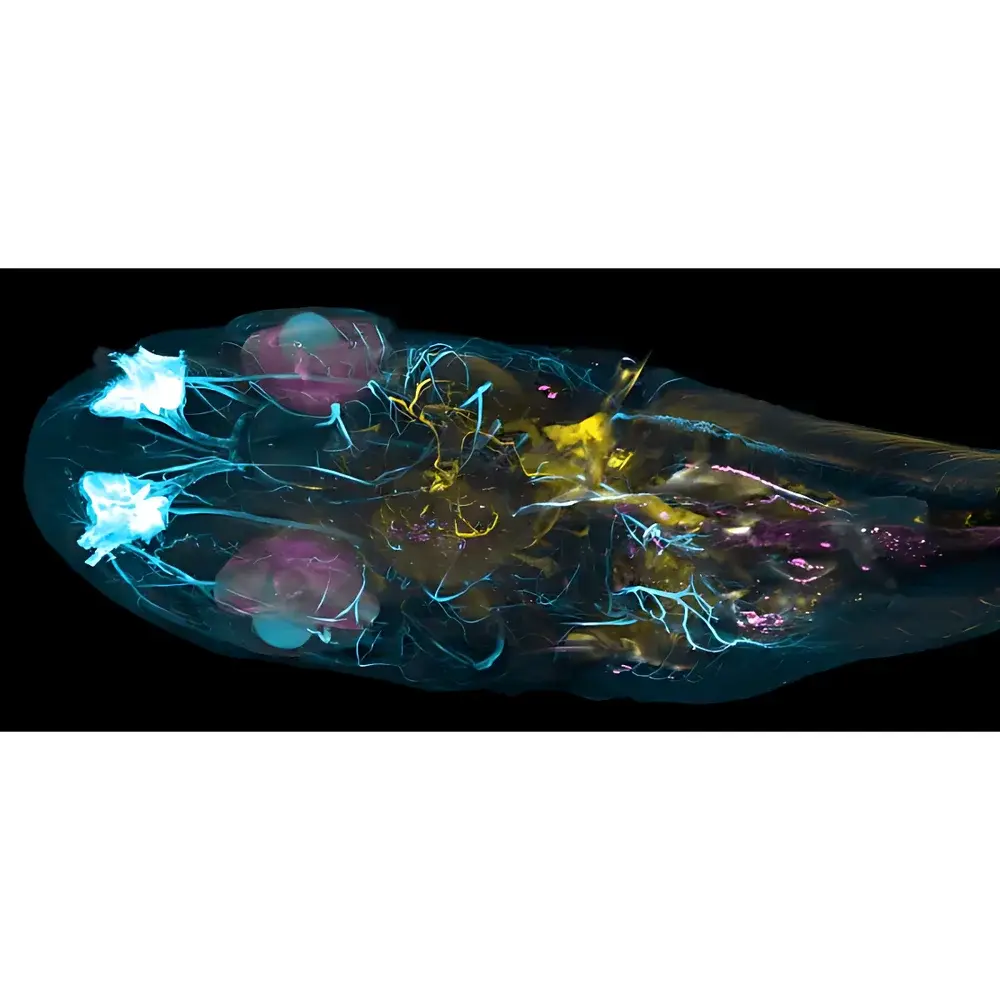
Oxford Instruments Imaris 10.2 Microscopic Image Analysis Software
| Brand | Oxford Instruments |
|---|---|
| Origin | United Kingdom |
| Model | Imaris 10.2 |
Overview
Oxford Instruments Imaris 10.2 is a high-performance, platform-agnostic microscopic image analysis software engineered for quantitative 3D/4D visualization and AI-driven segmentation of complex biological and material science datasets. Built on a modular, memory-efficient architecture, Imaris 10.2 implements voxel-based classification algorithms grounded in supervised machine learning principles—specifically optimized for confocal, light-sheet, STED, and widefield microscopy modalities. Unlike GPU-dependent alternatives, its core rendering and surface reconstruction pipelines are fully CPU-parallelized, enabling reproducible, hardware-flexible analysis across heterogeneous laboratory computing environments—including systems without dedicated graphics accelerators. The software operates as a standalone desktop application compatible with Windows 10/11 (64-bit) and macOS 12.0 or later, with native ARM64 binary support for Apple M-series chips (M1, M2, and M3), delivering up to 2× faster 3D volume rendering and real-time navigation through terabyte-scale multi-channel time-lapse datasets.
Key Features
- Native Apple Silicon Acceleration: Fully optimized ARM64 binaries leverage unified memory architecture and Neural Engine integration on M1/M2/M3 Macs—enabling sub-second preview generation and sustained high-throughput pixel classification without GPU dependency.
- AI-Powered Pixel Classification: Trainable, interpretable classifier supporting multi-class semantic segmentation; accommodates variable Z-stack thicknesses and anisotropic voxel dimensions—critical for resolving neurites, microglial processes, nuclear envelopes, or porous material microstructures.
- Smart Brush with Depth-Aware Voxel Selection: Intelligently adapts brush behavior based on local signal intensity gradients and Z-depth context, reducing manual correction effort in thick-tissue imaging (e.g., brain slices ≥50 µm).
- Real-Time Preview & Progressive Rendering: Instant low-resolution previews update during training; full-resolution surfaces reconstruct incrementally in background threads—allowing concurrent dataset navigation and analysis validation.
- Enhanced Keyframe Animation Engine: Includes scene freeze functionality for precise temporal anchoring, non-linear interpolation control, and export of publication-ready MP4/H.264 sequences with embedded metadata.
- Reproducibility Framework: Exports annotated training sets (including raw pixels, ground truth labels, and classifier parameters) in standardized HDF5 format—supporting FAIR data principles and GLP-compliant method documentation.
Sample Compatibility & Compliance
Imaris 10.2 natively imports >30 microscopy file formats—including Zeiss CZI, Nikon ND2, Olympus OIR, Leica LIF, and open standards such as TIFF (OME-TIFF), LSM, and HCS. It supports multi-dimensional data up to 5D (x, y, z, channel, time) with arbitrary bit-depth (8–64-bit integer/floating-point). For regulated environments, the software provides configurable audit trail logging (user actions, parameter changes, timestamped classifier versions), exportable provenance reports, and metadata preservation aligned with MIAME and OME-XML specifications. While not FDA-cleared as a medical device, Imaris 10.2 meets essential requirements for research use under ISO/IEC 17025 and supports documentation workflows compliant with GLP and GMP Annex 11 expectations for analytical software validation.
Software & Data Management
Imaris 10.2 employs a project-centric workflow with versioned session files (.ims) storing references—not copies—to source images, ensuring storage efficiency and traceability. All AI models are saved with full parameterization, enabling retraining or cross-platform validation. Batch processing via Python API (ImarisLib) allows integration into automated pipelines (e.g., Snakemake, Nextflow), while RESTful webhooks support notification triggers upon job completion. Export options include quantified measurements (volume, surface area, sphericity, track velocity), segmented masks (TIFF, NRRD), surface meshes (OBJ, STL), and interactive HTML reports with embedded 3D viewers. All exports retain calibrated spatial units (µm/pixel) and channel-specific intensity scaling.
Applications
- Neuroscience: Quantitative morphometry of dendritic spines, synaptic boutons, and microglial dynamics across longitudinal Z-stacks.
- Cell Biology: Mitotic spindle tracking, organelle co-localization analysis, and live-cell membrane protrusion quantification.
- Developmental Biology: Embryo segmentation, tissue boundary mapping, and 4D cell lineage tracing in light-sheet acquisitions.
- Materials Science: Pore network analysis in SEM/X-ray tomography data, grain boundary detection in polycrystalline structures.
- Drug Discovery: High-content screening (HCS) assay analysis with multiplexed biomarker segmentation and phenotypic scoring.
FAQ
Does Imaris 10.2 require a dedicated GPU for AI segmentation?
No. All pixel classification and surface reconstruction operations are executed on the CPU using highly parallelized C++ kernels—eliminating reliance on discrete graphics hardware while maintaining scalability across core count.
Can training datasets generated in Imaris 10.2 be reused in other ML frameworks?
Yes. Exported training sets include raw voxel intensities, label maps, and acquisition metadata in HDF5 format—compatible with TensorFlow, PyTorch, and scikit-learn preprocessing pipelines.
Is Imaris 10.2 validated for use in GLP-regulated studies?
Imaris is designed to support GLP-aligned documentation practices (audit trails, versioned classifiers, exportable provenance), though formal site-specific validation remains the responsibility of the end-user laboratory per OECD Principles of GLP.
How does Imaris handle anisotropic Z-resolution common in confocal datasets?
The Smart Brush and surface generation modules automatically compensate for non-isometric voxels by applying calibrated Z-scaling during both training and inference—preserving geometric fidelity in downstream morphometric analysis.
What file formats can be exported for publication figures?
Publication-ready outputs include vector-based SVG overlays, multi-panel TIFF composites with embedded scale bars, interactive 3D PDFs, and annotated MP4 animations with customizable color lookup tables and gamma correction.



