
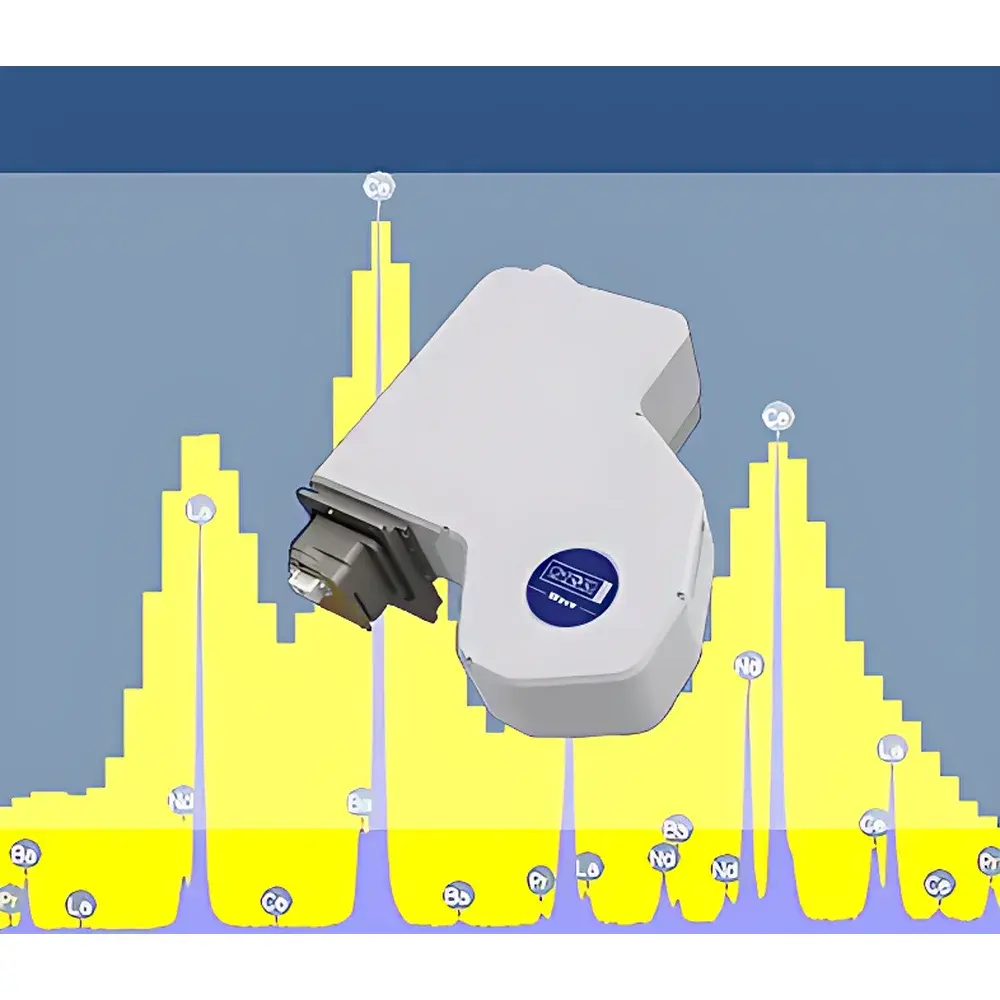
Oxford Instruments INCA WAVE WDS Spectrometer
| Brand | Oxford Instruments |
|---|---|
| Origin | United Kingdom |
| Manufacturer Type | Authorized Distributor |
| Origin Category | Imported |
| Model | WDS |
| Price | USD 185,000 (FOB UK) |
Overview
The Oxford Instruments INCA WAVE WDS Spectrometer is a high-performance wavelength dispersive spectrometer (WDS) engineered for integration with scanning electron microscopes (SEM), delivering analytical capabilities traditionally associated with electron probe microanalyzers (EPMA). Unlike conventional parallel-beam WDS systems, the INCA WAVE employs a true Rowland-circle geometry with full focusing optics—where the crystal analyzer, gas-flow proportional counter (or scintillation detector), and goniometer are mechanically synchronized to maintain precise Bragg diffraction conditions across the entire energy range. This optical architecture enables intrinsic spectral resolution down to ≤2 eV at Mn Kα, significantly enhancing peak separation for overlapping X-ray lines (e.g., S Kα/Pb Mα, Ti Kβ/V Kα) and improving quantitative fidelity in complex matrices. Designed for rigorous laboratory and industrial QA/QC environments, the WAVE operates stably under variable SEM vacuum conditions—including high-vacuum, low-vacuum, environmental (ESEM), and field-emission (FE-SEM) configurations—without compromising spectral integrity or positional reproducibility.
Key Features
- True full-focusing Rowland-circle optical design—eliminates dependence on sample vertical positioning accuracy, enabling consistent spectral acquisition across heterogeneous topographies.
- High-resolution diffraction crystals (e.g., LiF(200), PET, TAP) mounted on precision-machined goniometers with sub-arcsecond angular repeatability.
- Optimized detector interface supporting both gas-flow proportional counters (for light elements, Z ≥ 5) and scintillation detectors (for higher-energy lines up to 15 keV).
- Standard spectral coverage up to 10.8 keV; optional extended-range configuration supports analysis up to 15 keV for rare-earth and actinide elements.
- Mechanically robust, vibration-damped mounting system compatible with OEM SEM stages and column geometries—validated on >30 SEM platforms from Thermo Fisher, Zeiss, JEOL, and Hitachi.
- No requirement for optical microscope alignment—reducing setup time and operator dependency while improving long-term measurement stability.
Sample Compatibility & Compliance
The INCA WAVE accommodates a broad spectrum of solid-state specimens, including conductive metals, polished ceramics, geological thin sections, semiconductor wafers, and insulating polymers (with appropriate carbon coating). It supports quantitative analysis under low beam currents (<5 nA), making it suitable for radiation-sensitive materials and high-spatial-resolution mapping (≤100 nm feature size). The system complies with ISO 14709:2017 (electron probe microanalysis — terminology and definitions), ASTM E1508-22 (standard guide for quantitative elemental analysis by WDS), and supports GLP/GMP audit trails when paired with Oxford’s AZtecWave software. All mechanical components meet CE/UKCA directives for electromagnetic compatibility (EMC) and low-voltage safety.
Software & Data Management
Controlled via Oxford Instruments’ AZtecWave platform, the INCA WAVE integrates seamlessly with AZtecLive for real-time spectral acquisition, peak deconvolution, and matrix correction. Quantitative analysis leverages the XPP (X-ray Physical Principles) algorithm—a physics-based model incorporating absorption, fluorescence, and atomic number corrections without empirical standards. Software features include automated crystal selection, dynamic background modeling, spectral library matching (NIST SRM-compatible), and export-ready reports compliant with ISO/IEC 17025 documentation requirements. Audit logs record all parameter changes, calibration events, and user actions in accordance with FDA 21 CFR Part 11 electronic signature guidelines.
Applications
- High-accuracy quantification of trace elements (detection limits <100 ppm for Fe, Ni, Cu, Si, Al in metallic alloys).
- Light-element analysis (B, C, N, O, F) using specialized crystals and optimized take-off geometry.
- Phase identification and stoichiometric validation in intermetallics, oxides, and layered perovskites.
- Failure analysis in microelectronics—measuring dopant segregation at grain boundaries and interfacial interdiffusion.
- Geochemical provenance studies requiring ppm-level REE (rare earth element) profiling with minimal peak overlap interference.
FAQ
Is the INCA WAVE compatible with low-vacuum or ESEM modes?
Yes—the WAVE’s sealed vacuum path and differential pumping design enable stable operation at chamber pressures up to 200 Pa.
What is the minimum beam current required for reliable WDS detection?
Quantitative results have been validated at beam currents as low as 2.5 nA for major elements and 5 nA for trace analysis (Z > 11), depending on count time and matrix effects.
Can the system analyze boron and carbon simultaneously with high spectral resolution?
Yes—using the TAP crystal and optimized detector gain settings, B Kα (183 eV) and C Kα (277 eV) are fully resolved with baseline separation and counting statistics sufficient for sub-0.1 wt% quantification.
Does Oxford provide factory calibration certificates traceable to NIST standards?
Yes—each delivered system includes a full calibration report referencing NIST SRM 2100 (Fe–Ni alloy), SRM 2101 (aluminosilicate glass), and SRM 1160 (CaF₂), with uncertainty budgets provided per ISO/IEC 17025.
Related Products




