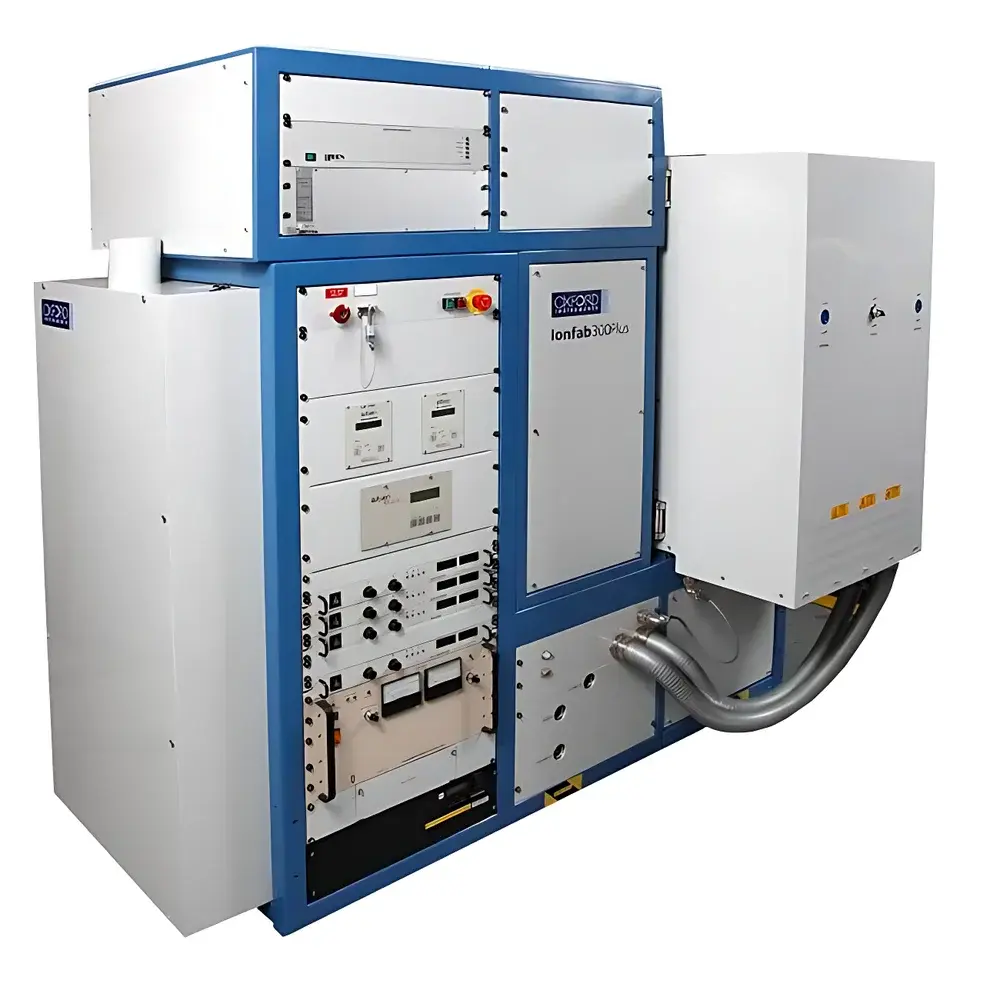
Oxford Instruments Ionfab 300 Ion Beam Etching and Deposition System
| Brand | Oxford Instruments |
|---|---|
| Origin | United Kingdom |
| Model | Ionfab 300 |
| Configuration Options | Direct-Load, Single-Wafer Transfer, Cassette-to-Cassette Transfer |
| Process Modes | Ion Beam Deposition (IBD), Ion Beam Etching (IBE), Co-deposition & Reactive IBE |
| Wafer Handling | 300 mm single-wafer or cluster-integrated |
| Surface Roughness | Sub-nanometer RMS (typical for IBD films) |
| Uniformity | ≤±1.5% across 300 mm wafer (process-dependent) |
| Reproducibility | CV < 2% for etch/deposition rate (run-to-run) |
Overview
The Oxford Instruments Ionfab 300 is a high-precision, dual-mode ion beam system engineered for advanced semiconductor process development and production-scale thin-film engineering. It operates on the physical principles of broad-beam ion sputtering—utilizing inert gas ions (typically Ar⁺) accelerated across a well-defined potential gradient to induce controlled momentum transfer at the target surface. This enables two distinct yet complementary operational modes: Ion Beam Etching (IBE), where incident ions physically remove material with minimal chemical interaction; and Ion Beam Deposition (IBD), where sputtered atoms from a solid target condense onto a substrate under ultra-high vacuum (UHV) conditions (base pressure <5×10⁻⁸ mbar). Unlike plasma-based techniques, the Ionfab 300 decouples plasma generation from the process chamber, eliminating substrate charging, ion energy dispersion, and reactive species contamination—making it indispensable for fabricating ultra-smooth, stoichiometrically precise, and low-defect-density films in memory devices, MEMS, photonics, and quantum materials research.
Key Features
- Dual-ion-beam architecture with independently adjustable primary and neutralizing beams—enabling simultaneous or sequential etching and deposition without breaking vacuum
- Modular chamber design supporting multiple load-lock configurations: direct-load (manual), single-wafer robotic transfer, and cassette-to-cassette integration for cluster tool compatibility
- High-stability ion optics with beam current stability <±0.5% over 8 hours—critical for reproducible etch rates and film thickness control
- In-situ endpoint detection interface compatible with optical emission spectroscopy (OES) and secondary ion mass spectrometry (SIMS) feedthroughs for real-time layer monitoring
- Programmable beam scanning and substrate rotation—optimized for uniformity across 300 mm wafers (≤±1.5% thickness variation, verified per ASTM F390-22)
- UHV-compatible construction using all-metal seals and cryo-pumped chambers—ensuring residual gas partial pressures <1×10⁻⁹ Torr for oxygen- and carbon-sensitive processes
Sample Compatibility & Compliance
The Ionfab 300 accommodates substrates up to 300 mm in diameter, including silicon, SiC, GaN, sapphire, fused silica, and flexible metal foils. Its non-reactive, low-damage ion beam processing preserves crystallinity and interfacial integrity—essential for epitaxial seed layers, hard mask trimming, and lift-off metallization. The system meets ISO 14644-1 Class 5 cleanroom integration requirements and supports full GLP/GMP documentation workflows. All software logs—including recipe parameters, beam currents, pressure traces, and endpoint signals—are timestamped and audit-trail enabled in accordance with FDA 21 CFR Part 11 and EU Annex 11 guidelines. Hardware interlocks, vacuum safety protocols, and radiation shielding comply with IEC 61000-6-2/6-4 and UK HSE Ionising Radiations Regulations 2017.
Software & Data Management
Control is executed via Oxford Instruments’ proprietary IonControl Suite—a deterministic, real-time operating system (RTOS) platform with deterministic cycle times threshold, trigger endpoint”). Raw sensor data (beam voltage/current, chamber pressure, substrate temperature) are acquired at 1 kHz sampling and stored in HDF5 format with embedded metadata (sample ID, operator, calibration timestamps). Integration with factory MES systems is supported via SECS/GEM protocol; OPC UA server enables bidirectional communication with Siemens Desigo or Rockwell FactoryTalk environments. All data exports include NIST-traceable calibration certificates for ion current monitors and thermocouple inputs.
Applications
- Atomic-layer-precise etching of high-k dielectrics (HfO₂, Al₂O₃) and ferroelectric oxides (Hf₀.₅Zr₀.₅O₂) without fluorine residue
- Deposition of ultra-low-roughness amorphous carbon hard masks (RMS <0.2 nm) for EUV lithography patterning
- Surface smoothing of GaN-on-Si templates prior to MOCVD regrowth
- Isotopically pure thin-film synthesis (e.g., ¹⁰B-enriched neutron absorbers) via multi-target co-sputtering
- Failure analysis cross-sectioning of 3D NAND stacks with sub-5 nm lateral damage zone
- Pre-deposition cleaning of superconducting NbTiN films for quantum circuit fabrication
FAQ
What vacuum level does the Ionfab 300 achieve, and how is it maintained?
The system achieves a base pressure of <5×10⁻⁸ mbar using a combination of turbomolecular pumping and cryogenic trapping, with continuous pressure monitoring via Bayard-Alpert and capacitance manometer gauges.
Can the Ionfab 300 perform reactive ion beam etching (RIBE)?
Yes—by introducing controlled flows of Cl₂, CHF₃, or SF₆ into the process chamber while maintaining beam-directed ion acceleration, enabling chemically enhanced physical etching with improved selectivity.
Is remote diagnostics and preventive maintenance supported?
All systems ship with Oxford Instruments’ RemoteConnect module, enabling secure TLS 1.3–encrypted access for firmware updates, log analysis, and predictive health monitoring based on ion source emission decay trends.
How is beam alignment validated and certified?
Each installation includes a beam profiling service using a Faraday cup array and phosphor screen imaging, with alignment certification traceable to NPL (UK) standards and documented in the FAT/SAT report.
Does the system support automated recipe transfer between R&D and production tools?
Yes—IonControl Suite uses a common recipe schema across Oxford’s Ionfab family (200/300/400), enabling one-to-one recipe portability with validation reports generated per JIS Z 8401 rounding rules.