
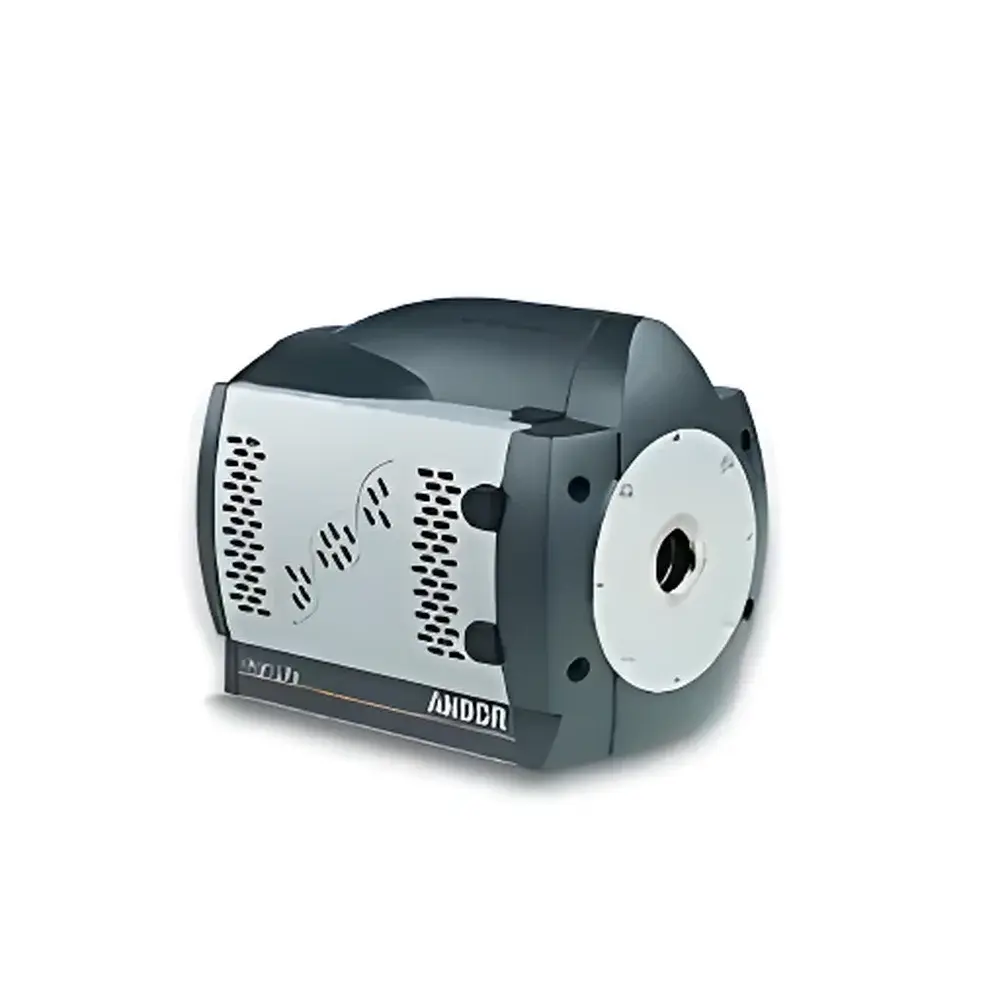
Oxford Instruments iXon Ultra 897 EMCCD Camera
| Brand | Oxford Instruments |
|---|---|
| Origin | United Kingdom |
| Model | iXon Ultra 897 |
| Pixel Size | 16 µm |
| Readout Speed | 17 MHz (full frame) |
| Frame Rate | 56 fps (512 × 512), 595 fps (128 × 128 ROI) |
| Cooling | Thermoelectric to −100 °C |
| Quantum Efficiency | Extended back-illuminated response (EX2 technology) |
| Gain Calibration | RealGain™ and EMCAL™ |
| Interface | USB 2.0 with raw data access |
| Operating Modes | EMCCD and conventional CCD |
| Software Features | OptAcquire, iCam, Counting Conversion, Edge Suppression |
Overview
The Oxford Instruments iXon Ultra 897 is a high-performance electron-multiplying charge-coupled device (EMCCD) camera engineered for quantitative, low-light scientific imaging in demanding applications such as single-molecule localization microscopy (SMLM), total internal reflection fluorescence (TIRF), Förster resonance energy transfer (FRET), and live-cell super-resolution imaging. Built around a back-illuminated 512 × 512 frame-transfer sensor, the iXon Ultra 897 leverages deep thermoelectric cooling (−100 °C) and ultra-low clock-induced charge (CIC) noise to achieve single-photon detection sensitivity with exceptional signal-to-noise ratio (SNR). Its 16 µm pixel architecture balances spatial resolution with full-well capacity, while the 17 MHz readout engine enables sustained 56 fps acquisition at full resolution—critical for capturing rapid dynamic events without compromising quantitative fidelity.
Key Features
- Ultra-Fast Readout & High Frame Rates: Optimized 17 MHz readout delivers 56 fps at full 512 × 512 resolution; region-of-interest (ROI) cropping supports up to 595 fps at 128 × 128 pixels, enabling real-time tracking of subcellular dynamics.
- Extended Quantum Efficiency (EX2 Technology): Back-illuminated sensor architecture enhanced with EX2 coating extends QE beyond standard back-thinned devices—particularly in the 500–900 nm range—improving photon collection efficiency for near-infrared fluorophores.
- Deep Thermoelectric Cooling: Stable −100 °C operation suppresses dark current to <0.001 e⁻/pix/sec, ensuring minimal background contribution during long exposures or low-signal acquisitions.
- RealGain™ and EMCAL™: RealGain™ provides linear, calibrated EM gain scaling across the entire gain range; EMCAL™ enables automated, on-the-fly EM gain recalibration—essential for longitudinal experiments requiring consistent quantitative output.
- OptAcquire & iCam: OptAcquire offers application-specific acquisition presets (e.g., TIRF, confocal, widefield) with one-click optimization of gain, exposure, and readout mode; iCam allows millisecond-level switching between exposure times without interrupting acquisition streams.
- Counting Conversion Mode: Converts raw EMCCD output into photon-counted or electron-counted data in real time—enabling Poisson-statistics-based quantification, drift correction, and post-acquisition analysis compatible with open-source reconstruction pipelines (e.g., ThunderSTORM, Picasso).
Sample Compatibility & Compliance
The iXon Ultra 897 is designed for integration into multi-modal optical platforms—including inverted and upright microscopes, light-sheet systems, and custom-built setups—via C-mount or proprietary adapter interfaces. Its compact form factor and USB 2.0 connectivity simplify installation without requiring PCIe slots or external power supplies. The camera complies with CE marking requirements for electromagnetic compatibility (EMC) and low-voltage directives. While not certified under FDA 21 CFR Part 11, its software architecture supports audit-trail logging and user-access controls when deployed within validated laboratory information management systems (LIMS) adhering to GLP/GMP workflows. Data integrity is preserved through lossless raw-data streaming and metadata embedding (including temperature, gain, exposure, and timestamp).
Software & Data Management
Oxford Instruments’ solis software suite provides native support for the iXon Ultra 897, offering real-time visualization, hardware-synchronized triggering, and export to TIFF, HDF5, and NDX formats. All acquisition parameters—including EM gain, ROI coordinates, binning, and cooling setpoint—are programmatically accessible via COM, .NET, and Python APIs (PySolis). Raw data streams are delivered without on-board processing, preserving bit-depth fidelity for downstream analysis in MATLAB, Python (NumPy/SciPy), or ImageJ/Fiji. The camera’s USB 2.0 interface ensures plug-and-play compatibility with Windows 10/11 and Linux (kernel ≥5.4) environments, with driver signing compliant with UEFI Secure Boot standards.
Applications
- Single-molecule tracking and PALM/STORM super-resolution microscopy
- Live-cell calcium imaging and voltage-sensitive dye recording
- Fluorescence correlation spectroscopy (FCS) and number & brightness (N&B) analysis
- Time-resolved luminescence and bioluminescence imaging
- Low-light astronomy and adaptive optics wavefront sensing
- Quantitative FRET and anisotropy measurements requiring high temporal resolution
FAQ
What is the difference between EMCCD and sCMOS performance in low-light imaging?
EMCCDs like the iXon Ultra 897 provide true single-photon sensitivity with sub-electron effective read noise—even at high frame rates—whereas sCMOS sensors typically exhibit higher read noise (>1 e⁻) below 100 fps. This makes EMCCDs preferable for photon-starved applications where signal is limited to ≤10 photons per pixel per frame.
Can the iXon Ultra 897 be used in vacuum or cryogenic environments?
No—the camera is rated for ambient laboratory operation only (5–40 °C ambient, non-condensing humidity). It is not sealed for vacuum use nor rated for cryogenic temperatures beyond its internal TE cooler’s −100 °C sensor stage.
Is RealGain™ calibration traceable to NIST standards?
RealGain™ is internally referenced against the camera’s fixed EM gain register and validated using controlled LED illumination sources. While not NIST-traceable out-of-box, users may perform secondary calibration using calibrated photodiodes or standardized fluorescent beads per ISO 17025 protocols.
Does the camera support hardware triggering with TTL or LVDS signals?
Yes—the iXon Ultra 897 features dual TTL-compatible trigger inputs (exposure start and frame sync) and one TTL output (exposure active), fully configurable via solis or API for synchronization with lasers, shutters, or piezo stages.
How does Edge Suppression reduce interference artifacts in NIR imaging?
Edge Suppression applies a tailored optical interference filter coating and firmware-based phase compensation to minimize etalon fringes arising from reflections between the sensor passivation layer and microlens array—particularly problematic above 750 nm in back-illuminated devices.




