
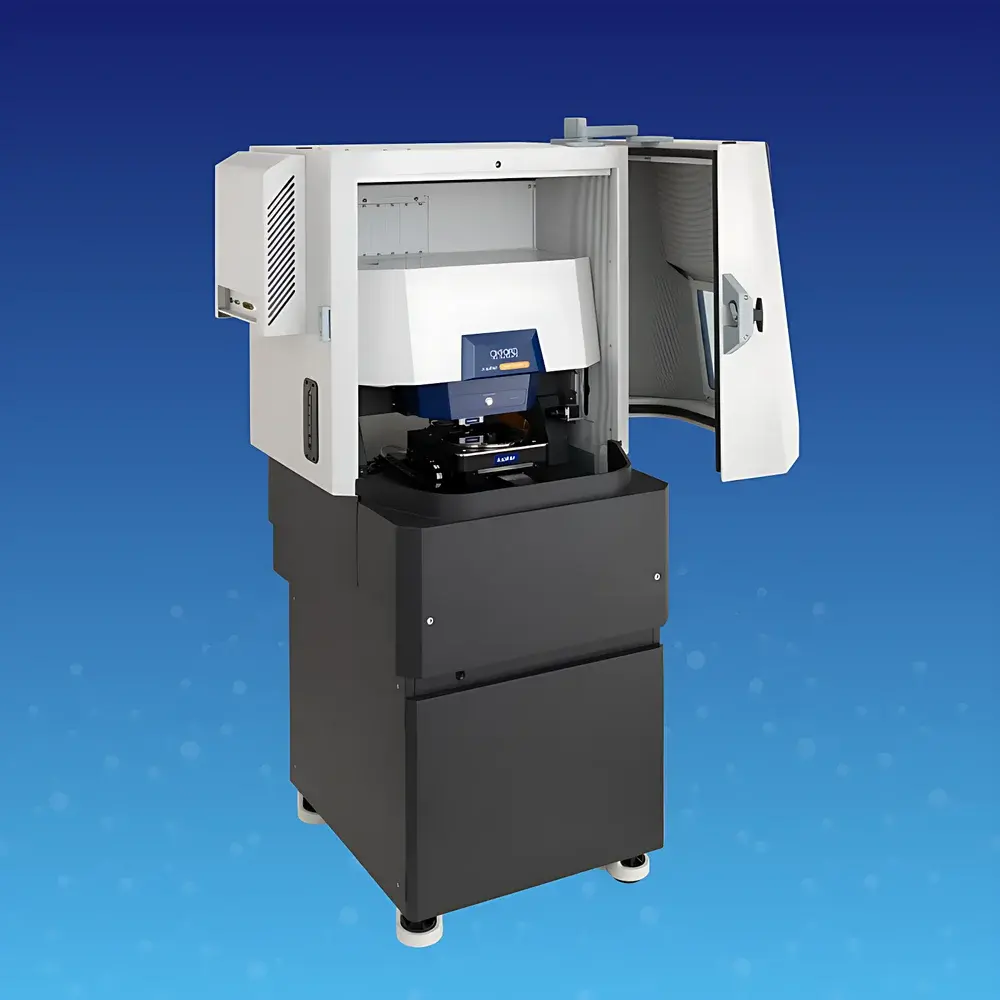
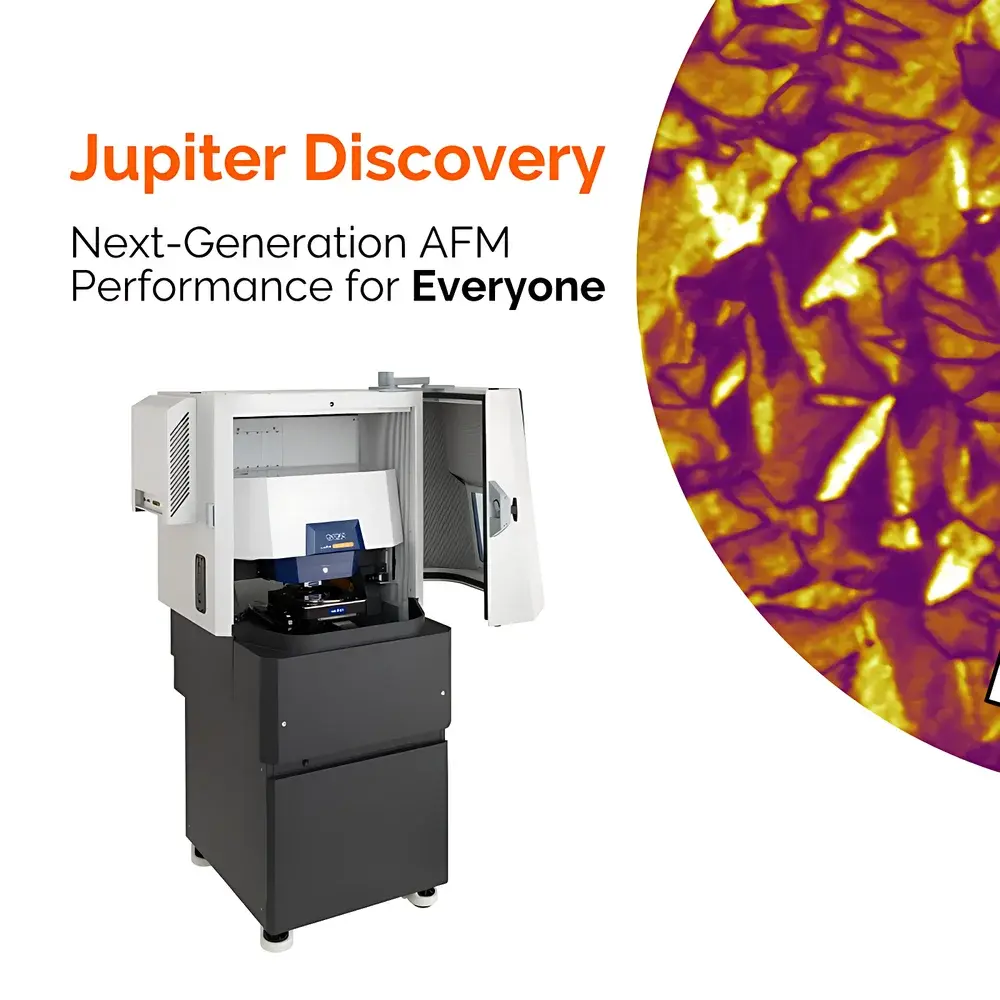
Oxford Instruments Jupiter Discovery Atomic Force Microscope
| Brand | Oxford Instruments |
|---|---|
| Origin | United Kingdom |
| Manufacturer Type | Authorized Distributor |
| Origin Category | Imported |
| Model | Jupiter Discovery AFM |
| Pricing | Available Upon Request |
Overview
The Oxford Instruments Jupiter Discovery Atomic Force Microscope (AFM) is a high-performance, large-sample scanning probe microscope engineered for precision nanoscale surface characterization in both academic and industrial R&D environments. Based on the fundamental principle of dynamic force detection—where a microfabricated cantilever with a sharp tip scans across a sample surface while monitoring tip–sample interaction forces via optical beam deflection—the Jupiter Discovery delivers true atomic-resolution topography, mechanical property mapping (e.g., modulus, adhesion), and electrical characterization (conductive AFM, Kelvin probe force microscopy) under ambient, liquid, or controlled environmental conditions. Its advanced closed-loop piezoelectric scanner architecture enables sub-angstrom Z-resolution and <1 nm lateral repeatability over scan ranges up to 100 × 100 µm, supporting demanding applications in semiconductor metrology, 2D materials research, polymer nanocomposites, and biological soft matter analysis.
Key Features
- High-speed scanning capability: Achieves imaging rates up to 20× faster than conventional large-sample AFMs, enabling rapid statistical surface analysis without compromising resolution.
- Pre-aligned, pre-installed cantilevers with integrated calibration standards reduce setup time and eliminate manual alignment errors.
- Dedicated side-view optical camera system provides real-time, parallax-free visualization of tip–sample engagement—critical for accurate approach control and fragile sample handling.
- AutoPilot-enabled FFM (Force Feedback Mode) automates parameter optimization for topographic imaging, dynamically adjusting setpoint, gain, and scan speed based on local surface properties—ideal for novice users and high-throughput labs.
- Modular design supports seamless integration of optional modules including electrochemical AFM (EC-AFM), magnetic force microscopy (MFM), and nanoindentation add-ons.
- Thermally stable, vibration-isolated baseplate and active acoustic shielding ensure robust performance in standard laboratory environments without requiring dedicated cleanrooms or active damping tables.
Sample Compatibility & Compliance
The Jupiter Discovery accommodates samples up to 200 mm in diameter and 50 mm in height, making it suitable for wafers, coated glass substrates, tissue sections, and macroscopic biomaterials. It complies with ISO/IEC 17025 requirements for measurement traceability when used with NIST-traceable calibration artifacts. The system supports GLP/GMP-compliant workflows through audit-trail-enabled software logging (including user actions, parameter changes, and instrument status), aligning with FDA 21 CFR Part 11 data integrity expectations for regulated pharmaceutical and medical device development. All firmware and control electronics meet CE, UKCA, and FCC electromagnetic compatibility standards.
Software & Data Management
Controlled via Oxford Instruments’ CypherOS platform—a modular, Python-scriptable interface—the Jupiter Discovery offers both guided wizard-based operation for routine measurements and full low-level parameter access for advanced method development. Raw data is stored in open-format HDF5 files with embedded metadata (timestamp, operator ID, calibration history, environmental conditions). Batch processing pipelines support automated roughness quantification (Sa, Sq, Sz per ISO 25178), grain analysis, and cross-sectional profiling. Export options include TIFF, CSV, and OMEXML-compatible formats for interoperability with third-party analysis tools such as Gwyddion, MountainsMap, and MATLAB. Remote monitoring and secure cloud backup are supported via optional enterprise license packages.
Applications
- Semiconductor process control: Quantitative line-edge roughness (LER) and trench profile analysis on EUV-patterned wafers.
- Advanced battery research: In-situ SEI layer evolution monitoring during electrochemical cycling in liquid cells.
- Biomedical materials: Nanomechanical mapping of collagen fibril stiffness gradients in decellularized scaffolds.
- Graphene and TMDC characterization: Layer-counting via phase contrast and work function mapping across heterostructures.
- Thin-film quality assurance: Defect density assessment and interfacial delamination detection in OLED encapsulation layers.
FAQ
What sample preparation is required for Jupiter Discovery AFM?
Minimal preparation is needed for most solid-state samples; conductive coatings are not required for topographic imaging. Biological specimens may require gentle fixation or drying protocols depending on modality.
Is liquid-phase imaging supported out-of-the-box?
Yes—the system includes a sealed fluid cell option compatible with physiological buffers and electrochemical electrolytes, with integrated temperature and flow control ports.
Can the Jupiter Discovery be integrated into automated fab metrology workflows?
It supports SECS/GEM communication protocols and can be linked to MES systems via OPC UA interfaces for unattended wafer lot inspection.
Does Oxford Instruments provide application-specific training and method validation support?
Yes—on-site installation qualification (IQ), operational qualification (OQ), and application-specific SOP development are available as part of extended service contracts.
What is the typical lead time for delivery and commissioning?
Standard configurations ship within 12–16 weeks from order confirmation; on-site commissioning and user training typically occur within two weeks of hardware arrival.





