
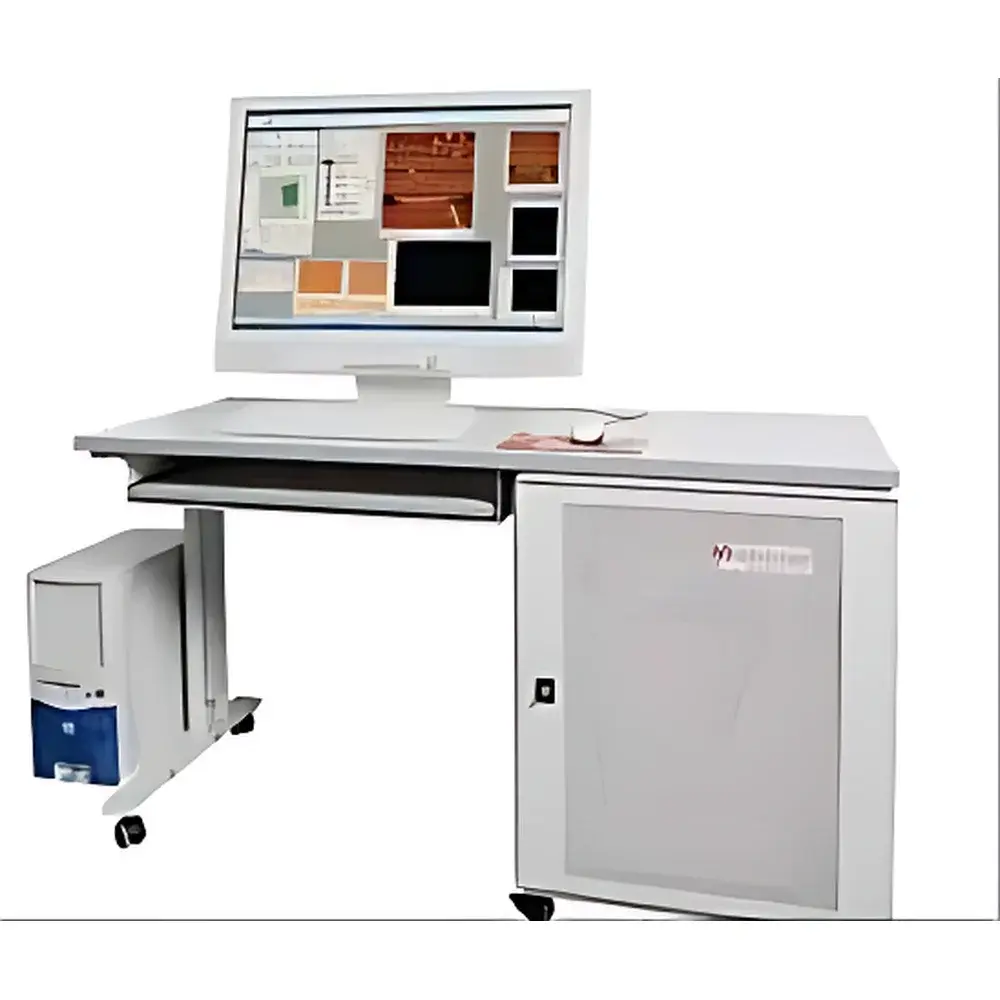
Oxford Instruments Matrix Control System for Scanning Probe Microscopy
| Brand | Oxford Instruments |
|---|---|
| Origin | Germany |
| Manufacturer Type | Authorized Distributor |
| Origin Category | Imported |
| Model | Matrix |
| Price Range | USD 320,000 – 385,000 |
| Instrument Type | Magnetic Force Microscope (MFM) Control System |
Overview
The Oxford Instruments Matrix Control System is a high-performance, fully digital control platform engineered specifically for advanced scanning probe microscopy (SPM) applications—including magnetic force microscopy (MFM), atomic force microscopy (AFM), and related modalities. Built upon a multi-processor architecture, the Matrix system integrates real-time signal processing, low-noise analog front-ends, and deterministic digital control loops to deliver exceptional measurement fidelity, sub-millisecond feedback response, and nanoscale spatial resolution. Its core design philosophy centers on modularity, scalability, and deterministic timing—enabling precise synchronization between probe actuation, sensor readout, and data acquisition across diverse SPM configurations. Unlike legacy analog or hybrid controllers, the Matrix employs a unified digital signal chain from sensor input to actuator output, minimizing phase lag and thermal drift while supporting high-bandwidth imaging (up to 10 kHz scan line rates under optimized conditions) and quantitative nanomechanical mapping.
Key Features
- Modular Hardware Architecture: All functional units—including Z-positioning control, XY-scanner drive, lock-in amplification, and external signal interfacing—are implemented on discrete, hot-swappable digital circuit boards. Each board shares a common digital core comprising an ARM-based CPU, a high-throughput DSP, and a reconfigurable FPGA for real-time logic and waveform generation.
- Deterministic Real-Time Operation: The system runs a hard real-time operating environment with sub-10 µs interrupt latency, ensuring consistent loop timing for closed-loop feedback—even during simultaneous multi-channel acquisition or complex spectroscopy routines.
- Low-Noise Signal Chain: Analog inputs feature 24-bit sigma-delta ADCs with programmable gain and anti-aliasing filtering; analog outputs employ 20-bit DACs with <10 nV/√Hz input-referred noise density (typ.) across DC–2 MHz bandwidth.
- Extensible I/O Framework: Standard PCIe-based expansion slots support optional add-on modules—for example, high-speed AFM cantilever deflection detection, multi-frequency MFM excitation, or integration with cryogenic sample stages and ultra-high vacuum (UHV) environments.
- Unified Software Interface: Native compatibility with Oxford Instruments’ Mercury software suite, enabling scriptable experiment sequencing, automated calibration routines, and vendor-agnostic data export in HDF5 and TIFF formats.
Sample Compatibility & Compliance
The Matrix Control System is designed for integration with Oxford Instruments’ family of SPM platforms—including the Cypher ES, Asylum Research MFP-3D, and custom-built UHV-MFM systems. It supports standard commercial probes (e.g., silicon, silicon nitride, and coated MFM tips) and accommodates sample sizes up to 100 mm in diameter. The system complies with CE marking requirements for electromagnetic compatibility (EMC Directive 2014/30/EU) and low-voltage safety (LVD Directive 2014/35/EU). When deployed in regulated environments (e.g., academic GLP labs or industrial R&D facilities), the Mercury software optionally supports audit-trail logging, electronic signatures, and 21 CFR Part 11–compliant user access controls—facilitating traceability and data integrity per ISO/IEC 17025 and ASTM E2500 standards.
Software & Data Management
Control and analysis are managed through Mercury—a cross-platform application built on Qt and Python-based scientific libraries (NumPy, SciPy, Matplotlib). Mercury provides a hierarchical experiment definition interface, allowing users to define scan parameters, feedback setpoints, and spectroscopic triggers via intuitive graphical workflows or Python scripting. All raw and processed data are stored in self-describing HDF5 files containing embedded metadata (timestamp, instrument configuration, calibration constants, and user annotations). Batch processing pipelines support automated flattening, FFT analysis, phase demodulation (for MFM), and force-distance curve fitting using open-source algorithms compliant with ISO 11393-2 (AFM force calibration) and ISO/TS 21360 (magnetic tip characterization).
Applications
The Matrix Control System enables quantitative nanoscale characterization across materials science, condensed matter physics, and semiconductor metrology. Typical use cases include: domain imaging of ferromagnetic thin films and spintronic heterostructures; visualization of stray fields above superconducting vortices; topographic and magnetic contrast correlation in multiferroics; nanomechanical property mapping (modulus, adhesion, dissipation) of polymer blends and biological membranes; and in situ electrochemical AFM/MFM studies of battery electrode interfaces. Its deterministic timing and modular I/O also support emerging techniques such as high-speed multifrequency SPM and time-resolved nanomagnetism.
FAQ
Is the Matrix Control System compatible with third-party SPM hardware?
Yes—it supports industry-standard analog and digital I/O protocols (e.g., ±10 V analog control signals, TTL synchronization pulses, and SPI/I²C peripheral interfaces), enabling integration with non-Oxford scanning stages, detectors, and environmental chambers.
Can existing SPM systems be retrofitted with the Matrix controller?
Retrofitting is feasible for most modern SPM platforms with accessible analog control interfaces and mechanical mounting provisions; Oxford Instruments provides detailed integration guides and engineering support for qualified installations.
Does the system support automated calibration procedures?
Yes—Mercury includes built-in routines for scanner linearity correction, photodiode sensitivity calibration, and MFM tip magnetization characterization using reference samples traceable to NIST SRM 2023.
What operating systems are supported?
Mercury is natively supported on Windows 10/11 (64-bit) and Ubuntu LTS (22.04+); Linux support requires installation of proprietary FPGA programming tools provided under license.
Is remote operation and monitoring supported?
Yes—via secure WebSocket-based API and optional VNC-enabled remote desktop access, with role-based permissions and encrypted data transmission compliant with TLS 1.3.




