
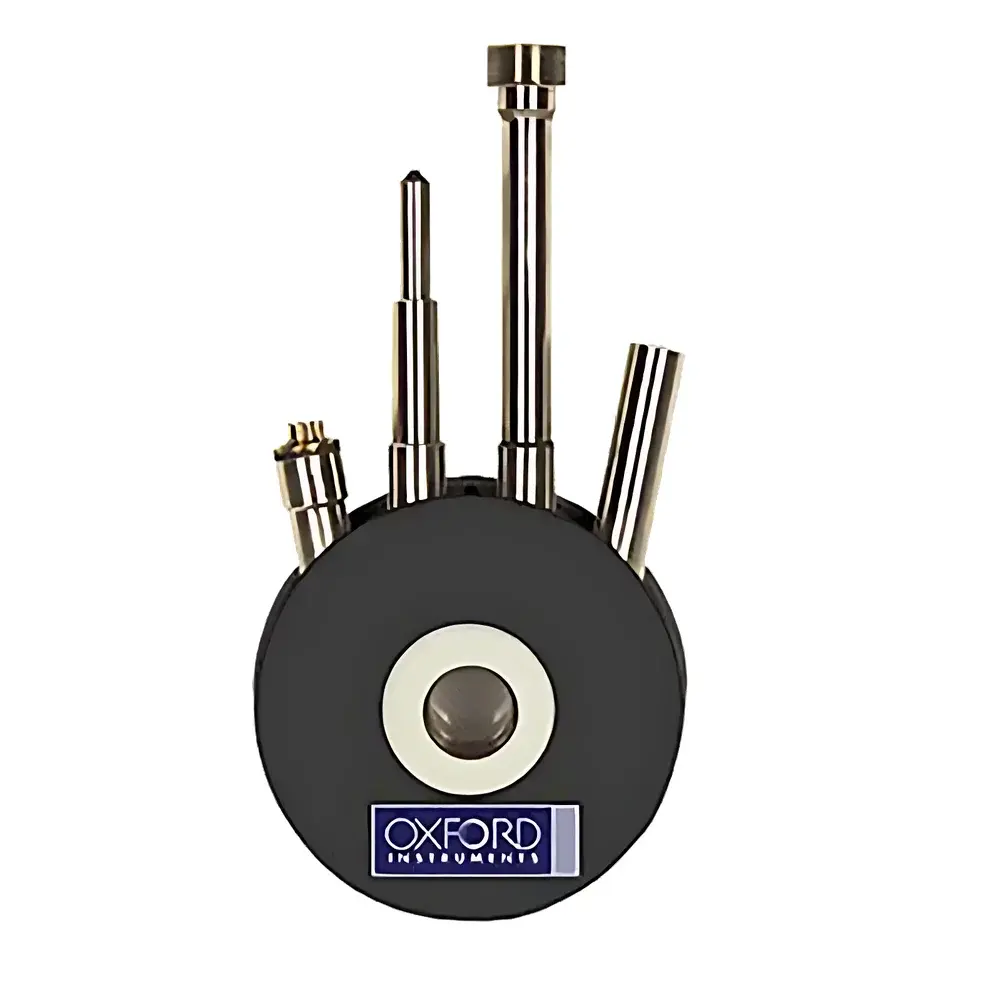
Oxford Instruments Microstat Cryogenic Optical Microscope Stage
| Brand | Oxford Instruments |
|---|---|
| Origin | United Kingdom |
| Model | Microstat |
| Temperature Range | 1.5 K to 300 K (depending on configuration) |
| Cooling Method | Closed-cycle helium cryocooler or liquid helium flow cryostat |
| Optical Access | Dual windows (UV to FIR transmission, optional AR coatings) |
| Electrical Feedthroughs | Up to 24 low-noise coaxial or twisted-pair leads |
| Footprint | Compact benchtop design (< 300 mm × 300 mm base) |
| Vibration Isolation | Active/passive hybrid stage stabilization |
| Compliance | CE, UKCA, RoHS |
Overview
The Oxford Instruments Microstat is a high-precision cryogenic optical microscope stage engineered for in situ low-temperature characterization of materials under controlled thermal conditions. Based on closed-cycle helium refrigeration or continuous-flow liquid helium cryostat architecture, the Microstat delivers stable, vibration-minimized thermal environments from 1.5 K to 300 K—enabling quantum transport measurements, magneto-optical spectroscopy, photoluminescence mapping, and superconducting device testing. Its core design integrates cryogenic thermal management with uncompromised optical throughput: dual anti-reflection-coated sapphire, CaF₂, or polyethylene windows support broadband transmission across UV (190 nm), visible, near-IR (up to 2.5 µm), and far-IR (up to 1 mm wavelength), while maintaining hermetic vacuum integrity (< 1 × 10⁻⁶ mbar operating pressure). The stage features a rigid monolithic copper cold finger and optimized thermal anchoring to ensure temperature homogeneity (< ±10 mK spatial variation over 10 mm sample area) and fast thermal settling (< 15 minutes from 300 K to 4 K).
Key Features
- Temperature range: 1.5 K–300 K (with < 5 mK stability over 24 h at setpoint)
- Dual optical access ports configurable for collinear or orthogonal beam paths; window materials selectable per spectral requirement (e.g., MgF₂ for deep UV, Si for mid-IR, Mylar for THz)
- Integrated electrical feedthroughs: up to 24 individually shielded, low-thermal-conductivity coaxial or twisted-pair lines rated for DC–18 GHz operation
- Benchtop footprint (280 mm × 280 mm × 420 mm H) compatible with standard upright and inverted optical microscopes, including confocal, Raman, and AFM platforms
- Vibration mitigation system combining passive elastomeric mounts and optional active piezoelectric dampers (residual motion < 5 nm RMS at 1–100 Hz)
- Modular cold head interface supporting integration with Oxford Instruments’ ILM series cryocoolers or external liquid helium dewars
Sample Compatibility & Compliance
The Microstat accommodates standard microscope slides (26 mm × 76 mm), custom PCB carriers, and chip-scale devices up to 25 mm diameter. Sample mounting uses non-magnetic, low-outgassing kinematic fixtures with gold-plated copper thermal links. All vacuum components conform to ASTM E595 outgassing specifications (< 1.0% TML, < 0.1% CVCM), ensuring compatibility with ultra-high vacuum (UHV) and ultra-low-vibration cleanroom environments. The system meets CE and UKCA directives for electromagnetic compatibility (EMC Directive 2014/30/EU) and low-voltage safety (LVD Directive 2014/35/EU). Optional firmware enables audit-trail logging compliant with GLP and GMP documentation requirements per FDA 21 CFR Part 11.
Software & Data Management
Operation is managed via Oxford Instruments’ Intelligent CryoControl™ software suite (Windows 10/11, 64-bit), providing real-time PID-controlled temperature ramping, multi-channel sensor monitoring (PT100, Cernox®, diode), and synchronized data capture from external instruments (lock-in amplifiers, spectrometers, source meters). Software supports scripting (Python API), automated temperature sweeps with user-defined dwell times, and export of timestamped .csv/.tdms files. Raw sensor data includes full calibration coefficients traceable to NPL standards. Audit logs record all parameter changes, user logins, and system events with SHA-256 hashing for integrity verification.
Applications
- Low-temperature photoluminescence (PL) and cathodoluminescence (CL) spectroscopy of 2D materials (e.g., WSe₂, MoS₂) and quantum dots
- In situ magnetotransport measurements (Hall effect, Shubnikov–de Haas oscillations) under fields up to 16 T when integrated with split-coil magnets
- Far-infrared reflectance and THz time-domain spectroscopy (THz-TDS) of topological insulators and correlated oxides
- Cryogenic scanning probe microscopy (SPM) with integrated biasing for STM/AFM junction characterization
- Quantum device validation: qubit coherence time measurement, Josephson junction IV-curve analysis, and single-electron transistor operation
FAQ
What cooling methods are supported by the Microstat platform?
The Microstat supports both closed-cycle mechanical cryocoolers (e.g., Oxford Instruments ILM-400) and liquid helium flow cryostats. Selection depends on required base temperature, cooling power, and experimental duty cycle.
Can the Microstat be integrated with commercial confocal microscopes?
Yes—standard flange interfaces (CF-35, CF-63) and modular height-adjustment stages enable direct coupling to Zeiss LSM, Nikon A1R, and Leica SP8 platforms without optical realignment.
Is remote operation and monitoring possible?
Fully supported via Ethernet-connected CryoControl™ software with TLS-encrypted web interface, enabling secure off-site temperature control and diagnostic telemetry.
What is the typical cooldown time from room temperature to 4 K?
Approximately 12–15 minutes using a 4 W @ 4 K cryocooler; liquid helium flow configurations achieve sub-5-minute cooldowns depending on fill rate and thermal mass.
Does Oxford Instruments offer application-specific customization?
Yes—custom window stacks, RF-tight enclosures, magnetic shielding (µ-metal), and bespoke electrical routing are available under NDA-supported engineering collaboration.



