
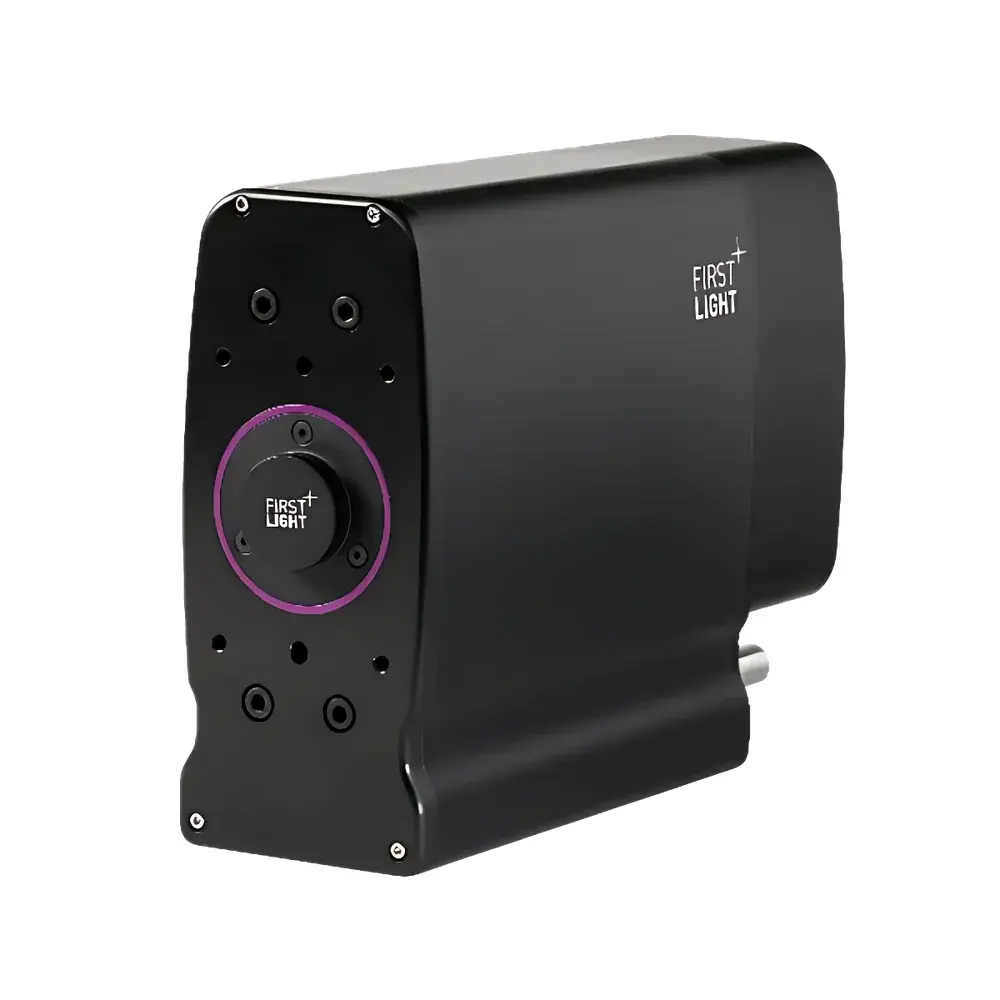
Oxford Instruments OCAM² EMCCD Camera
| Brand | Oxford Instruments |
|---|---|
| Origin | France |
| Model | OCAM² |
| Sensor Type | Back-illuminated Frame-transfer EMCCD (OCAM²K) / Split-frame EMCCD with Embedded Electronic Shutter (OCAM²S) |
| Resolution | 240 × 240 pixels |
| Pixel Size | 24 µm |
| Maximum Frame Rate | 2067 fps (up to 3700 fps in binning mode) |
| Read Noise | Sub-electron (≤0.7 e⁻ rms) |
| Quantum Efficiency | >95% (400–900 nm) |
| Minimum Integration Time | <1 µs (OCAM²S, with 50 ns timing precision) |
| Image Transfer Time | 12 µs per frame |
| Output Latency | As low as 43 µs post-exposure |
| Clocking Speed | Up to 7 Mlines/s |
| Spectral Range | 400–900 nm |
| Cooling | Peltier-cooled (−40 °C typical operating temperature) |
| Compliance | CE, RoHS, ISO 9001-manufactured |
| Software Interface | GenICam-compliant, supports GigE Vision and custom SDKs |
Overview
The Oxford Instruments OCAM² is a high-performance, scientific-grade electron-multiplying charge-coupled device (EMCCD) camera engineered for extreme low-light, high-speed visible-light imaging. Designed originally by astronomers for adaptive optics wavefront sensing, the OCAM² platform comprises two variants—OCAM²K and OCAM²S—each optimized for distinct operational requirements while sharing core architecture: a 240 × 240 back-illuminated sensor, sub-electron read noise, and >95% quantum efficiency across 400–900 nm. The OCAM²K integrates the Teledyne E2V CCD220 frame-transfer EMCCD, cooled via thermoelectric (Peltier) means to −40 °C, enabling ultra-low dark current and stable gain calibration. The OCAM²S employs the Teledyne E2V CCD219 split-frame EMCCD, incorporating an embedded electronic shutter capable of generating arbitrary integration pulses with sub-microsecond precision (down to <1 µs, ±50 ns timing accuracy). Both models utilize eight parallel output channels and high-speed metal-to-metal clock routing—operating at up to 7 million lines per second—to achieve full-frame readout in just 12 µs and system latency as low as 43 µs after exposure termination. This combination of speed, sensitivity, and temporal fidelity makes the OCAM² uniquely suited for closed-loop wavefront correction, single-photon counting applications, fluorescence lifetime imaging (FLIM), and time-resolved spectroscopy where photon-starved conditions prevail.
Key Features
- Sub-electron read noise (≤0.7 e⁻ rms) enabled by on-chip electron multiplication and optimized clocking architecture
- Quantum efficiency exceeding 95% across the visible to near-infrared spectrum (400–900 nm)
- Two sensor configurations: OCAM²K (frame-transfer, PE-cooled CCD220) and OCAM²S (split-frame with programmable electronic shutter, CCD219)
- Maximum native frame rate of 2067 fps at full resolution; up to 3700 fps in 2×2 binning mode
- Ultra-low latency: ≤43 µs delay between exposure end and first pixel output
- High-speed image transfer: 12 µs per frame via synchronized 8-channel readout and metal对接 clock lines
- Peltier-based thermal stabilization to −40 °C, ensuring stable EM gain and minimal dark current drift
- GenICam-compliant interface supporting GigE Vision protocol and custom C/C++/Python SDKs for deterministic real-time control
Sample Compatibility & Compliance
The OCAM² is designed for integration into vacuum-compatible, vibration-isolated optical benches and laser laboratories. Its compact, shielded housing meets CE and RoHS directives, and its firmware architecture adheres to ISO 9001 quality management standards throughout manufacturing. While not certified for medical or industrial safety standards (e.g., IEC 61000-6-2/4), the camera’s deterministic timing, reproducible gain response, and audit-ready metadata logging support GLP/GMP-aligned experimental workflows when deployed in regulated R&D environments. It is fully compatible with standard 25 mm and 32 mm optical mounts and accepts standard C-mount and F-mount adapters (optional). For wavefront sensing applications, optional 20 × 20 micro-lens arrays can be integrated directly onto the sensor window upon request—custom pitch and focal length configurations are available under NDA.
Software & Data Management
Oxford Instruments provides a comprehensive software development kit (SDK) supporting Windows and Linux (x86_64), with bindings for C, C++, Python (via ctypes and NumPy), and MATLAB. All drivers comply with GenICam v3.1 and GigE Vision 2.1 specifications, enabling seamless integration with third-party acquisition platforms such as HALCON, LabVIEW, and Micro-Manager. Timestamping is hardware-synchronized to IEEE 1588 Precision Time Protocol (PTP) inputs, allowing nanosecond-level correlation with external triggers or laser pulse sources. Raw frames include embedded metadata (exposure time, EM gain, sensor temperature, clock voltage settings) compliant with FITS and HDF5 formats. Audit trails—including parameter change logs, firmware version stamps, and user-defined experiment tags—are recorded automatically and exportable for regulatory review.
Applications
- Adaptive optics wavefront sensing in ground-based and space-qualified telescopes (e.g., ESO VLT, Keck, Subaru AO systems)
- High-speed laser-induced fluorescence (LIF) and plasma diagnostics requiring sub-microsecond gating
- Single-molecule localization microscopy (SMLM) and super-resolution techniques relying on photon-limited detection
- Time-correlated single-photon counting (TCSPC) synchronization with pulsed laser sources
- Quantum optics experiments involving entangled photon pair detection and coincidence analysis
- Industrial laser beam profiling under ultra-low-power conditions (e.g., UV curing monitoring, femtosecond laser alignment)
FAQ
What is the difference between OCAM²K and OCAM²S?
OCAM²K uses a frame-transfer architecture (CCD220) ideal for continuous, high-duty-cycle imaging with minimal smearing; OCAM²S uses a split-frame design (CCD219) with an embedded electronic shutter enabling precise, variable-integration exposures down to <1 µs.
Does the OCAM² support hardware triggering and external synchronization?
Yes—both models feature TTL-compatible trigger input/output ports with programmable polarity and delay, fully synchronized to the internal clock domain.
Is the EM gain calibrated and stable over time?
EM gain is factory-calibrated and remains stable within ±2% over 24 hours at constant −40 °C sensor temperature; long-term drift is tracked via built-in reference pixel monitoring.
Can the OCAM² be used in vacuum or cryogenic environments?
The standard unit is rated for ambient operation only; vacuum-compatible versions with modified housings and feedthroughs are available under custom engineering engagement.
What file formats are supported for data export?
Raw 16-bit unsigned integer frames are exported in memory-mapped binary, FITS, and HDF5 formats—with full metadata embedding per frame.




