
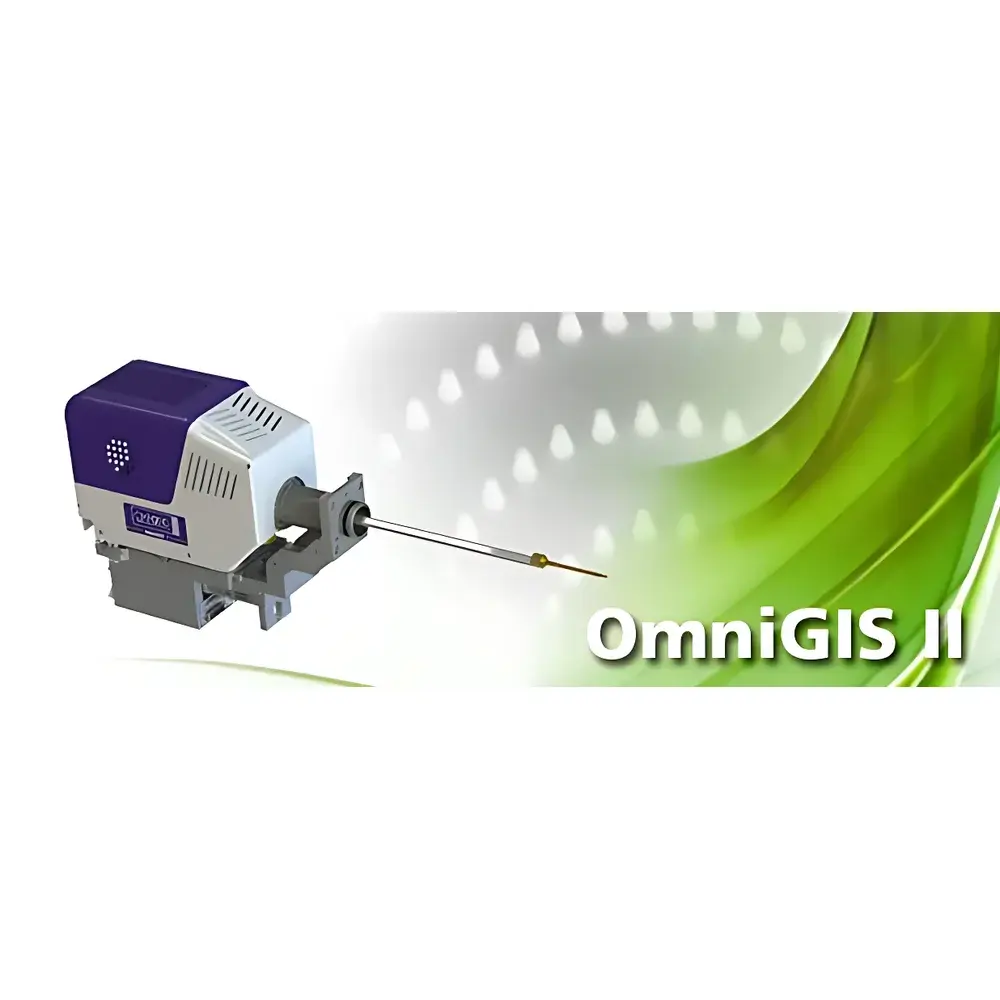
Oxford Instruments OmniGIS II Gas Injection System
| Brand | Oxford Instruments |
|---|---|
| Origin | United Kingdom |
| Model | OmniGIS II |
| Gas Port Configuration | Single-port, multi-source compatible |
| Gas Capacity | Up to 3 primary gas sources + 2 auxiliary gases |
| Control Architecture | Pressure-feedback regulated flow control |
| Vacuum Compatibility | Adaptive operation across wide chamber pressure range (10⁻⁷ mbar to 10⁻¹ mbar) |
| Integration | Designed for SEM and FIB platforms |
| Compliance | CE-marked |
| Software Interface | Native integration with AZtec GIS Control Suite (v5.0+) |
Overview
The Oxford Instruments OmniGIS II Gas Injection System is an engineered solution for localized gas-assisted nanofabrication and in situ sample modification within scanning electron microscopy (SEM) and focused ion beam (FIB) environments. Operating on the principle of beam-induced chemical vapor interaction, the OmniGIS II delivers precisely metered gaseous precursors—such as tungsten hexacarbonyl (W(CO)₆), platinum(II) acetylacetonate (Pt(acac)₂), or xenon difluoride (XeF₂)—directly onto the specimen surface under controlled vacuum conditions. When intersected by the primary electron or ion beam, these gases undergo dissociation, enabling site-specific deposition (e.g., conductive metal lines) or etching (e.g., selective material removal). Unlike first-generation GIS systems, the OmniGIS II incorporates a closed-loop pressure feedback mechanism that dynamically adjusts mass flow rates in response to real-time chamber pressure fluctuations—ensuring consistent precursor flux across operational regimes from high-resolution low-pressure imaging (≤10⁻⁵ mbar) to rapid high-throughput processing (≥10⁻² mbar).
Key Features
- Single-port, modular gas delivery architecture with automatic gas source recognition via integrated RFID tagging—enabling tool-free, error-resistant gas cartridge swapping.
- Simultaneous support for up to three primary gas sources and two auxiliary gases (e.g., purge or carrier gases), managed through a centralized valve manifold with <100 ms actuation latency.
- “Flow-through” capillary design minimizes dead volume and residence time, reducing cross-contamination risk and improving temporal resolution during sequential multi-gas processes.
- Pressure-adaptive mass flow control maintains ±1.5% full-scale repeatability over a dynamic vacuum range spanning seven orders of magnitude (10⁻⁷–10⁻¹ mbar).
- Integrated thermal stabilization (±0.1 °C) of the injection nozzle prevents condensation and ensures stable gas-phase kinetics at the beam–surface interaction zone.
- Compatible with Oxford Instruments’ AZtec GIS Control Suite, supporting synchronized beam blanking, dwell time modulation, and script-driven pattern generation for maskless nanolithography.
Sample Compatibility & Compliance
The OmniGIS II is validated for use with standard SEM/FIB sample holders (including Omniprobe™ manipulators and cryo-stages) and accommodates substrates up to 25 mm in diameter. It supports both conductive and insulating specimens—including Si/SiO₂ wafers, TEM grids, MEMS devices, and biological scaffolds coated with conductive layers. All wetted components comply with ASTM F86-22 (standard practice for surface preparation and marking of metallic surgical implants) and are constructed from electropolished 316L stainless steel and VCR®-rated seals. The system meets CE Directive 2014/30/EU (EMC) and 2014/35/EU (LVD), and its firmware architecture supports audit-trail logging required under GLP and GMP-aligned quality management systems.
Software & Data Management
Control is executed via AZtec GIS Control Suite v5.0+, which provides deterministic synchronization between beam scanning parameters (pixel dwell time, line speed, frame rate) and gas valve timing. The software logs timestamped metadata—including chamber pressure, gas type, flow rate, beam current, and stage coordinates—for each deposition/etching event. Export formats include CSV, HDF5, and vendor-neutral JSON-LD, facilitating traceability in regulated environments. Optional integration with LabArchives ELN or Thermo Fisher Connect enables direct ingestion into electronic lab notebooks compliant with FDA 21 CFR Part 11 requirements for electronic records and signatures.
Applications
- Direct-write nanofabrication of electrical interconnects, plasmonic antennas, and superconducting nanostructures without lithographic masks.
- In situ FIB-GIS trench repair and via filling in semiconductor failure analysis workflows.
- Site-specific passivation of quantum dot arrays and 2D material edges for charge transport studies.
- Gas-assisted lift-out of TEM lamellae using XeF₂ etching combined with Pt/C deposition for structural reinforcement.
- Rapid prototyping of microfluidic channel terminations and MEMS release structures with sub-20 nm feature fidelity.
FAQ
What vacuum ranges does the OmniGIS II support without hardware recalibration?
It operates autonomously across 10⁻⁷ to 10⁻¹ mbar without manual intervention, thanks to its pressure-compensated flow control loop.
Can the OmniGIS II be retrofitted to legacy SEM/FIB platforms?
Yes—mechanical and electrical interfaces conform to ISO 80000-4:2019 dimensional standards and utilize standard M30×1.5 vacuum flanges with KF40 or CF63 options.
Is gas purity monitoring included in the base configuration?
No—gas purity verification requires external residual gas analyzers (RGAs); however, the system includes leak-check ports and integrated helium leak test compatibility.
How does the OmniGIS II handle gas cross-talk during multi-source switching?
The flow-through architecture and purge-integrated valve sequencing reduce carryover to <0.05% volume fraction between gas transitions.
Does Oxford Instruments provide application-specific gas protocol libraries?
Yes—validated protocols for W, Pt, C, SiO₂, and Al₂O₃ deposition/etching are included with AZtec GIS, with quarterly updates aligned to published literature benchmarks.



